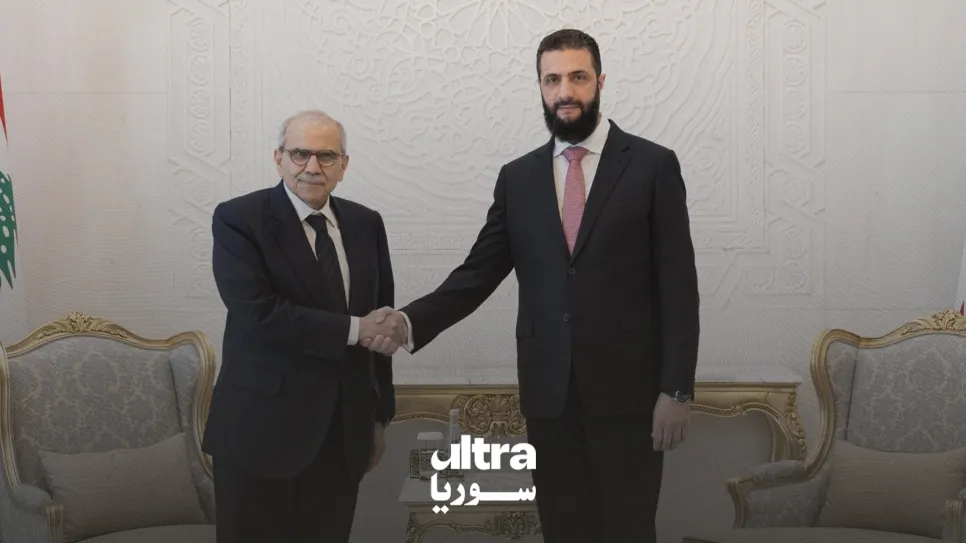
The brief side conversation between Syrian President Ahmad al-Sharaa and Egyptian President Abdel Fattah El-Sisi on the sidelines of the Cyprus meeting on April 24 opened the door to wide speculation about the future of relations between Damascus and Cairo. Though short, the encounter appeared to be more than a passing diplomatic courtesy. It came at a highly sensitive regional moment, crowded with files related to security, energy, and shifting Arab alignments following the fall of Bashar al-Assad’s regime.
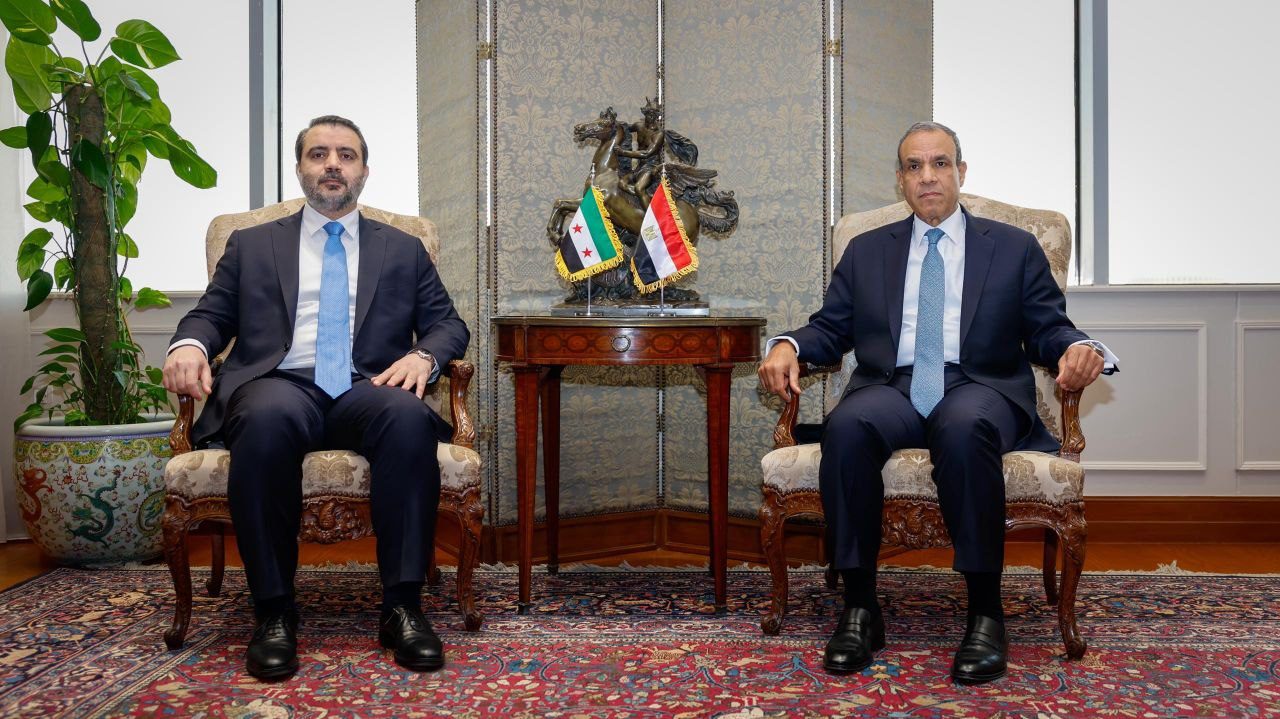
Only days later, the visit of Syrian Foreign Minister Asaad al-Shibani to Cairo gave that meeting a clearer political dimension. The high-level visit did not simply signal a desire to resume communication; it suggested the beginning of a shift from symbolic gestures to testing the prospects for direct coordination between two states bound by a long political legacy and intertwined security and strategic interests.
A Beginning of Thaw
Syrian-Egyptian relations carry a historical specificity that cannot be reduced to diplomatic representation or official statements. At pivotal moments in modern Arab history, the two countries formed a political and nationalist center of gravity. Yet in recent years, the relationship slipped into coolness and stagnation due to diverging approaches to the Syrian crisis, overlapping regional and international pressures, concerns over sanctions, and each country’s preoccupation with its own internal priorities.
During that period, communication remained limited—often confined to narrow security or humanitarian channels—without rising to the level of an announced political partnership or broad strategic coordination. Today, however, recent developments suggest that Cairo and Damascus are moving closer to revisiting this reality. Shibani’s visit does not appear to be an isolated protocol gesture, but rather an indication of a shared desire to translate what was discussed in Cyprus into a political track that can be built upon.
For Cairo, returning to the Syrian file reflects a broader recognition that Egypt’s absence in recent years allowed regional and international actors to operate in the Syrian arena according to their own calculations. The decline of Arab—particularly Egyptian—presence created a strategic vacuum filled by powers with divergent interests, some of which treated Syria as a sphere of influence rather than an Arab state whose unity, institutions, and stability must be preserved.
This new Egyptian movement therefore carries significance. It suggests that Cairo is no longer content to observe developments from afar, but is seeking to restore its position as a key Arab actor in managing the Syrian file. Egypt appears to view engagement with the new Damascus as a gateway to rebalancing the scales, limiting non-Arab interventions, and returning the Syrian issue to its broader Arab context.
Shared Files That Cannot Be Deferred
Syrian and Egyptian interests intersect across a wide range of files, making renewed coordination a political, security, and economic necessity. At the forefront is national security and counter-terrorism: both Cairo and Damascus share concerns over extremist organizations and the dangers of any security vacuum that could allow chaos to re-emerge or threaten state institutions.
The economic file stands out as a practical entry point for rebuilding the relationship. Egyptian companies possess extensive experience in infrastructure, housing, energy, and land reclamation—sectors Syria will need in the reconstruction phase. Regional interconnection projects, particularly the Arab Gas Pipeline, could also give cooperation between the two countries an economic and strategic dimension that transcends traditional bilateral relations.
The presence of Syrian refugees in Egypt likewise requires higher-level coordination. A large Syrian community has become integrated into Egypt’s economic and social life, forming part of the fabric of its cities and markets. Regulating this presence, safeguarding Syrians’ rights, and coordinating any voluntary, safe, and sustainable return is therefore a shared interest.
There is also an urgent need for closer political coordination within the Arab League and international forums. Syria’s return to the Arab fold is not completed by regaining its seat alone; it requires a political path that reconnects Damascus with its natural environment and enables a more cohesive Arab approach to sanctions, reconstruction, border security, and regional interventions.
Cairo Faces an Opportunity to Restore Its Role
Recent indicators suggest that Cairo is increasingly ready to move from observer to actor in the Syrian file. If consolidated, this shift could help reshape part of the regional balance of power. Egyptian engagement gives Damascus the Arab weight it needs in the state-building phase, while offering Cairo the chance to restore its historical role in one of the files most closely tied to Arab national security.
But success requires a clear strategy that goes beyond political messages or reciprocal visits. Cairo must adopt a policy of constructive engagement with the new Syria, based on parallel tracks: political and diplomatic support, disciplined security coordination, calibrated economic openness, and a tangible contribution to reconstruction, energy, and infrastructure projects.
Practically, Egypt can begin by activating the Egyptian-Syrian Business Council and encouraging its companies to enter the construction, energy, agriculture, and services sectors, while using its Arab and international weight to facilitate Syria’s full reintegration into its Arab environment and remove obstacles hindering development and stability. Cairo can also assume the role of an Arab mediator capable of reconciling divergent interests within a framework that preserves Syrian state unity and prevents the country from becoming an open arena for settling scores.
For its part, Damascus must treat Egyptian engagement as a strategic opportunity, not merely a diplomatic stop. Restoring trust with Cairo means opening up to a major Arab gateway capable of providing political, economic, and security support—and of balancing the roles of regional powers that have sought in recent years to monopolize influence over the Syrian path.
A Test of Intentions and Capabilities
The significance of Shibani’s visit lies in its shift of the relationship from signals to political action. It is now clear that both sides wish to test a new path, based on mutual recognition that previous stagnation served neither Damascus nor Cairo, and that the continued Arab vacuum in Syria invites further interventions and tensions.
But the real test begins after the visit. Political momentum must be translated into concrete progress on specific files: security, economy, energy, refugees, reconstruction, and Arab coordination. Without tangible steps in these areas, rapprochement risks remaining within the realm of political imagery rather than evolving into a partnership capable of shaping realities.
What happened in Cyprus—and then in Cairo—suggests that Syrian-Egyptian relations stand before a long-awaited opportunity for course correction. Cairo’s return to the Syrian file is not a diplomatic luxury but a strategic necessity at a moment when regional balances are being rearranged. If the two countries succeed in transforming this rapprochement into sustainable institutional cooperation, the Cairo-Damascus axis may reclaim part of its historical role as a pillar of Arab stability and a political line of defense against chaos and external interventions.
This article was translated and edited by The Syrian Observer. The Syrian Observer has not verified the content of this story. Responsibility for the information and views set out in this article lies entirely with the author.