Hargeisa (WDN) – In a move that has drawn regional attention, the commander of Somaliland’s Navy and Coast Guard has declared that the self-governing territory is prepared to contribute to international efforts to safeguard the strategically vital Bab el-Mandeb Strait, signaling an ambition to assume a more visible role in one of the world’s most sensitive maritime security zones.
Rear Admiral Ahmed Haari Hariye said Somaliland stands ready to cooperate with neighboring countries and international partners to help protect maritime security and ensure the uninterrupted flow of commercial shipping through the narrow waterway linking the Red Sea and the Gulf of Aden.
The announcement comes as security concerns in the Red Sea continue to intensify following repeated attacks on commercial vessels, raising questions about whether Somaliland is seeking to expand its international security profile beyond coastal patrol operations.
“Our priority is to preserve maritime security and guarantee freedom of navigation in accordance with international maritime laws and conventions,” the admiral said. He described the Bab el-Mandeb Strait as one of the world’s most critical shipping corridors, noting that it serves as the gateway between the Red Sea and the Gulf of Aden and carries a significant share of global trade moving between Asia, Europe, and the Mediterranean via the Suez Canal.
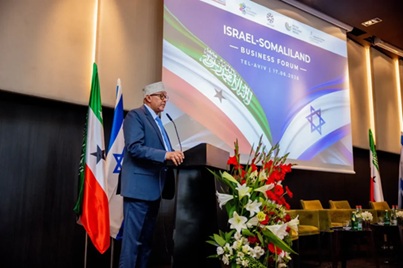
Although Somaliland is not known to maintain a naval fleet, its statement appears to signal an ambition to assert greater influence in the Gulf of Aden and the strategically critical Bab el-Mandeb Strait, a posture that some observers believe may have been encouraged by its growing relationship with Israel.
Expanding Maritime Ambitions
Although Somaliland has long maintained a coast guard responsible for securing its extensive coastline along the Gulf of Aden, the latest statement suggests a broader willingness to participate in regional maritime security initiatives.
According to the naval commander, Somaliland could contribute through:
- Coastal and territorial water surveillance.
- Monitoring commercial maritime traffic.
- Counter-piracy and maritime crime operations.
- Intelligence-sharing on maritime security threats.
- Cooperation with international naval forces protecting commercial shipping.
- Supporting efforts to preserve freedom of navigation.
However, the commander stopped short of suggesting that Somaliland intends to undertake military operations beyond its maritime jurisdiction. His remarks instead framed Somaliland’s role as one of security cooperation rather than direct participation in regional military campaigns.
A Strategic Moment
The timing of the announcement is particularly striking. The Bab el-Mandeb Strait has become one of the world’s most contested maritime chokepoints following attacks by Yemen’s Houthi movement on commercial vessels transiting the Red Sea. Those attacks have prompted several major shipping companies to divert vessels around the Cape of Good Hope, dramatically increasing shipping costs and transit times.
The growing instability has led the United States and several allied nations to expand their naval presence in the region to safeguard international shipping lanes. Somaliland appears eager to emphasize the strategic value of its geography.
Its long coastline faces the Gulf of Aden, while the Port of Berbera sits close to one of the busiest maritime routes in global commerce. In recent years, Berbera Port and its adjacent airport have attracted growing interest from international investors and regional partners, further enhancing Somaliland’s geopolitical significance.
While the statement focuses on maritime security, it also carries broader political significance. Any expanded role for Somaliland in international security cooperation around Bab el-Mandeb would inevitably intersect with wider regional rivalries involving Middle Eastern powers, African states, and major global actors competing for influence in the Red Sea.
Analysts note that any future security cooperation would need to be carefully defined—including the identity of Somaliland’s partners, the scope of any operations, and the limits of its involvement—to avoid becoming entangled in the broader military confrontations unfolding across the Middle East.
For now, Somaliland’s naval leadership has presented its proposal as an offer of cooperation rather than military intervention. Nevertheless, the announcement reflects Somaliland’s growing determination to leverage its strategic location to expand its role in maritime security, deepen cooperation with international partners, and position itself as an increasingly important stakeholder along one of the world’s most critical shipping corridors.
WardheerNews