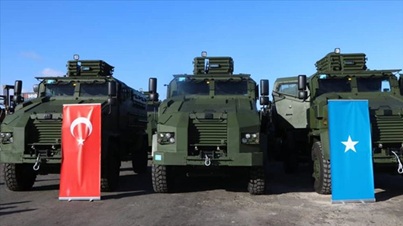
GALKAYO, SOMALIA – Puntland troops have surrounded a camp in Galkayo held by Puntland Security Force personnel who draw their orders from Mogadishu. The encirclement follows the fighting near Laag on 20 July, where Puntland forces stopped a PSF column, seized 13 military vehicles and captured 30 fighters. Garowe has reinforced its positions across the north and warned that it will treat further federally aligned deployments as hostile. Galkayo is the wrong city in which to test that warning, because the town is split between two federal member states and has a long memory of what happens when the line through it moves.
Why Galkayo and Not Somewhere Else
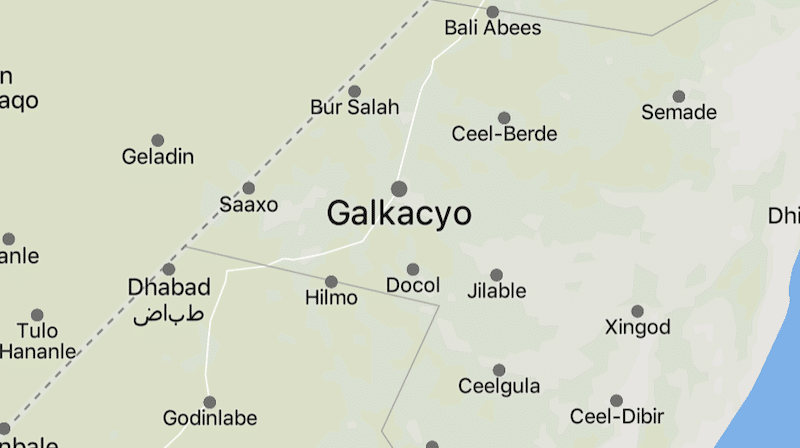
Galkayo sits on the boundary between Puntland and Galmudug, divided north and south, with separate administrations, separate police and a green line that residents can point to. It has its own history of clan war and its own hard-won local agreements, which is precisely why armed movement through it alarms people who would shrug at a convoy elsewhere. The town also controls the road south. Anything moving between Mogadishu and the northeast by land passes through it, which makes Galkayo the natural place to position forces intended to influence Puntland.
Garowe read the buildup that way from the start. Puntland said on 25 July that it was monitoring federal military manoeuvres around the town, accusing Hassan Sheikh Mohamud’s government of using military and political pressure to weaken Puntland’s institutions. It sent a parallel warning to Galmudug, urging its neighbour not to let its territory, airports or facilities carry weapons and forces directed at Puntland. Galmudug has not answered that accusation. The silence has been noticed in Garowe, where officials read it as consent rather than neutrality.
Puntland has since deployed additional troops across its main cities and strengthened checkpoints outside Bosaso, Garowe and Galkayo. That is not the posture of an administration expecting a negotiated outcome. It is the posture of one that expects a second Laag and intends to win it faster. The Laag engagement was the first direct armed confrontation between the two sides, and it ended with Puntland holding prisoners and equipment. Garowe drew the lesson that speed and local knowledge favour it inside its own territory, and that the advantage shrinks the longer a federal presence is allowed to settle.
The Legal Argument Underneath the Guns
The dispute is formally about command, and Puntland’s position is unusually precise. Garowe states that no force called the Puntland Security Force lawfully belongs to the Puntland Defence Forces, and that the unit now operating under that name is not registered under federal authority either. By that reading the PSF is not a rival state institution at all. It is an armed group with a salary source, and Puntland is entitled to disarm it inside its own territory. That framing is what allows Garowe to encircle a camp in Galkayo and call it law enforcement rather than secession.
Villa Somalia disputes the characterisation and treats the PSF as a legitimate counter-terrorism formation with federal backing. The force has genuine history behind that claim, having been built and trained with American support for operations against the Islamic State faction in the Cal Miskaad mountains. What changed is not the unit’s origin but its alignment. Once its chain of command ran to Mogadishu rather than Garowe during an open constitutional dispute, Puntland stopped treating it as a partner.
The pattern is familiar to anyone who watched Baidoa. Federal forces entered Southwest state in late March, Abdiaziz Laftagareen resigned and left for Kenya, and a friendlier administration took office through a vote his supporters call rigged. Puntland’s officials cite that sequence constantly, and they draw the obvious conclusion. The instrument used against Laftagareen was an armed formation inside his own state, and Galkayo is where a comparable instrument is now parked. Puntland and Jubaland closed ranks against Villa Somalia partly on the strength of that reading, and nothing since March has weakened it.
What Garowe Is Signalling in Galkayo
Puntland’s calculation is that acting early is cheaper than acting late. It has already suspended intergovernmental processes with the federal government, runs its own budget and forces, and coordinates politically with Jubaland. Deni’s administration has no expectation that Mogadishu will stand down in response to protest, so it is answering deployments with deployments and letting the encirclement in Galkayo make the argument. Garowe also knows that a federal government two thirds funded from abroad has limited capacity to sustain a long confrontation in the northeast.
There is a cost to that. Puntland has spent nineteen months fighting the Islamic State faction in Cal Miskaad, an operation that gave it standing with Washington and a claim to be the one Somali administration delivering counter-terrorism results. Every soldier watching a PSF camp in Galkayo is a soldier not in the mountains. Garowe has decided that a federally aligned force in its own cities is the more urgent threat, which is a striking judgement from an administration that built its reputation on the other fight. Garowe has argued for months that the two campaigns are the same campaign, since both involve armed bodies operating inside Puntland without Puntland’s authority.
The accusations circulating about federal outreach sharpen the picture. Local media have reported that Hassan Sheikh Mohamud met Puntland politicians and security figures who command men on the ground, urging them to align against Deni in exchange for federal resources and security support. Those reports remain unverified and Villa Somalia has not addressed them. They match the pattern Puntland already believes it is facing, which is why they circulate so easily.
The Risk Nobody in Galkayo Controls
A surrounded camp is an unstable arrangement. It requires discipline from junior officers on both sides, in a city where a single exchange of fire can pull in clan militias that answer to neither administration. The Laag confrontation ended with prisoners and captured vehicles rather than a massacre, which suggests restraint at the top. Galkayo offers less room for that, because the geography puts civilians and a contested boundary inside the field of fire.
The timing compounds the danger. Troop-contributing countries are meeting in Kampala this week to decide whether the African Union mission survives the end of UNSOS funding in December, and Somalia’s opposition has asked those governments to make support conditional on a political settlement. A shooting war between a federal member state and a federally aligned force would answer the question the summit is asking, in the worst possible way, at the exact moment foreign backers are deciding what Somalia is worth to them. Every general in that room would have to explain why his soldiers should stand between two Somali forces rather than between Somalis and al-Shabaab.
Al-Shabaab and the Islamic State faction have no stake in how the command dispute resolves, only in how long it lasts. Both have used federal-regional quarrels before to move where attention has left. What is happening in Galkayo is not a border incident or a misunderstanding between allied units. It is two governments contesting who may lawfully carry a weapon inside Puntland, and neither has shown any sign of accepting the other’s answer.