Mogadishu (WDN) – Ethiopia has reaffirmed its commitment to supporting peace and security in Somalia, even as serious questions emerge over whether Addis Ababa possesses the economic and military capacity to sustain a prolonged deployment after the United States ends logistical support for the African Union Support and Stabilization Mission in Somalia (AUSSOM) at the end of December 2026.
The renewed pledge comes at a pivotal moment for Somalia’s security architecture. Washington has confirmed that it will terminate funding for critical logistical support to AUSSOM on 31 December 2026, creating uncertainty over how the mission will sustain thousands of peacekeepers operating across Somalia.
In a statement, Ethiopia’s Ministry of Foreign Affairs said its position was reaffirmed during a special summit in Kampala, Uganda, attended by leaders of troop-contributing countries. Addis Ababa stressed that it remains committed to preserving the gains made against Al-Shabaab and will continue working closely with the African Union, the Federal Government of Somalia, and international partners.
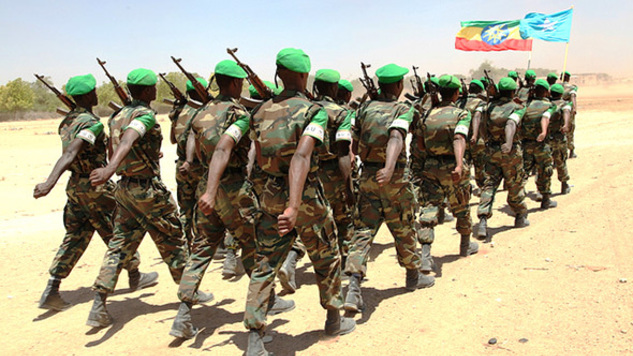
Ethiopia also highlighted that its forces have served in Somalia for more than two decades, describing their contribution as central to efforts aimed at stabilizing both Somalia and the wider Horn of Africa.
However, Ethiopia’s renewed commitment has also prompted difficult questions among regional security analysts. Unlike previous years, Ethiopia is now grappling with severe internal political, economic, and security pressures that could complicate its ability to sustain a costly external military mission without substantial international assistance.
The country continues to face armed conflicts on multiple fronts. Violence persists in the Amhara region, insurgency remains active in Oromia, while tensions continue to simmer in Tigray despite the peace agreement that formally ended the devastating civil war.
At the same time, Ethiopia’s economy remains under considerable strain following years of conflict, high inflation, mounting public debt, reconstruction costs, and continuing humanitarian needs affecting millions of citizens. Analyst question whether Addis Ababa can realistically finance and sustain a large military presence inside Somalia if external logistical support is significantly reduced.
For years, AUSSOM and its predecessor missions have depended heavily on international funding for transportation, fuel, medical evacuation, communications, engineering support, and troop sustainment. The United States has played a particularly important role in financing those logistical requirements. With that support scheduled to end, troop-contributing countries—including Ethiopia—may be required to shoulder substantially greater financial and operational responsibilities unless alternative funding arrangements are secured.
Security experts warn that replacing such support would place a considerable burden on countries that are themselves confronting domestic economic challenges. The concerns extend beyond Ethiopia alone. Regional analysts caution that if troop-contributing countries prove unable to maintain current force levels or operational effectiveness, Somalia could face a dangerous security vacuum before its own security forces are fully prepared to assume nationwide responsibility.
Many observers have drawn comparisons with Afghanistan following the withdrawal of U.S. forces in 2021, where the rapid collapse of government security institutions dramatically altered the country’s security landscape.
The United States has defended its decision by arguing that limited progress has been made in defeating Al-Shabaab and strengthening Somalia’s security institutions despite years of international investment.
Washington has indicated that continued financial support cannot be sustained indefinitely without measurable improvements in governance, institutional capacity, and battlefield outcomes. In response, troop-contributing countries have appealed to the United Nations to establish an interim financing mechanism capable of sustaining AUSSOM until Somali security forces are fully prepared to assume responsibility for national security.
Whether such a mechanism can be agreed upon remains uncertain. Somalia has relied on African Union peace support missions for nearly two decades as a cornerstone of its fight against Al-Shabaab.
The future of AUSSOM has therefore become one of the most consequential security debates facing the Horn of Africa. While Ethiopia’s public commitment signals political determination, analysts argue that determination alone may not be enough.
The central question is no longer whether Ethiopia wishes to remain engaged in Somalia—it is whether a country confronting armed conflicts in Amhara, Oromia, and lingering instability in Tigray, while simultaneously managing significant economic pressures, can realistically sustain thousands of troops abroad without the extensive logistical backing that has underpinned the mission for years.
As the December 2026 deadline approaches, the future of Somalia’s security may depend not only on the resolve of regional partners but also on whether a credible international replacement for U.S. logistical support can be found before the existing framework expires.
WardheerNews