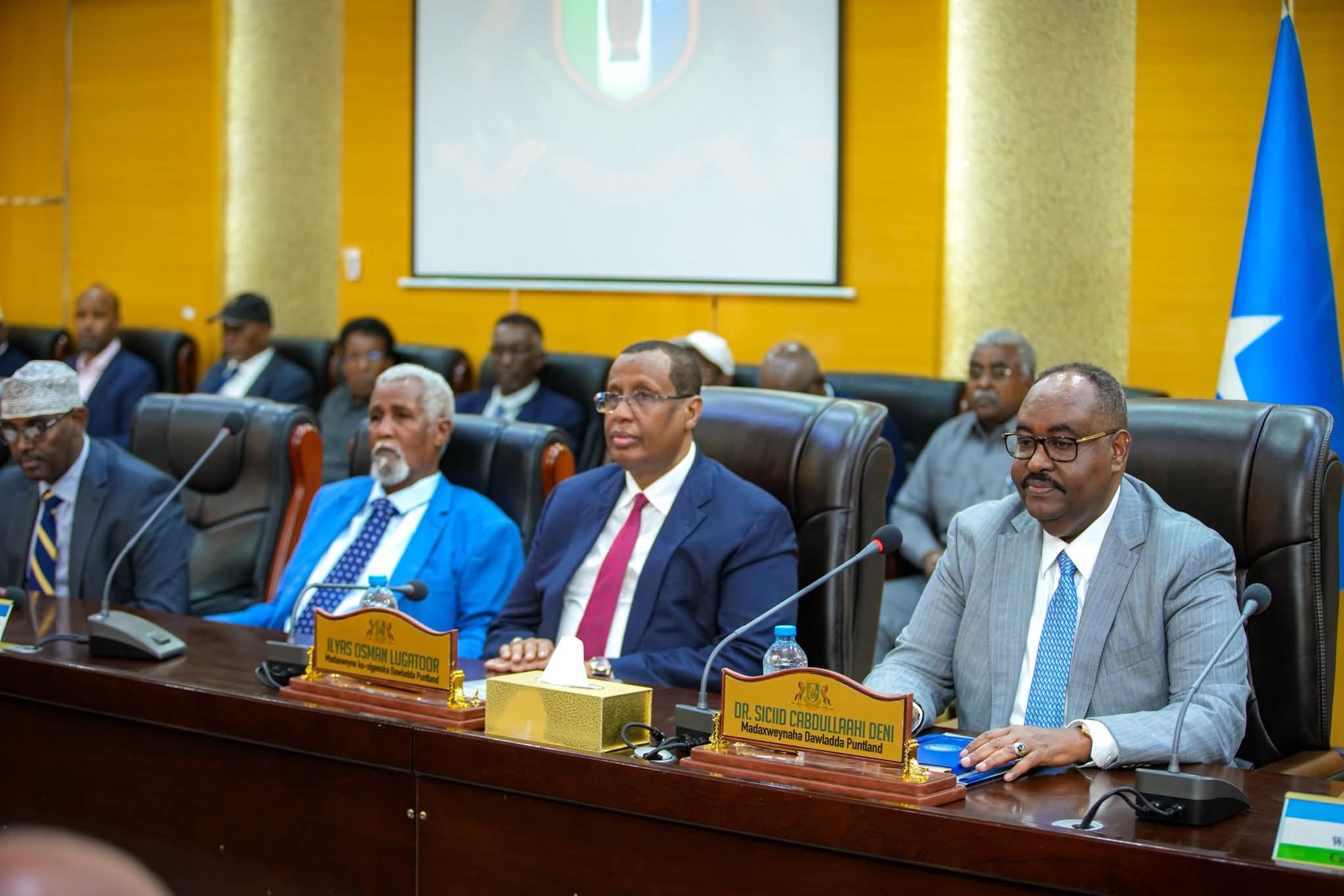
Mogadishu, SOMALIA – Defence chiefs from the countries that supply AUSSOM met in the Somali capital this week to approve a joint plan for accelerating operations against al-Shabaab, taking delivery of a framework drawn up by military experts at the mission’s force headquarters and sitting for talks at Villa Somalia with President Hassan Sheikh Mohamud. The plan commits AUSSOM to faster offensives, deeper intelligence sharing and tighter coordination with the Somali National Army. None of it is funded past 31 December, the date after which Washington stops paying for the logistics package that keeps the mission in the field, and the African Union’s own military advisers have already started modelling how it ends rather than how it expands.
What the AUSSOM Chiefs Actually Approved
The sequence began on 3 August, when military experts from the troop-contributing countries opened their work at the AUSSOM force headquarters in Mogadishu. Major General Mohamed Ali Bariise, who chairs the experts committee, said the framework would tighten cooperation between the Somali National Army and the mission’s forces. He added that it would improve security across the wider region. The experts spent the week converting the political undertakings made at the Kampala extraordinary summit on 31 July into something an operations room can act on. Their output moved this week to the defence chiefs, whose conference in the capital drew senior commanders from every contributing army.
Lieutenant General Sam Okiding, deputy commander of the Uganda People’s Defence Forces, was among them. He was received at Villa Somalia for talks on counter-terrorism operations and the bilateral relationship, and the Somali president used the meeting to thank Uganda for two decades of deployments. Okiding commanded Sector One under the African Union’s earlier mission between 2015 and 2017 and later led ATMIS, which makes him one of the few officers who has watched the whole arc of the intervention from inside. Uganda supplies 4,500 of the mission’s troops and has kept forces in Somalia since the first deployments in 2007.
The plan reads as a statement of intent rather than a schedule. Accelerated operations, stronger intelligence sharing between contributing armies, better coordination of capabilities and resources: every item on that list assumes an aviation fleet, a fuel supply, a casualty evacuation chain and a reimbursement stream that AUSSOM does not itself control. The United Nations Support Office in Somalia controls all of it. UNSOS funding is precisely what the United States has moved to end, so commanders in Mogadishu spent the week approving a framework whose execution turns on a decision taken in Washington five weeks earlier.
The Arithmetic Behind the AUSSOM Plan
The numbers underneath the conference are unforgiving. For the 2025/26 financial year AUSSOM required roughly 190 million dollars for troop reimbursements alone, and confirmed pledges reached only 120 million. The African Union’s Peace Support Operations Division has said the sole assured money available is the 502 million dollar UNSOS logistics package. Washington’s 25 percent share of that was already withdrawn in October 2025 to plug earlier shortfalls, so the assured figure was never the real one. For the current year the General Assembly approved a 481 million dollar UNSOS budget, a reduction of some seven and a half percent on the year before. The United Nations under-secretary-general for operational support has acknowledged that even the reduced budget is not yet fully financed.
Two decades of external money built the habit that these figures are now breaking. The European Union has put roughly 2.8 billion euros into African Union operations in Somalia. The United States has added about 1.6 billion dollars bilaterally to troop contributors, plus a further 2 billion through UNSOS. Washington told the African Union on 1 July that it would not support renewing the AUSSOM mandate when it reaches the Security Council in December, and it has signalled it will oppose any move to keep financing UNSOS past the current authorisation.
What UNSOS supplies explains why the withdrawal bites so hard. Fuel, rations, aviation, medical and casualty evacuation, strategic air mobility and reimbursement for damaged contingent equipment all flow through it. The Peace Support Operations Division has warned that losing that package would leave strategic towns and supply corridors more exposed, degrade medical evacuation, and open operational gaps for al-Shabaab. An accelerated offensive is the most logistics-hungry undertaking an army can attempt, since it consumes fuel, ordnance and airlift faster than static defence ever does. That is what the defence chiefs signed up to at the moment AUSSOM’s logistics are least secure.
A Withdrawal the African Union Is Already Modelling
Inside the African Union the conversation moved on some time ago. At an emergency meeting of military advisers to the Peace and Security Council on 3 July, Cameroon and Gabon told the room that every peace support operation eventually ends. Both pressed Somalia to build security institutions capable of standing without foreign troops. Morocco reserved its position pending instructions from home, while Ethiopia restated its support for Mogadishu and gave no indication of drawing down its own contingent. Those interventions came from members with no stake in the argument between the federal government and its member states, which is where their bluntness comes from.
The advisers examined three futures for AUSSOM: a phased withdrawal of African Union forces, keeping the current deployment with bilateral partners replacing UNSOS logistics, or shrinking to a smaller regional force on hybrid funding. Diplomats familiar with those talks say the second and third options drew little enthusiasm. Both would still require contributing countries to pay for an expensive deployment while external money falls away. A managed withdrawal, long treated as the outcome to avoid, is now widely read inside the organisation as the realistic one. Planning for an end state has quietly displaced planning for an extension, which is the opposite of what the Mogadishu conference was convened to do.
Uganda has begun saying publicly that its presence cannot run indefinitely, and that carries further coming from the largest contributor. The shift in the debate runs from how to extend the mission to how to close it without leaving a vacuum. AUSSOM formally began on 1 January 2025 with 12,591 personnel and a five-year mandate running to the end of 2029, subject to annual authorisation by the Security Council. That mandate now looks less like a five-year horizon than a document requiring an annual renewal nobody in the Security Council has committed to granting beyond this December.
The Army That Is Not Where the Plan Needs It
Every version of the transition rests on the same assumption, that the Somali National Army will absorb the ground AUSSOM vacates. The record of the past year runs the other way. Al-Shabaab reversed two years of army gains across the central regions, walked back into Teedaan in the Hiran region at the start of this month, and has retaken towns cleared twice before. Analysts tracking the conflict warn that the mission could face operational collapse entering 2027, with Somali forces overstretched and short of the logistics needed to sustain complex operations. The army would then inherit terrain it has failed to hold under far better conditions.
The federal government is meanwhile spending its army elsewhere. Federal-aligned units have been registering and deploying in Mudug, two of their camps fell to Puntland forces this week, and the men taken prisoner at Galkayo had been equipped by Mogadishu for a fight that has nothing to do with al-Shabaab. Puntland has carried the campaign against both the insurgency and the Islamic State faction in the Calmiskaad mountains largely on its own budget, with none of the logistics package the mission enjoys further south. It now spends part of that capacity policing federal deployments on its own territory, which is capacity the transition plan assumes will be available for the insurgency.
That is the gap the defence chiefs cannot plan around. A framework for accelerated operations assumes a partner army concentrated on the enemy the framework names, and the partner army is being pulled north into an argument between administrations. The warnings issued before the ATMIS drawdown described this outcome precisely, and the concerns raised then went unanswered. AUSSOM’s contributing armies have drawn up their most ambitious offensive plan in years, with money that expires in December, for a country whose government has spent the week fighting somewhere else entirely.