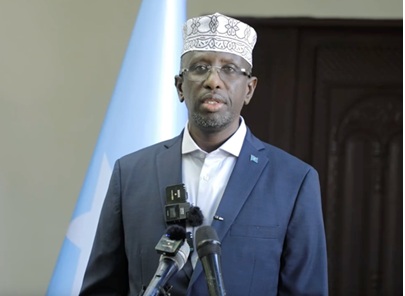
NAIROBI, KENYA – Kenya turned back a serving Somali state minister at Jomo Kenyatta International Airport on Sunday and put him on a return flight to Mogadishu the same day. Abshir Bukhaari, State Minister at the Office of the President and a former First Deputy Speaker of Somalia’s Upper House, arrived on a Somali diplomatic passport and left the country in custody. It was the second time in just over a month that Kenya had done this to a senior member of Hassan Sheikh Mohamud’s government, and neither capital has explained in public what happened at the counter.
What Kenyan Sources Say Happened to Abshir Bukhaari
The account circulating in Nairobi comes from security officials speaking anonymously, and that caveat governs everything below. Abshir Mohamed Ahmed, known throughout Somali politics as Abshir Bukhaari, landed on a flight from Mogadishu, and Kenyan officers stopped him before he cleared immigration. Kenya’s Anti-Terrorism Police Unit questioned him alongside immigration staff. Kenya then flew him back to Mogadishu once that questioning ended.
Two claims sit at the centre of the affair. The first concerns documents. Sources say Abshir Bukhaari also holds a Kenyan passport that authorities suspect he obtained illegally. That would place him among the holders of Kenyan travel documents the government has spent months reviewing. The second concerns money. The same sources say he arrived carrying a bag with an undisclosed sum of cash. Kenyan security officials read that cash against intelligence they had gathered earlier, and they suggest it raises the possibility of terrorism financing or money laundering.
Every element of that account is an allegation from officials who would not give their names. No Kenyan agency has issued a statement, no prosecutor has filed a charge, nobody has published a figure for the cash, and no evidence has reached the public. Abshir Bukhaari has said nothing since his return, and the government he serves has produced no account of its own minister’s detention. Somali outlets carried the story on 27 July, and the silence on both sides of the border has fed the speculation more effectively than any of the leaked detail.
Accounts also diverge on who did the stopping. One version has intelligence officers detaining him before immigration formalities began, which frames the episode as a security operation. Another has immigration staff questioning the travel documents first, with everything else following from that, which frames it as routine border enforcement. The distinction matters for what Kenya is willing to defend later, and the absence of any official version leaves both readings alive.
The Second Senior Official Kenya Has Sent Home
The episode reads differently because of late June, when Kenya denied entry to Second Deputy Prime Minister Jibril Abdirashid Haji and returned him to Mogadishu. A Kenyan police report cited in international coverage said he arrived on a Somali diplomatic passport with a valid visa. Officials then concluded he also held a Kenyan passport obtained unlawfully. He acknowledged possessing it, according to that account, and refused to hand it over, saying he would produce it only in a court of law. Kenyan officials held him overnight at the airport before flying him out.
The timing of that first case carried its own message. It landed in a week when Hassan Sheikh Mohamud was in Kenya for talks with President William Ruto. Two removals in five weeks, both involving officials at the top of his administration, form a pattern that neither government wants to name aloud. Nairobi has avoided any formal statement that would convert an immigration decision into a diplomatic rupture, and that silence is the point. An immigration officer can exercise the same discretion repeatedly without it ever becoming policy that a foreign ministry must defend.
The two cases differ in one respect that matters. Against the deputy prime minister the allegation stopped at the passport, which is a documents offence with a familiar shape. The briefing about Abshir Bukhaari runs further, into cash and counter-terrorism, and it came from intelligence officials rather than immigration staff. That escalation, from a paperwork problem to a security file, is what turned a routine denial of entry into a story that reached well beyond the Horn.
Mogadishu summoned Kenya’s ambassador after the Abshir Bukhaari incident, seeking clarification over the treatment of the minister and members of his delegation, and Somali officials argued that handling senior representatives this way would damage bilateral relations. The foreign ministry has not published the substance of that meeting. A summons registers displeasure while committing the government to nothing. The gap between the gravity of the allegations and the modesty of the response indicates how little political capital Villa Somalia can spend on a fight with Nairobi.
Kenya’s Passport Crackdown Sets the Context
None of this began with Somali ministers. Kenya has spent recent months intensifying a campaign against fraudulent national documents, with the passport at its centre. Kenyan media have published material alleging that people holding no claim to citizenship acquired Kenyan passports through official channels. Somali nationals feature heavily in that reporting, which reflects both the size of the community and the direction of the scrutiny.
A Kenyan passport is a valuable instrument for a Somali official. It opens visa regimes that a Somali document does not, it moves money and property more easily, and it outlasts any change of government in Mogadishu. The incentive has existed for as long as the two passports have been unequal. Kenyan enforcement has now caught up with a practice that everyone understood and nobody tested at an arrivals counter.
Kenya carries a heavier concern alongside the paperwork. Kenyan security sources believe some Somali political figures have been organising armed militias and funding conflict in districts near the shared border, and they fear the fighting will cross it. That belief is the connective tissue between a bag of cash and a counter-terrorism unit at an airport gate. Somalia’s own disputes over who may raise and pay armed forces have made the worry harder to wave away, whatever the truth of the specific allegation against Abshir Bukhaari.
Nairobi Enforces Quietly on an Ally
Kenya’s position carries an obvious tension. It hosts the largest Somali diaspora in the region and runs the airport that carries most Somali official travel. It also contributes troops to the African Union mission holding ground inside Somalia. Enforcement at the border therefore lands on an ally as much as on a suspect, and Nairobi has calibrated it accordingly, choosing removals over prosecutions and leaks over charges. That approach keeps the leverage available and the relationship intact.
A Government Losing Its Room to Move
The timing compounds the damage. Somalia entered a constitutional grey zone when the mandates of its federal institutions lapsed, parliament in April and the presidency on 15 May 2026. The political dispute that followed produced armed clashes in Mogadishu and a mediation process that closed last week without a joint communique. A government insisting that it remains the legitimate authority can least afford to have its ministers turned around at foreign airports.
The airport cases also sit inside a broader freeze. Neighbouring states have reportedly refused visas or entry permits to several cabinet members and senior security officials close to the president, citing security grounds, and some restrictions reportedly reach Western countries too. No government has confirmed those measures, and no list exists. The Abshir Bukhaari deportation is the visible edge of something that has otherwise happened in email traffic and consular back rooms.
Physical access is narrowing for separate reasons. The European Union is preparing to end its dedicated Mogadishu to Nairobi service, which mainly carries diplomats and senior aid staff, with the last flight expected on 13 August. The UN humanitarian air service has already suspended its own link between the two cities. Those decisions follow budget cuts and falling demand as agencies reduce international staff in Somalia, so they say more about the shrinking of the aid presence than about any pressure on the government. The practical result is the same, fewer ways in and out, at the moment Somalia’s leadership most needs to show its face abroad.
Nairobi has functioned for two decades as Somalia’s second capital. Donors meet officials there, families of the political class live there, and deals happen there away from Mogadishu’s security constraints. Losing easy access to it costs a Somali government more than the loss of any single embassy. The federal executive now approaches the African Union summit season with its ministers uncertain of their reception at the one airport that has always been open to them.
What the Abshir Bukhaari Case Actually Establishes
Careful readers should hold two things at once. Anonymous security sources in the middle of a regional quarrel are an interested party. Terrorism financing is also the most damaging accusation available in the Horn of Africa, which makes it the most useful one to leak. The public record contains nothing establishing that Abshir Bukhaari financed anything, and the burden of proof rests entirely with officials who briefed the allegation while declining to attach their names to it.
The verified facts are narrower and still serious. A foreign state stopped a serving minister of the Somali federal government, put him through counter-terrorism questioning, and expelled him with his delegation. His own government has neither obtained an explanation nor offered one. That happened to the second such official in five weeks. Both men reached Nairobi on Somali diplomatic passports, and in both cases the reported problem was a second passport belonging to another state.
There is a further fact worth stating plainly. A diplomatic passport is a claim about who a traveller represents, and a second passport from the host country undercuts that claim at the moment it is presented. Whatever the merits of the individual cases, the pattern points at a political class hedging its own citizenship. Kenyan officials have found the most public way to say so without saying it.
Nairobi has drawn a boundary and is enforcing it quietly, which is the method a neighbour chooses when it wants leverage rather than a confrontation. Mogadishu has answered with a summons and a silence. Pressure on Somalia’s political crisis increasingly runs through regional and African capitals rather than Western statements. That makes the treatment of Somali officials at the region’s busiest airport a fair measure of the credit the federal government still holds with its neighbours. The reading this month is poor.