By Georgina Kekea | Beijing, China
Disclaimer: This article reflects the author’s personal observations and views and does not represent the position of any organisation with which the author is professionally associated.
Inside China’s growing AI-generated entertainment industry, where fantasy dramas are earning millions and new technology could give smaller countries a chance to tell their stories. A fantasy drama about a werewolf queen has reportedly generated more than US$5 million in revenue, without relying on traditional filmmaking methods. It is one example of how artificial intelligence is changing the entertainment industry, creating imaginary worlds that once required expensive sets, actors and elaborate special effects. During a visit to Kunlun Tech in Beijing on 22 October, we saw how this technology is being used to produce dramas featuring dragons, elves, werewolves and magical kingdoms. The visit was part of our internship with Xinhua News Agency under the China International Press Communication Centre (CIPCC) programme at Renmin University of China.
CIPCC cohorts from Asia, Pacific and Latin America
But as I watched these fantasy worlds come alive, my thoughts turned to Solomon Islands. If artificial intelligence can bring imaginary kingdoms and supernatural creatures to the screen, what could it do for our own kastom stories?
The young people behind the technology
One of the first things that struck me at Kunlun Tech was the youthful workforce. Many of the employees we encountered appeared to belong to Generation Z. One employee, aged around 30, even joked that she was beginning to feel old among her younger colleagues. It was a humorous moment, but it also reflected how a younger generation is helping shape the future of digital entertainment. At the centre of this transformation is Artificial Intelligence-Generated Content, commonly known as AIGC. In simple terms, AIGC uses artificial intelligence to create material such as text, images, music, voices, animation and video. In filmmaking, entire characters, backgrounds and scenes can now be generated digitally instead of being physically filmed.
Young Executives from Kunlun Tech Company
Kunlun Tech, a Chinese technology company that began in online gaming, has expanded into AI-generated entertainment through platforms including DramaWave and its AI production system, SkyProduction. DramaWave distributes short dramas to international audiences, while SkyProduction provides AI-powered tools that assist with script development, storyboarding, visual production and editing. The technology can help transform written stories into moving images, generate characters, create backgrounds and produce sequences that would traditionally require substantial production resources.
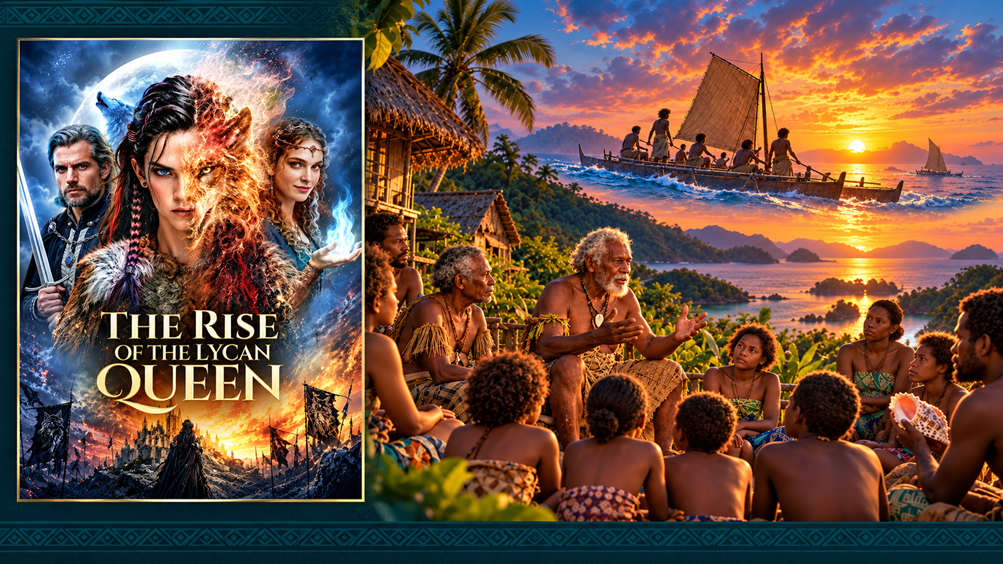
But behind these artificial creations are real people. Human creativity still matters. Someone must develop the story, shape its characters, direct the scenes and decide what audiences eventually see. What has changed is how those ideas can be brought to life. When a werewolf queen earns millions One example of the commercial possibilities is The Rise of the Lycan Queen, an AI-generated fantasy drama distributed through DramaWave.
The story follows a wolf princess rejected by her family because she is believed to have no special powers. Years later, she returns as a powerful queen seeking justice and revenge. It is the kind of story that combines fantasy, betrayal, supernatural powers and dramatic twists to keep viewers watching. According to a Chinese entertainment industry report published by Duanju Shenshuiqu on 7 July 2026 and reproduced by Kuai Chuhai, the drama had generated more than US$5
million in estimated revenue. Kunlun Tech’s publicly released 2026 half-year financial report provides further evidence of the scale of its growing AI entertainment business. The company reported that more than 90 per cent of the dramas newly released on DramaWave in July were AI-generated. It also reported that its wider AI short-drama platform business recorded more than US$65 million in monthly gross transactions in June. These figures demonstrate how AI-generated entertainment is developing into a significant commercial business.
Changing the cost of filmmaking
Perhaps the most important development is the potential reduction in production costs. Traditional filmmaking can require considerable investment. Actors must be paid, equipment hired, locations secured, costumes prepared and production teams organised. Fantasy productions can be particularly expensive because they require imaginary environments, elaborate visual effects and sometimes large casts. Artificial intelligence is beginning to change that equation. In an investor-relations response published in August 2026, Kunlun Tech estimated that producing a conventional short drama for overseas markets costs approximately US200,000 per production. By comparison, the company said an AI-generated short drama could be produced for less than US$20,000. These are company estimates, and actual costs depend on the length and complexity of a production. Nevertheless, the difference is substantial. AI-assisted filmmaking allows creators to generate settings, characters and visual effects without necessarily having to build physical sets or film every scene. Scenes can be adjusted, characters refined and sequences regenerated digitally. This does not mean producing a successful film is effortless. Good storytelling still requires creativity, planning, editing and an understanding of audiences. Marketing and distribution can also be expensive. Nor does low-cost production guarantee commercial success. But for smaller countries with limited filmmaking resources, the possibility of reducing production expenses could open opportunities that previously seemed beyond reach. And this is where Solomon Islands comes into the picture. Imagine Solomon Islands kastom stories on screen Solomon Islands does not lack stories or storytellers.
AI Generated image
Across our islands, generations have passed down stories about ancestral journeys, traditional chiefs, warriors, spirits, the sea and the natural world. Our oral traditions contain a wealth of cultural knowledge, history and imagination. What we often lack are the resources to bring these stories to wider audiences through film and animation. Imagine what AIGC could make possible. Picture a traditional village at sunset. The sound of a conch shell echoes across the hills as villagers gather around their chief. An elder begins recounting a story passed down through generations. Then the story comes alive on screen, transporting viewers into the world of our ancestors. Imagine animated productions about traditional voyages, early settlements, historical events or legends associated with particular islands.
These could be told in local languages, with subtitles for audiences elsewhere. For young Solomon Islanders, such productions could offer another way of learning about their history and cultural identity. For Solomon Islanders living overseas, they could help maintain connections with home. For international audiences, they could introduce a side of Solomon Islands beyond the familiar images of tropical beaches and tourism. The possibilities extend beyond entertainment. AIGC could support educational programmes, cultural documentaries, children’s stories, historical reconstructions and public awareness campaigns. It could also provide opportunities for writers, musicians, artists and young digital creators to collaborate on productions grounded in our own experiences.
But can AI understand our kastom?
There is, however, an important question. Technology can generate images, but can it accurately represent our cultures? In experimenting with AI-generated imagery myself, I discovered how easily the technology can get things wrong. I requested an image of a traditional Solomon Islands chief, but the system produced someone who looked more Polynesian than Melanesian. The image needed correction. It was a small example of a much bigger challenge. AI systems do not automatically understand the cultural differences between Pacific communities. Without careful human direction, they could misrepresent traditional clothing, village architecture, customary practices and cultural identities. More importantly, our kastom stories are not simply entertainment material available for
anyone to commercialise. Some belong to particular tribes, families or communities. Others carry responsibilities and restrictions concerning who may tell them and how they may be shared. Any attempt to bring these stories to the screen must respect those traditions. Customary custodians, elders and communities should guide how their knowledge is represented, who has permission to use it and who benefits from its commercial use. UNESCO has highlighted similar concerns about cultural ownership, informed consent and the potential misuse of traditional knowledge through artificial intelligence. For Solomon Islands, AI should provide another means of sharing and preserving our stories, not replace the people who own and pass them on.
Opportunities for a new generation
The young employees we encountered at Kunlun Tech also made me think about opportunities for young Solomon Islanders. Artificial intelligence may reduce the need for some traditional production roles, but it is also creating demand for different creative and technical skills. These include script development, AI-assisted video production, animation, editing, sound design and digital distribution. Many young Solomon Islanders are already familiar with social media, online entertainment and digital video. With suitable training and access to technology, some could begin developing their own animated stories, short dramas and educational productions. But significant barriers remain. Reliable internet, affordable technology, computing resources and specialised training are not equally available throughout Solomon Islands.
There are also questions about copyright, cultural ownership, employment and the authenticity of AI-generated material. For journalism, the distinction is particularly important. Artificially generated images and videos must never be presented as genuine recordings of real events. These concerns should not be overlooked in the excitement surrounding new technology.
From consumers to creators
For decades, Solomon Islanders have consumed entertainment produced elsewhere. Hollywood films, Chinese dramas, Korean productions and international television programmes have shaped much of what we watch. But could emerging technology help change that relationship? Could Solomon Islanders become producers of their own animated kastom stories, historical dramas and culturally grounded entertainment for local and international audiences? The opportunity is not necessarily to compete with Hollywood or China’s entertainment industry on the same scale. It is to develop the ability to tell stories that only we can tell.
Affordable technology alone will not create a successful creative industry. That will also require investment, training, imagination, cultural knowledge and opportunities to reach audiences.
Nevertheless, reducing the cost of production could be an important starting point. Our visit to Kunlun Tech offered a glimpse into how rapidly content creation is changing. Behind the artificial characters, fantasy kingdoms and digital worlds are real people using new tools to turn their ideas into entertainment. For Solomon Islands, the challenge is whether we can develop the skills and resources to make those tools work for our own storytellers. Because if artificial intelligence can bring imaginary worlds of dragons, elves and werewolves to life, perhaps it can also help bring our extraordinary kastom stories to the screen.
The technology may be artificial, but the stories we have to tell are real.