By Emilija Rozgić and Biagio Carrano
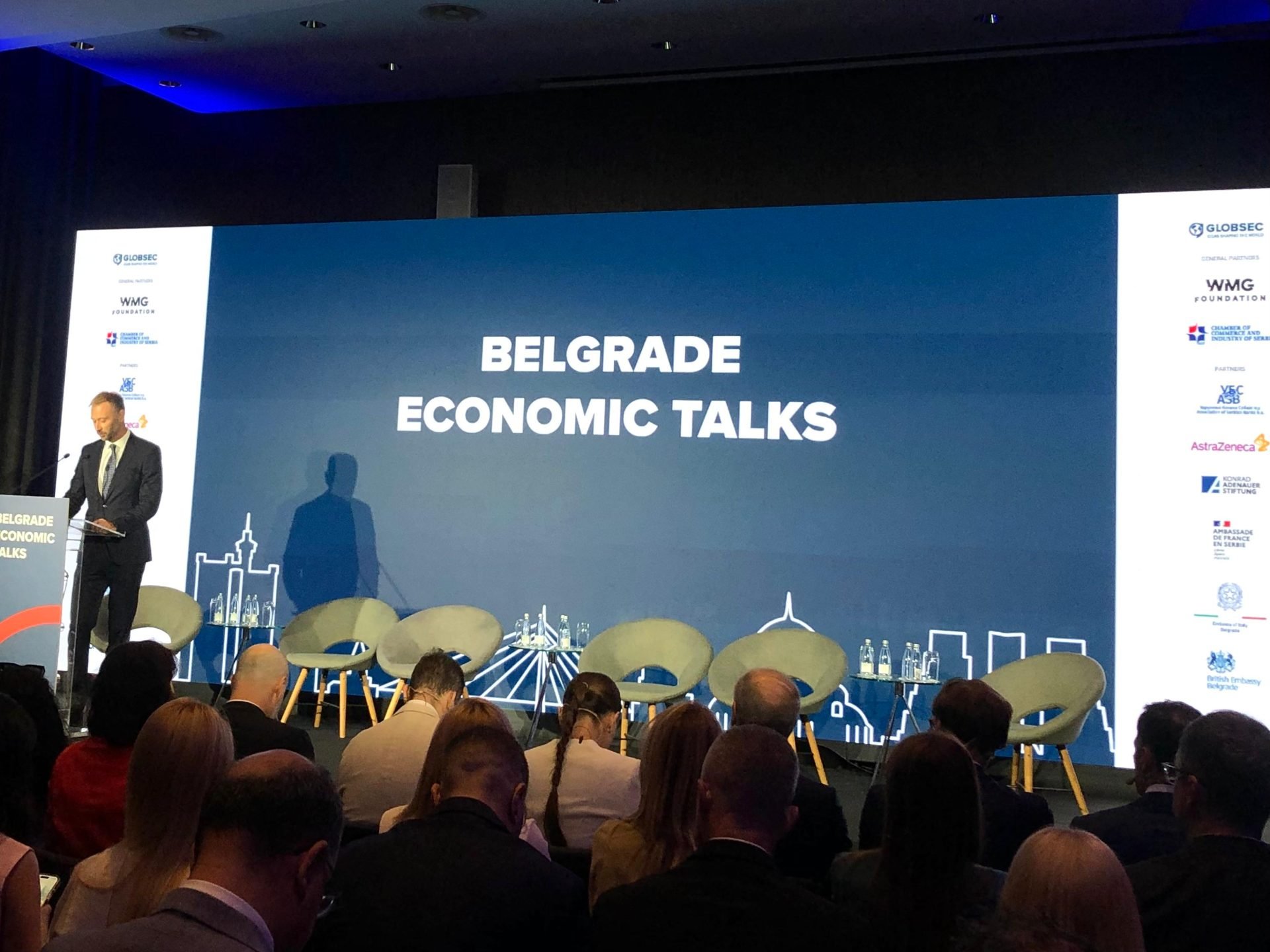
The Western Balkans should not be viewed as a problem for the European Union to solve, but rather as part of the solution to Europe’s economic and strategic challenges. This was one of the central messages to emerge from this year’s BELTALKS (Belgrade Economic Talks) conference, held on 10 September in Belgrade.
Organised by GLOBSEC, the second edition of the conference focused on attracting investment, regional competitiveness, energy security, digitalisation, and artificial intelligence, as well as opportunities for deeper economic integration between the Western Balkans and the EU.
The event brought together government officials, members of the diplomatic corps, EU institutions, and the business sector to discuss the region’s economic potential and its integration into European value chains.
The conference was opened by Róbert Vass, founder and president of GLOBSEC, and Vladimír Bilčík, former MEP and senior fellow at GLOBSEC. Vass highlighted the need for a shift in approach towards the region: rather than asking when Western Balkan countries will become EU members, the focus should be on what can be integrated right now. As he noted, economic innovation cannot wait for formal accession to the Union, particularly in an era of global technological and economic transformation.
Investment: From six small markets to a single investment space
One of the core themes of the conference was attracting long-term private capital. Delegates stressed that while the Western Balkans offer many advantages sought by investors – geographic proximity to the EU, expanding infrastructure, and significant room for growth – the region’s appeal remains constrained by market fragmentation and regulatory disparities.
These issues were addressed by Siniša Mali, First Deputy Prime Minister and Minister of Finance of Serbia; Damien Sorrell, Head of the European Investment Bank’s Regional Representation for the Western Balkans; René Troccaz, France’s Special Envoy for the Western Balkans; Maryna Khlystun, Executive Director of UkraineInvest; and Jan Růžička, Chief External Affairs Officer at PPF Group. The panel was moderated by Raphael Minder, Central Europe Correspondent for the Financial Times.
From left to right: moderator Raphael Minder, Central Europe correspondent for the *Financial Times*; Siniša Mali, First Deputy Prime Minister and Minister of Finance of Serbia; Damien Sorrell, Head of the European Investment Bank’s Regional Representation for the Western Balkans; René Troccaz, France’s Special Envoy for the Western Balkans; Maryna Khlystun, Executive Director of UkraineInvest; and Jan Růžička, Chief External Affairs Officer at PPF Group.
Mali outlined the resilience of the Serbian economy since 2020, pointing to GDP growth, record-low unemployment, and high levels of foreign direct investment. He highlighted the country’s ability to maintain stability despite global crises, the energy crunch, the war in Ukraine, Middle Eastern instability, and emerging geopolitical risks. According to Mali, resilience, diversification, and joint promotion of investment potential are vital for the region’s future. Serbia aims to lay the groundwork for new capital inflows through public investment in railways, roads, and industrial zones, while closer regional cooperation could make the Western Balkans even more attractive as a unified economic space.
Sorrell noted that investors today are more selective, placing greater emphasis on a predictable business environment, though he affirmed that interest in the region remains strong. Among Serbia’s advantages, he highlighted its network of free trade agreements, which offers investors access to a broader range of markets.
Addressing the integration process and the opening of Cluster 3, Troccaz stated that France supports opening Cluster 3 in Serbia’s EU accession negotiations, viewing such a step as a clear, concrete, and positive signal for Serbia and the wider region. He stressed that economic integration cannot be divorced from the political accession process, noting that investment is not politically neutral.
Jan Růžička offered a different perspective from Gulf investors who, he said, recognise the region’s challenges but also see Eastern European economies growing much faster than those in Western Europe. “This is the right place to invest,” he stated, emphasizing that the region needs capital, infrastructure, roads, and new industrial projects – and that local populations welcome this investment. He highlighted joint regional action as an essential next step: rather than competing with one another for capital, Western Balkan countries should focus on promoting the region collectively.
Energy security as a European issue
Energy was another key topic, with consensus emerging that energy security can no longer be tackled by individual states in isolation.
Dubravka Đedović Handanović, Minister of Mining and Energy, discussed Serbia’s energy system, recalling the 2022 energy crisis and the pressures Serbia faced due to rising gas and electricity prices, supply bottlenecks, and broader geopolitical instability. Since then, Serbia has expanded its production capacity and is working on further interconnections with neighbouring countries, including gas and electricity links. As the minister pointed out, energy security cannot be guaranteed strictly within national borders. The energy crisis following Russia’s invasion of Ukraine in 2022 demonstrated the importance of cross-border connections, which provide countries with multiple supply options during emergencies. Serbia therefore intends to continue developing regional energy corridors and interconnectors with both EU members and regional neighbours.
A particular challenge is reliance on single suppliers. According to the minister, depending on a single source can become a lever for political and economic pressure, making it imperative to secure physical alternatives and a wider array of supply sources. She added that while Serbia already possesses a well-developed network of connections with EU and non-EU states, the goal is to further bolster existing corridors and construct new links across the region.
AI and the digital economy as new growth opportunities
Artificial intelligence was the third major topic, with speakers noting that a country’s ability to build digital infrastructure, secure sufficient power, and retain skilled talent will increasingly dictate its economic competitiveness.
From left to right: moderator Daniel Braun, CEO of GLOBSEC; Stefan Andonovski, Minister of Digital Transformation of North Macedonia; Ana Brnabić, Speaker of the National Assembly of Serbia; Marko Čadež, President of the Chamber of Commerce and Industry of Serbia; and Aleksandar Bogdanović, CEO and President of the Executive Board of Yettel Bank.
Marko Čadež, President of the Chamber of Commerce and Industry of Serbia, spoke on the region’s potential, emphasising that AI is no longer just a technological tool, but a force redefining how businesses design products, services, and work operations. For the Western Balkans, this represents both a challenge and an opportunity to narrow the gap with more developed economies.
Ana Brnabić, Speaker of the National Assembly of Serbia and former Prime Minister, also spoke on the growth of the Serbian IT sector, using a distinctly political approach to highlight the current government’s achievements over the past 12 years. According to figures she cited, IT is the fastest-growing sector of the Serbian economy, with ICT service exports surging from around €375 million in 2012 to over €4.5 billion last year. Over the past decade, she added, the sector has generated more than 60,000 new jobs.
Brnabić identified data, skills, and infrastructure as the core prerequisites for AI development. She explained that Serbia has expanded e-government, introduced coding into primary school curricula, and invested in data centres and supercomputers in recent years. At the same time, AI development introduces new challenges, including massive energy demands and compliance with data protection standards – reasons why Serbia is currently drafting dedicated legislation on artificial intelligence, Brnabić noted.
What EUmeter shows
Irena Petrović, Director of the WMG Foundation, during the presentation of EUmeter
Irena Petrović, Director of the WMG Foundation, presented EUmeter – a digital platform that tracks the progress of Serbia and other candidate countries towards EU membership, making the integration process more measurable and comparable. The platform aggregates data on reform implementation, legislative alignment with the EU acquis, and compliance by relevant institutions. EUmeter translates European Commission assessments – ranging from an “early stage” to an “advanced level of preparation” – onto a one-to-five scale.
According to data updated at the end of August 2026, Serbia has an average baseline score of 3.12 out of 5, placing it second among candidate countries after Montenegro. The platform estimated that if all obligations scheduled by 31 August 2026 had been fulfilled, Serbia’s reform potential would have reached 3.63. The data further revealed that by 31 August, 85 out of the 243 analysed reform commitments had been implemented, representing 35 per cent.
Further information on tracking European integration and comparative progress data is available on the official EUmeter website.
From accession to integration
A recurring theme at BELTALKS was that the economic integration of the Western Balkans into the European space should not wait for formal EU accession. Investments, infrastructure, energy, and digital technologies can strengthen the region’s links to the European market today, while offering local economies greater connectivity, joint investment promotion, and faster adoption of new technologies. Concurrently, the EU increasingly views the region as a market, an investment destination, and a potential component in responding to global competitive challenges. In this light, the question is no longer merely when regional countries will join the EU, but how much of their economies and markets can be linked to Europe right now.
However, very little was said during the conference regarding the rule of law, media freedom, or other core prerequisites for EU membership, illustrating that economic convergence alone cannot replace the political and institutional reforms that remain integral to the European path.
Is integration possible without full membership?
The panel featured two contrasting positions: one reiterated by Serbian Foreign Minister Marko Đurić regarding the Vučić-Rama plan – in which the leaders of Serbia and Albania proposed a Schengen-style arrangement for the Balkans to ensure the free movement of people, goods, and capital without requiring full EU membership; and a firm stance from Ukraine’s Deputy Finance Minister, Oleksandr Kava, who bluntly stated that after the war, given the immense sacrifice endured, Ukraine will accept nothing short of rapid and full EU membership.
While Thomas Botsios, Director for the Adriatic and Western Balkans at the Italian Foreign Ministry, and Edita Hrdá, Czech Government Envoy for the Balkans, pointed to shared initiatives, open forums, and pathways already underway in the region’s alignment with the Union, Kaush Arha, Senior Advisor at the US-based Pupin Initiative, framed the matter starkly: “For the US, Europe – all the way to Ukraine – is part of the Western world. It is up to the EU to find the best ways to operationalise and secure this premise. In this regard, Europe must overcome its contradictions: it cannot buy most of its security systems from Israel while simultaneously criticising it.”
How is Serbia navigating the new global landscape?
Concluding the proceedings at the panel “The Adaptation Imperative: Competitiveness and Trade in the New Era”, Serbian President Aleksandar Vučić spoke alongside František Ružička, OECD Deputy Secretary-General, and Alexander Schallenberg, former Austrian Chancellor and Foreign Minister.
“I could express satisfaction because Serbia grew by 3.5 per cent in the first six months of the year, but I am not satisfied. Much remains to be done. The transformation of the Serbian economy – which cannot rely solely on domestic consumption and public investment – is not yet far enough along. I could point out that when I came to power the country’s GDP was €34 billion and today it exceeds €100 billion, but we cannot rest on our laurels; on the contrary, we must work harder,” Vučić said.
“I was in Paris yesterday evening at the International Space Summit, where I met with business leaders focusing on robotics, automation, and AI, backed by investment volumes out of our reach. If we do not invest more and work harder, we could lose the gains of recent years in an instant.”
Addressing regional tensions, including those following the military-honour funeral of Ratko Mladić, Vučić noted that he had requested his ministers and staff to maintain a low profile and avoid responding to provocations.
“In Croatia, half a million people glorify violence against Serbs at a concert; their Parliament – the legislature of an EU member state – observed a minute’s silence for a Croatian soldier who committed suicide inside the Hague Tribunal after being convicted of war crimes and crimes against humanity. Yet the only ones asked to apologise and disregard their own history are Serbs. The emotion displayed last Monday touched the hearts of many Serbs, and I must take that into account,” Vučić said.
“Serbia must push harder on all fronts and focus above all on its economic success, because no one gives us, or ever will give us, a free pass,” Vučić concluded.