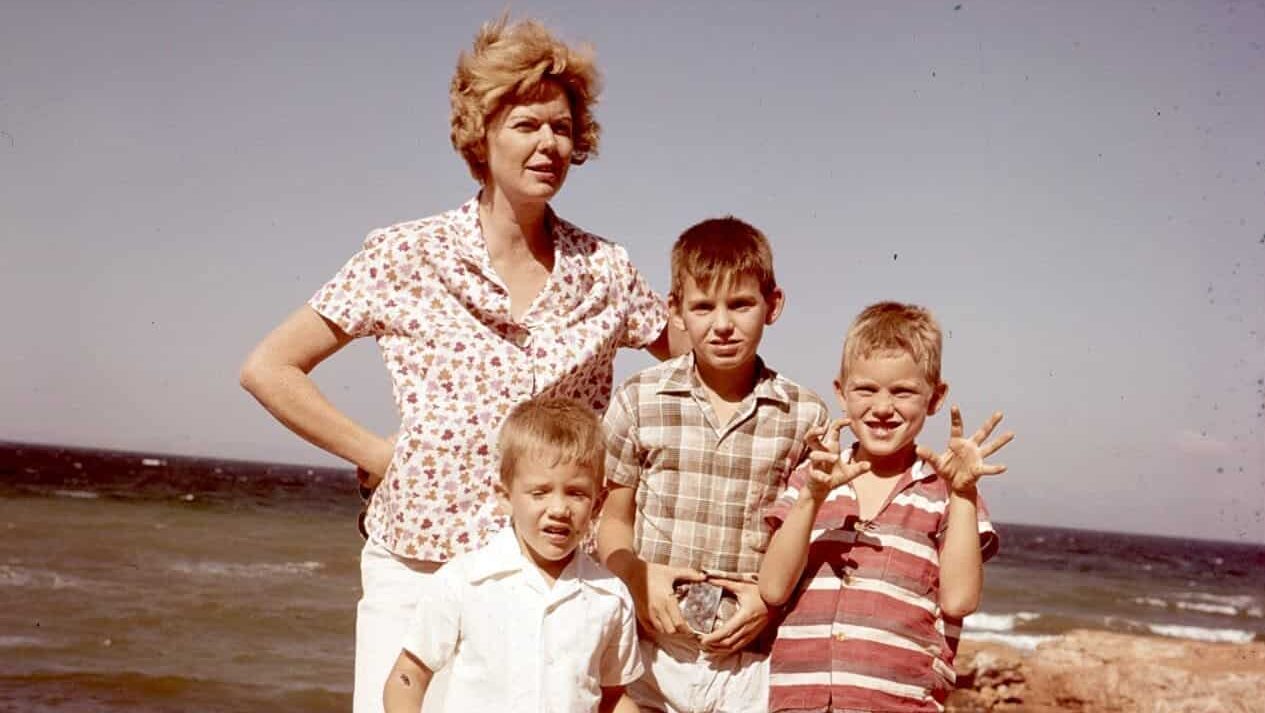
Margarita Papandreou with her three sons Photo: Nikos Papandreou/Facebook.
Greek feminist and author Margarita Papandreou, who was the wife of prime minister and centre-left PASOK party founder Andreas Papandreou, died in Athens on Friday. On September 20, she would have turned 103 years old.
Margarita (Margaret) Chant-Papandreou, originally from the US, studied journalism and pursued postgraduate studies in Public Health. Her name became linked to one of the most prominent political dynasties in Greek history, as well as to a series of significant reforms regarding gender equality.
She was the second wife from 1951 to 1989 of Andreas Papandreou; together they had four children, including former PM George Papandreou and PASOK MEP Nikos Papandreou.
“Margarita Papandreou linked her name to the struggle for women’s rights and social progress,” stated PASOK’s current leader, Nikos Androulakis.
Margarita met Andreas in the US in 1948 and the couple moved to Greece in 1961. Following the military takeover and Andreas’s arrest in 1967, she campaigned for his release. They left Greece for Sweden, and then Canada, returning to Greece after the fall of the military junta in 1974, when Andreas announced the founding of PASOK.
Margarita did not remain in her husband’s shadow; in 1976, alongside other women, she founded the Women’s Union of Greece, a women’s non-profit.
She played a pivotal role in promoting, drafting and passing legislation that improved the social status of Greek women. Key measures included the introduction of civil marriage in 1982, the abolition of the dowry system, the legalisation of divorce by mutual consent, the right of women to retain their maiden names after marriage in 1983, and the legalisation of abortion in 1986.
In her book, Love and Power, she recounted her turbulent relationship with her husband – marked by infidelity, their acrimonious divorce and his subsequent marriage to a younger woman.
Her son, Nikos Papandreou, wrote in the preface: “She may have stood by the side of the Greek politician who transformed Greece – Andreas – but she also created and led the country’s most significant feminist movement, the one that exerted the greatest influence regarding women’s rights in Greece.”