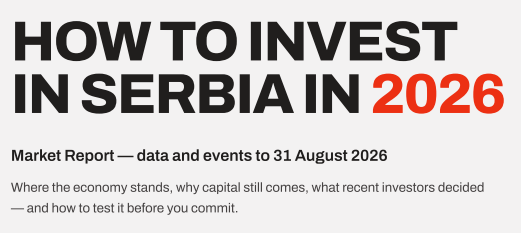
Serbia remains an important investment destination in South-Eastern Europe — but the latest data reveal a market that is changing rapidly, and in ways the headline figures conceal. Here are the trends, the numbers and the risks shaping investment decisions in 2026. Our new report, How to Invest in Serbia in 2026, is available free of charge.
Serbia continues to attract international companies looking for access to European and regional markets, competitive operating conditions and an established industrial base. Yet the country’s investment landscape is becoming more complex — and several of the figures most often quoted about it point the wrong way.
The new How to Invest in Serbia in 2026 report by eastCOM Consulting examines the country’s economic performance, the structure of investment flows, the business environment and the fourteen most significant recent projects. It is built on Serbian Monitor’s daily coverage of the Serbian economy, published since 2013, and cross-checked against primary and official sources.
→ Download the report — 31 pages, data and events to 31 August 2026
A stronger economy, on a narrower base
Serbia’s economy grew 3.8% year on year in the second quarter of 2026, revised up from a flash estimate of 3.6% and well ahead of the 2.5% economists had expected. The National Bank raised its full-year forecast to 3.2%, the Ministry of Finance to 3.3%.
The composition is where the caution lies. Growth is driven almost entirely by domestic demand, while gross fixed capital formation was revised down from 6.9% to 4.6%, and imports grew faster than exports. An economy expanding on consumption rather than investment is growing, but not necessarily building capacity. The Vienna Institute for International Economic Studies still forecasts 2.0% for the year — the lowest in the Western Balkans.
Inflation: the figure most likely to mislead you
Consumer price inflation fell to 1.9% in July, the weakest reading since March 2021. It would be easy to read that as disinflation. It is not.
Almost all of it is food: prices of food and non-alcoholic beverages were 6.1% lower than a year earlier after a strong agricultural season. Strip that out and the picture inverts. Housing and utilities rose 9.7% year on year, recreation and culture 10.0%, health 7.9%, transport 7.1%, restaurants and hotels 6.1%. Core inflation stands at 4.5% — at the top of the National Bank’s target band, and higher than headline inflation, which is the reverse of what genuine disinflation looks like. The NBS itself expects the headline figure back to around 4% in September.
For a company budgeting rent, utilities, transport and local services in Serbia, 1.9% is not merely optimistic. It is the wrong number by a factor of four or five.
Labour: the cost advantage has a visible expiry date
Average net pay reached €1,026 in June 2026, up 11.5% in nominal terms and 8.4% in real terms over the first half of the year. The 2027 minimum wage was fixed in August at 405 dinars net per hour, about €600 a month — a cumulative increase of roughly 135% since 2020, far ahead of inflation.
Two things are easily missed. The national average overstates what most employees earn: the median is €803, some 22% lower, with Belgrade IT and financial services pulling the mean upward. And in the established industrial zones the binding constraint is no longer the price of labour but its availability — the employment rate is 50.7%, and more than 100,000 foreign workers are now registered in the country.
Serbia remains cost-competitive against Croatia, Slovenia and the EU average. But a business case built on today’s wage bill, held constant, will be wrong within three years.
Foreign investment: expansion, not arrival
The single most revealing figure in the report concerns the structure of foreign direct investment rather than its total.
Net FDI in the first five months of 2026 reached €596 million, comfortably ahead of the €438.9 million recorded a year earlier. Read alone, that looks like recovery. The composition says something else: reinvested earnings of €1.27 billion, against net new equity capital of minus €10 million.
In plain terms, the companies already operating in Serbia are committing more, and almost nobody new is arriving. Economists read the first half of that positively — these firms could have taken their profits out of the country and chose not to. But the absence of new equity means the 2026 inflow is not evidence that Serbia is winning new investment decisions. It is evidence that it is keeping the ones it already won.
Why Serbia stays on investors’ radar
Several structural advantages continue to support the country’s position:
- Free trade agreements with the EU, CEFTA, EFTA, Turkey, Russia, China and the UAE — preferential access to more than a billion consumers, without the obligations of EU membership;
- Strategic geopolitical position, toward Middle East, Russia and Far East
- Flexible labour market and related legal framework
- Internationalised banking system
- Internal market with a strong growth of affluent consumption
- A 15% flat corporate income tax rate, with R&D deductions and fifteen free zones;
- Employment incentives refunding 65% to 75% of social contributions on new hires, extended to 31 December 2028;
- No inbound investment screening mechanism, and unrestricted capital transfers for FDI purposes;
- An automotive supplier cluster deep enough that new entrants inherit an ecosystem rather than build one;
- Investment-grade status — S&P raised Serbia to BBB− in October 2024, a first for the country and unique in the Western Balkans.
The relative weight of these factors, however, is shifting. Labour availability, supply-chain integration and the reliability of project implementation now matter as much as tax rates.
The growing role of Chinese capital
Of the fourteen investments examined in the report, nine are Chinese and a tenth is a Serbian-Chinese joint venture. Three are European and one Turkish.
The largest cluster was signed at a single ceremony in China in May 2026: agreements worth around €953 million and close to 1,700 declared jobs. Linglong Tire added €566 million in Zrenjanin; Minth committed €135 million in Loznica and €91 million in Šabac; Xingyu is expanding automotive lighting in Niš with €77 million, against €8.2 million in state aid; Yusei is bringing €27 million and 280 jobs in precision injection moulding. In August a humanoid robot plant opened in Šabac, and a framework agreement followed for a battery factory in Inđija.
That is not what Serbia’s investment base has historically looked like. Between 2010 and 2024, EU countries supplied more than 56% of all FDI registered in the country — yet by the end of 2024 the EU share of the stock had fallen to 39.6%, with China at 31.3% and closing.
The report asks the question that follows: how much of this represents a genuine move up the value chain, and how much remains assembly dependent on external supply chains? The debate is already public in Serbia, and the plants themselves concede part of it — first-phase assembly, with localisation to follow.
Beyond the announcements
Announcements are a signal, not an outcome. The report documents one case that can be followed from announcement to result.
In 2020 Serbia agreed to pay Xingyu €16.4 million in incentives; the company undertook to invest around €60 million and employ 1,000 workers by the end of 2025. In 2024 the contract was renegotiated: the employment obligation was cut to 550, and the subsidy reduced to €12.3 million.
Nothing improper occurred — terms were revised and the incentive adjusted with them. That is precisely the point. A headline job figure is an opening position in a negotiation that runs for years, and it is normal for it to move. It moves in public only when someone checks the file.
What this means for prospective investors
Serbia continues to offer real opportunities, but a market entry built on tax rates and average wages will not survive contact with the ground. What decides an investment is narrower: which sectors are actually expanding, where the industrial ecosystems are, how labour availability affects operating costs by region, which incentives are genuinely obtainable and on what conditions, and which announcements have translated into operating plants.
The How to Invest in Serbia in 2026 report brings these elements together in one document: the macroeconomic picture, the real cost of labour, the structure of foreign investment, the seven factors that still bring capital, the map of bilateral agreements, and fourteen recent investments with the logic behind each of them — 31 pages, 40 sources cited, data and events to 31 August 2026.→ Request the full report
Prepared by eastCOM Consulting on the basis of reporting published by Serbian Monitor and cross-checked against primary and official sources. Biagio Carrano is founder and Managing Director of eastCOM Consulting d.o.o. (Belgrade) and publisher of Serbian Monitor.