Whether the elections will be held this summer or autumn should, if announcements from the President’s cabinet are to be believed, become clear around Đurđevdan (6 May). However, even a cursory glance at the media and social networks gives the impression that the pre-election campaign is already well underway. Both the government and the opposition are active in the field, announcing large rallies for May and June; stalls from both sides are appearing across the country, slogans have been launched, and electoral alliances are being negotiated.
The question now is: is all of this an election campaign, pre-election warm-up and mobilisation of supporters, or political testing of strength? Analysts told NIN that there is no doubt the campaign has been underway for quite some time, and that what we are witnessing is classic positioning by all political actors.
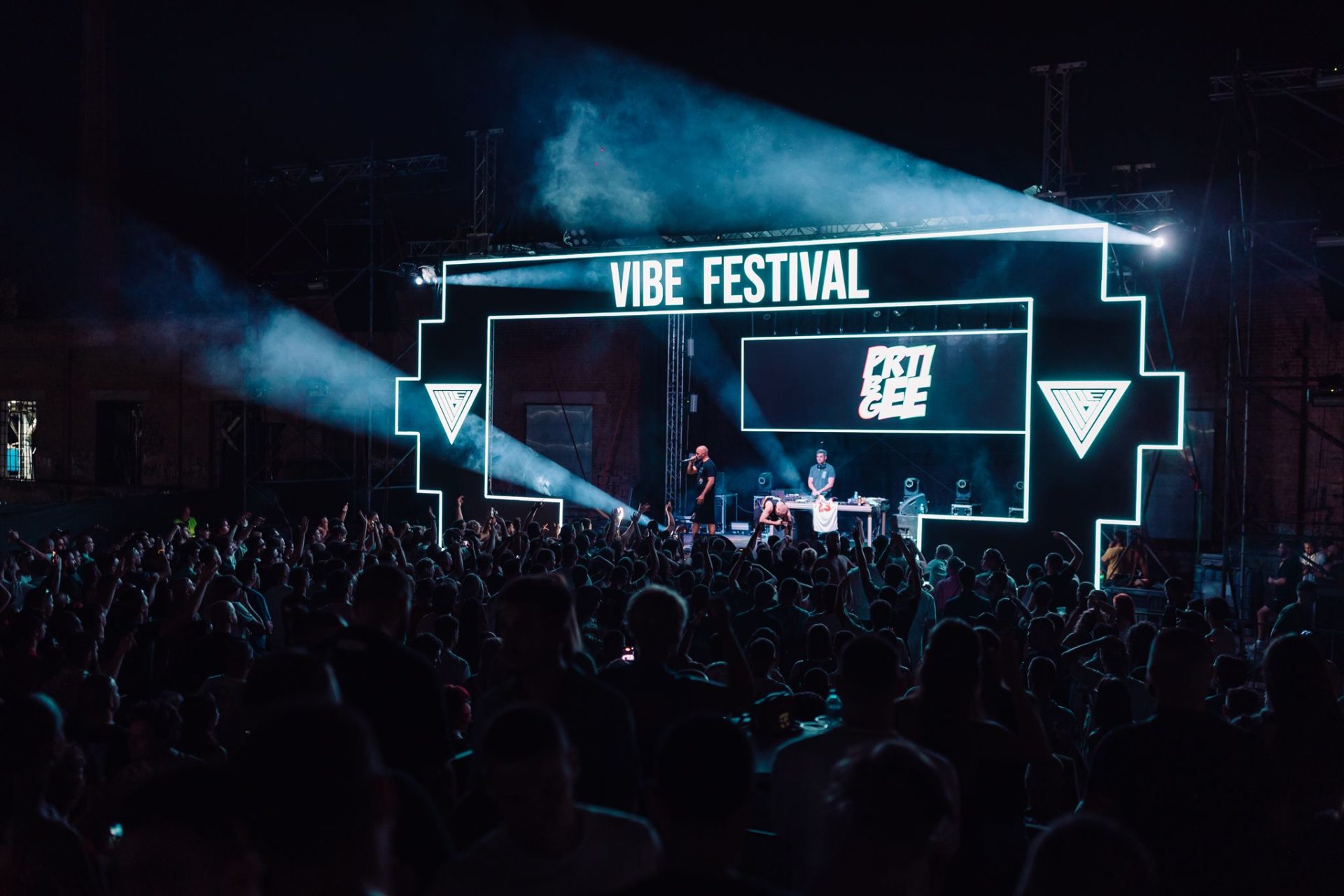
The President of Serbia, Aleksandar Vučić, recently announced that the Serbian Progressive Party (SNS) will hold a major rally in Belgrade on Vidovdan, 28 June, or earlier, as well as in other cities. More specific was the Minister for Public Investment, Darko Glišić, who stated that SNS has registered a large gathering in Belgrade from 26 to 29 June and expects several hundred thousand attendees. Spaces in front of the National Assembly building, Nikola Pašić Square, and surrounding streets up to Republic Square have been reserved, with the ambition of making it “one of the largest gatherings ever held.”
Students: “We love Slavija. Very much. Fact.”
After a period of relative calm in recent months, protesting students are also resuming actions and organising rallies, although they are not yet revealing all details. More information is expected after the May Day holidays, but unofficially, a large gathering in Belgrade is planned for late May at Slavija Square – the site of one of their largest protests in December 2024 during an uprising that has lasted a year and a half.
On social media, students listed dates of previous major protests, including the one at Slavija, adding that the “series will soon continue,” with the message: “See you soon.”
“Let’s meet again at the end of May in the capital, at a roundabout with a fountain in the centre,” one post reads. Another hints at “??.5.2026?”, while a third states: “We love Slavija. Very much. Fact.”
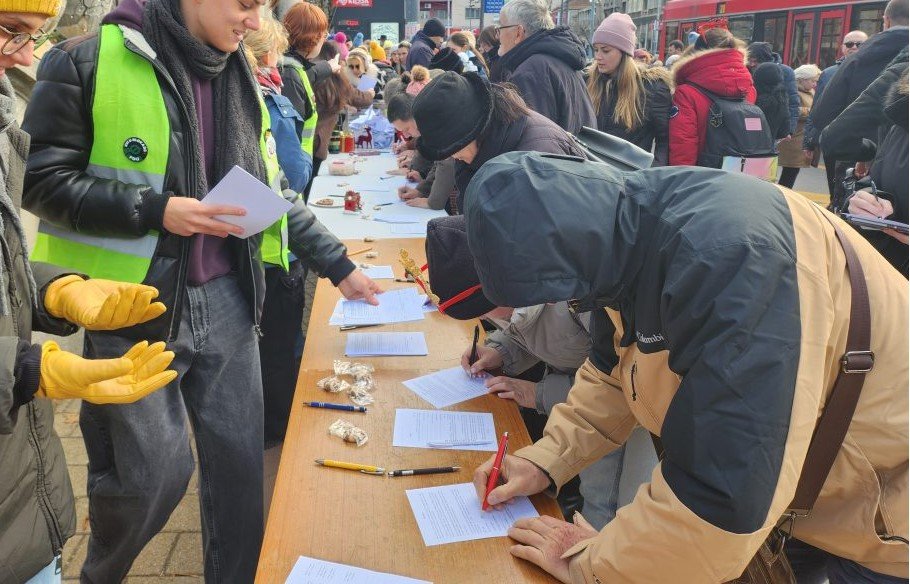
Until the next major rally, students remain active across the country. Today, in 54 locations across Serbia, at more than 100 stands, they distributed 400,000 stickers reading “Students win,” their new slogan. Supporters of the government quickly responded with the slogan “Serbia wins.”
“What we started in December with 400,000 signatures, we are now continuing more concretely: we have prepared the same number of stickers that must reach every corner of Serbia. Come and help us cover Serbia with the truth,” students said in their call to action.
Today, the two sides encountered each other on the streets. For example, in Zvezdara, near a student stand distributing “Students win” stickers, there was also an SNS stand. SNS members claimed they are there “every weekend, on weekdays, maintaining regular communication…”
The opposition is also preparing for potential elections. At the headquarters of the People’s Movement of Serbia, nine opposition parties met last week – including the Party of Freedom and Justice, Green-Left Front, and others – describing the talks as “very good” and announcing continued cooperation, though without revealing further details.
A message to opponents and a sense of momentum
Political scientist Fahrudin Kladničanin told NIN that it is quite clear the campaign has already begun, even if it has not been formally declared due to the lack of an election date. What we are witnessing, he says, is classic pre-election positioning.
“The government, through announcing large rallies, aims to demonstrate political strength and organisational capacity, showing its voter base remains firmly loyal to Vučić and SNS. This is not just mobilisation, but also a message to opponents that the regime still controls the political field. On the other hand, students are trying to create what is often crucial in politics – a sense of momentum. The slogan ‘Students win’ is clearly designed as a political brand for a potential electoral run. However, while we see strong symbolism and mobilisation, we still lack clear political articulation – we do not know the programme, the structure of any list, or who, apart from Rector Vladan Đokić, would lead this project. And that is an important distinction, because energy alone is not the same as a political offer,” he explains.
He adds that the slogan is more carefully crafted than it appears, as it not only mobilises but also creates polarization – often beneficial to challengers in elections. Its strength lies in communicating victory rather than protest, suggesting change is possible and achievable. It establishes a binary logic, drawing a clear line between two sides and framing politics as a choice between the current order and the alternative symbolised by students.
Kladničanin concludes that everyone is already behaving as if elections have begun, which is logical because “in such circumstances, the struggle is not only for votes, but for initiative, narrative, and psychological advantage.”
“Keeping the fire alive”
Political scientist and former president of the Democratic Party, Zoran Lutovac, told NIN that the campaign has been ongoing for a long time, with only its intensity changing.
“Campaign confrontations are always a form of testing strength and public opinion. Vučić, as always, leads in this. He is constantly in campaign mode, even when elections are not imminent, supported by a vast media and financial machinery, as well as captured state institutions. Every public appearance – even seemingly private social media posts – serves the campaign. However, for the first time since coming to power, he is not acting from the position of a clear favourite. On the contrary, students have emerged as a political force, provoking often nervous reactions from the regime. The campaign is increasingly turning into open verbal, institutional, and even physical conflict, which reflects a losing syndrome. Meanwhile, the student movement is ‘keeping the fire alive’ and preparing to peak when elections are officially called,” Lutovac says.
Although nearly all political actors are already campaigning, it remains unclear what elections will come first – early parliamentary elections, which students have demanded for a year, presidential elections, or possibly both combined. Observers say both the timing and type of elections will depend on public opinion polling conducted regularly by the government.
With only a few days until Đurđevdan, it may soon become clear whether Serbia will witness another precedent – “summer elections” for the first time in the past two decades. In any case, with or without elections in June or July, the campaign will certainly continue.
(NIN, 30.04.2026)
https://www.nin.rs/politika/vesti/111476/da-li-je-kampanja-vec-pocela-iako-se-ne-zna-kad-ce-biti-izbori