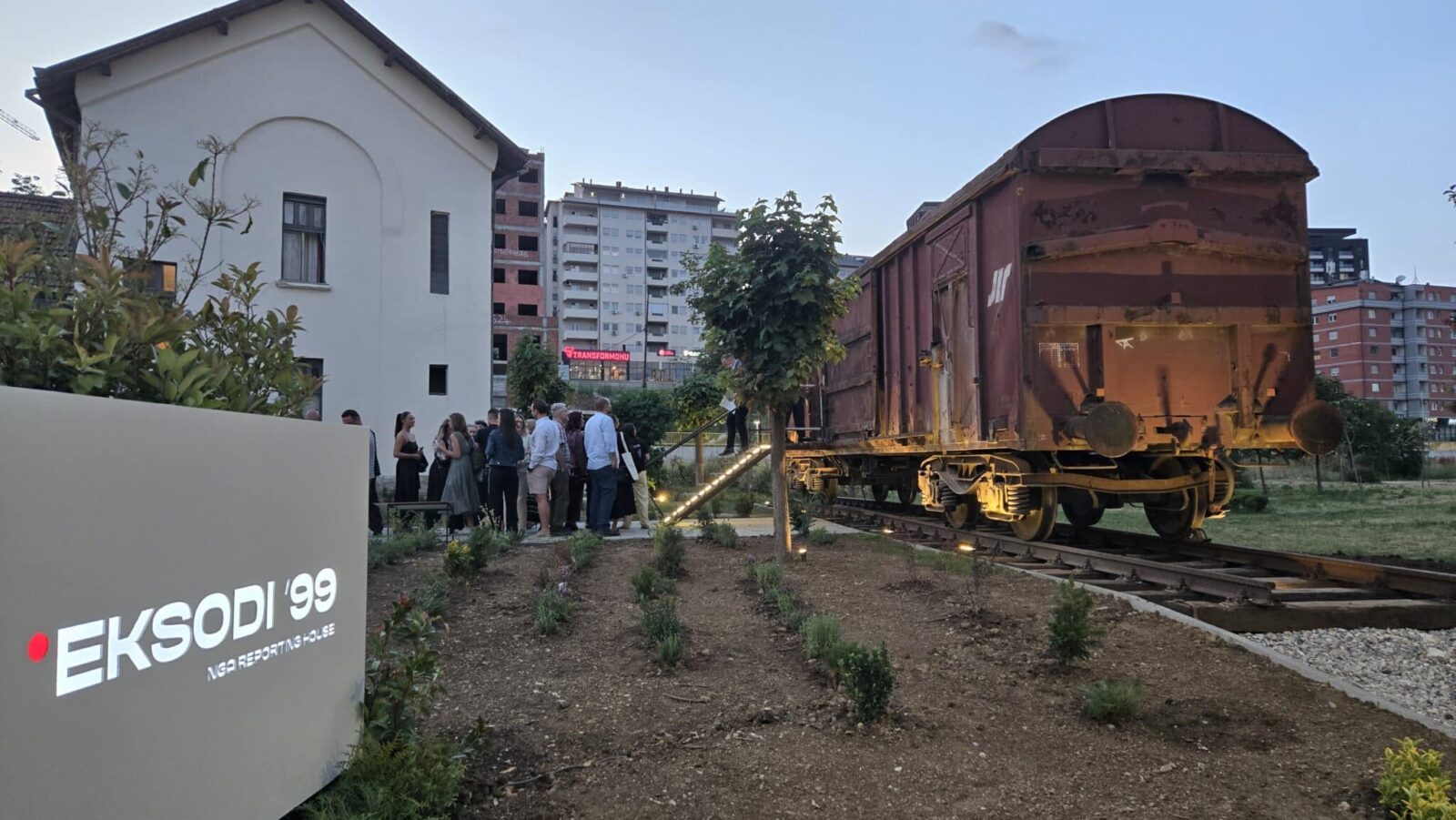
The ‘Exodus ’99’ wagon, the second location of BIRN’s Reporting House exhibition, at Pristina railway station. Photo: BIRN
An exhibition opened on Wednesday at Pristina railway station displaying 48 testimonies of Kosovo Albanians who were forcibly expelled from Kosovo from March to June 1999 by Serbian forces and transported mainly to what was then Macedonia in crowded railway wagons.
The exhibition, “Exodus ’99”, is the second location for BIRN’s museum on the Kosovo war, Reporting House. Located at Pristina railway station, it consists of an old train wagon with monitors inside, on which the stories of the participants can be heard and seen.
The stories are divided into four themes: expulsion, life in refugee camps, staying with host families, and return. Some testimonies are from people who were not expelled but went into hiding and joined the armed resistance of the Kosovo Liberation Army, KLA – or whose train was turned back after the Kosovo Albanian politician Fehmi Agani was pulled off it and killed.
BIRN Kosovo director Jeta Xharra, the producer of Reporting House, said at the opening that “the idea of this wagon came from a very talented artist, Gazmend Ejupi, after he heard the stories of refugees. One refugee recalled how when there were no more passenger cars, Serbian forces started using two other means of transport for the refugees – trucks and freight wagons. When he heard this, the curator went to the locomotive graveyard and now we have the stories shown inside one wagon.
“Most of the testimonies are from adults who were children at the time. It is interesting how many details they remember despite being very young children at the time,” Xharra said.
Some of the blankets the victims used at the time have been placed inside the wagon. Curator Ejupi said at the opening: “It was hard for people to give us these blankets, but we hope we will have more artefacts moving forward and collect more material on our history, to protect our past.”
By the time NATO launched its air campaign in March 1999 to halt the war in Kosovo, as armed repression by Serbian forces intensified, more than 300,000 people had already fled their homes after more than a year of fighting and the failure of international efforts to resolve the conflict.
But the largest wave of deportations occurred during the air strikes, when nearly a million people were forced to flee.
The cattle wagon used to house “Exodus ’99” carried refugees from Pristina to Bllace, then across the border into what was then Macedonia, in 1999.
An abandoned public toilet beside Pristina railway station has also been turned into a mini-gallery that exhibits some artefacts from the new museum. Among them is a document from the archives of INFRAKOS, the public railway company, which shows how Serbia organised additional train carriages and sent extra freight wagons from Belgrade for the mass deportation of Kosovo Albanians.