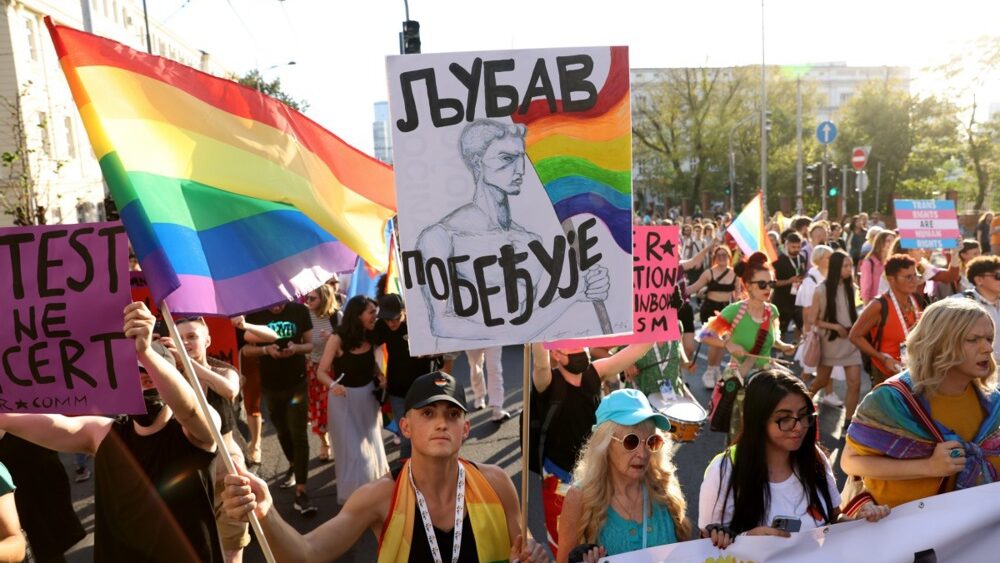
“I’m getting ready and somehow have this ‘surreal’ feeling; as if it is unreal that something like that will happen now in Serbia, in Belgrade, for the first time in history,” Agata Milan Djuric recalls feeling on June 30, 2001, the day of the first Belgrade Pride.
“I feel great excitement, great fear. I was even supposed to open Pride as the first drag queen, Viva La Diva,” she adds.
Djuric is one of the pioneers of the LGBTQ+ movement in Serbia and one of the original Pride organisers.
“I was planning on singing I Will Survive, one of the queer anthems, and Over the Rainbow by Judy Garland,” she says.
The event was supposed to start with a gathering at the Republic Square in the city centre and continue at the Student Cultural Centre, with two discussion panels about LGBTQ+ people in Serbian society.
“It was supposed to be a celebration of love and inclusiveness and celebrating human diversity,” she continues.
“However, that event unfortunately turned into brutal violence. It actually, in one day, gave a cross-section of the depth of violence in which LGBT people lived daily in the then context and at that time.”
Hordes of young thugs descended on Republic Square and attacked the activists and anyone else looking like they could be queer.
Over 40 people were injured as the attackers chased, punched and kicked the Pride participants. The authorities were accused of failing to protect people from various neo-fascist organisations that had pre-announced attacks with public threats and declarations before the event started.
“There was [the extreme right-wing group] Obraz, they had that proclamation about various groups of people that were ‘enemies’, LGBT people among others; there was also ‘Blood and Honour’, ‘1389’ and other [far-right] organisations,” Djuric remembers.
“As the date of our Pride approached, the threats increased and the whole city was plastered with various posters – threats that ‘We are waiting for you’. But we naively thought that we would really have the support of the state,” she adds.
Coming after the ousting of Serbia’s nationalist strongman leader Slobodan Milosevic the previous year and the installation of a new, democratically oriented government, there was a mood of optimism among the activists.
“We were simply carried away and inspired by the change [in government], because many of us were anti-regime activists, peace activists, anti-war activists, and we had great trust in the leaders of the then government in terms of their values and that somehow there would be a change in the overall political climate in society,” Djuric says.
The Pride organisers received advice from human rights organisations and various others who warned that it was “not the right time”. Djuric says they thought that advice was “absurd, because it is always the right time for everyone’s rights”.
They informed the authorities about what they planned – to some bemusement. “We went to the police to talk about the event four times, and it was like some movie scene; when we would go to the police, they would look at us like some exotic creatures who now want some kind of celebration.”
As Djuric notes, the regime had changed but many of the old security officials from Milosevic’s system remained in place. “We simply have to bear in mind that, despite the change of government, the entire structure of the state apparatus did not change,” she acknowledges, now.
“It was obviously assessed that the event was high-risk, and that threats were coming from various sources, but somehow, in that kind of enthusiasm, we believed in the then representatives of the government, and we did not expect that violence would await us to such an extent.”
On the day, however, few police were on the streets to keep the marchers safe. Reinforcements only came when the thugs started attacking those few officers who were present. Some refused to protect the marchers even then: “We won’t protect faggots and lesbians,” Djuric remembers one saying.
When the participants were attacked, she remained in Republic Square, “even though there were a few situations in which I probably might have been killed, or at least seriously physically injured. I, as the organiser, was responsible for telling all the people we recognised as or thought were LGBTQ: ‘Go home.’”
Now, she says, that first Pride has huge historical importance: “From a historical perspective, I absolutely consider it a revolutionary act.”