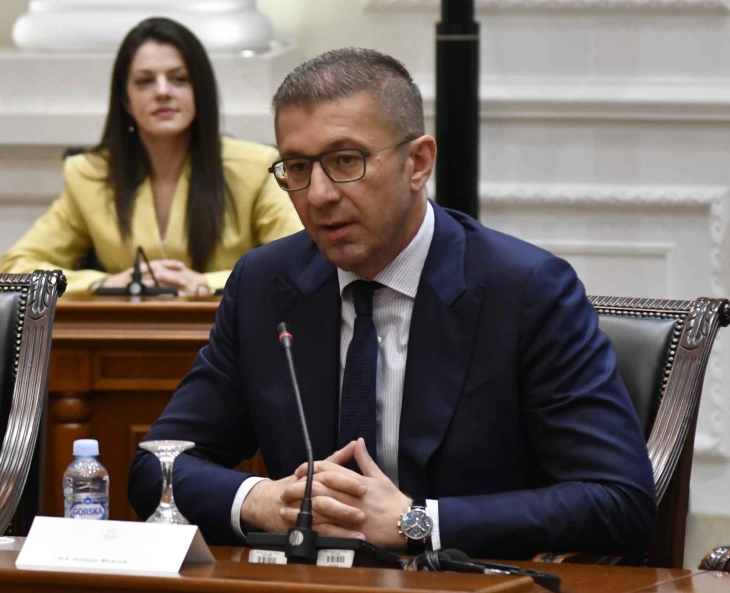
The past two years of hard work have crystallized, optimized and made clearer this project, which previously meant that we should finish half of the tunnel and without having a clear prediction from our eastern neighbor that we would have a modernization of the section connecting the border with us and Sofia, including the other half of the tunnel. Yes, it took time. Progress had to be achieved in the talks with our eastern neighbor. That progress has been achieved, agreements have been signed, there is commitment and dedication from both sides and a tunnel that is practically the third part of the project, said Prime Minister Hristijan Mickoski today before the signing ceremony of the agreements for financing the construction of the Kriva Palanka – Deve Bair railway section of Corridor 8. The project was left half-finished by the previous Government, with a plan that Macedonia unilateraly builds the tunnel under Osogovo Mountain on its side, and then wait for a move from the Bulgarian side – an idea that was rejected by Mickovski and renegotiated with Bulgaria.
We have a commitment from our eastern neighbor for a clear modernization of that part of Corridor 8 and a joint project. This is the tunnel that we expect to be fully financed as a grant by the European Commission, added the Prime Minister.
As Mickoski noted, the support from European financial institutions and the EU worth 149 million EUR is further proof that when we work dedicatedly and together, something that seems difficult or impossible becomes a reality and possible.
Now comes the harder part. The construction of these over 22 kilometers from the aspect of an engineering undertaking is truly challenging. I am not speaking as the Prime Minister, but as an engineer. However, I am convinced of the capacities possessed by the Macedonian construction sector which, I expect, will make a great contribution to the realization of this project, will be well organized and will be able to participate in the tender which I expect to be completed during this year and the construction of this project to begin, also this year. This will also have positive implications for the construction industry which will further participate in the country’s gross domestic product, emphasized the Prime Minister.
According to him, some opposition politicians complained about the loss of the 60 million EUR grant, that was tied to the failed previous project.
This project will not end in a dead end half-tunnel. Now we have a whole tunnel. And that is very important. Because when you build something, it should be functional. It is not just about ticking a box and saying: “Okay, we started this, we held a press conference, we addressed, we spent the money”. Someone needs to return that money. That money will be returned to the greatest extent by the citizens of the country. And if they are returning something, we need to have a clear whole that will bring income. Now, as the project has been formed and optimized, we can already say that there will be added value to the Macedonian economy. We continue to round off the process of Corridor 8. In the part of the reform agenda, I can say that the section from Skopje to Gostivar via Jegunovce and Tetovo will be included in the financing part. And here I mean modernization and electrification, said Mickoski.
Now the situation is clearer. Now we have a whole that will connect the two countries and which whole will mean added value for both countries. That is part of NATO’s priorities, but also the economic priorities of both countries. I will say two things that I think are important. And that is that I was a teenager when the eastern part of Corridor 8 was first mentioned. Today I am the Prime Minister and I can say with pleasure that the eastern part of Corridor 8 will finally be completed. What does that mean? If I was a teenager then, and now I am 48 years old, it means that for more than 30 years we have been waiting for what someone once announced to us to finally close as a project and as a financial construction by this Government, thanks to the policies it is pursuing, but also with the enormous support of our partners from European financial institutions such as the EIB and EBRD. Of course, there is the European Commission’s investment framework for the Western Balkans, i.e. the grant that will be awarded in the amount of 169 million euros and additionally the two parts that will be financed by these two financial institutions, Mickoski pointed out.