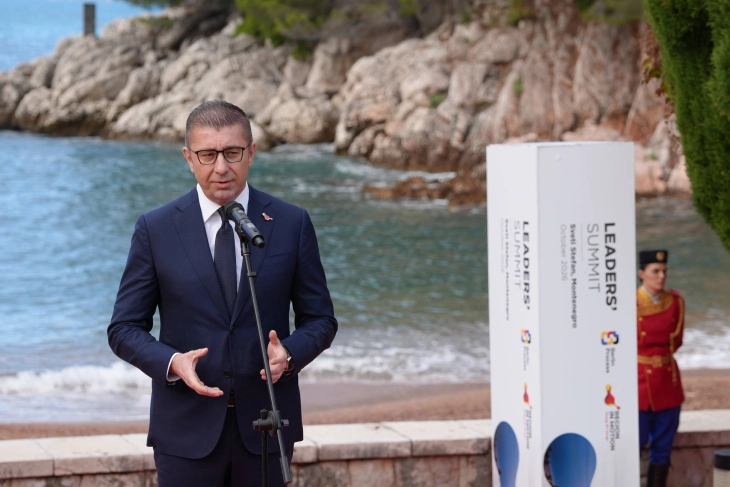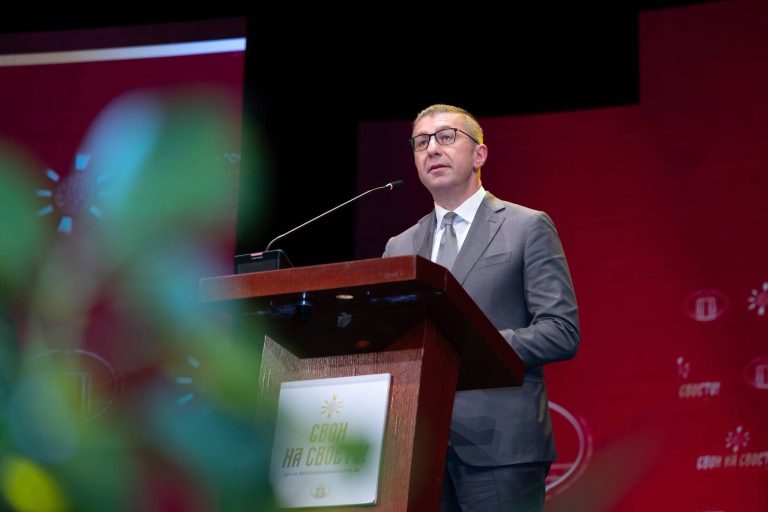
October 23rd, the Day of the Macedonian Revolutionary Struggle, marks the founding of the Macedonian Revolutionary Organization in Thessaloniki in 1893. The holiday is dedicated to the generations that fought for freedom and self-determination. At a formal ceremony held under the motto “Masters of Our Own Land”, Prime Minister Hristijan Mickoski spoke about their sacrifice, the Macedonian identity, and the political and economic challenges that, according to him, the country faces today.
Mickoski began his address by asking what today’s generations are doing with the freedom for which the revolutionaries fought, and what kind of state they will leave for their children. He reminded the audience that the founders of the Organization had no state or institutions to protect them; instead, they possessed faith, courage, and a clear goal. He mentioned figures such as Uzunov, Dame Gruev, Hristo Tatarchev, Pitu Guli, and Goce Delchev, emphasizing that Macedonian statehood was forged through persecution, imprisonment, uprisings, and wars—not through freedom that was simply gifted.
He stated that October 23rd is a day of both pride and responsibility. According to him, “being masters of our own land” means living and making decisions within one’s own state, while also building a future in which young people will want to stay. He identified the Macedonian name, language, culture, and historical memory as the foundations of national identity. He emphasized that these must be passed on to the next generation, while the state should cultivate friendships with other nations without compromising its own dignity.
A significant portion of the political segment of his speech focused on the European path. Mickoski stated that he believes in a European future for Macedonia—one to be built through reforms, knowledge, and strong institutions, all while preserving national dignity. In this context, he also noted the citizens’ exhaustion resulting from the long wait, the conditions imposed, and various bilateral disputes.
He rejected calls to abandon the negotiations, arguing that doing so would mean forfeiting the opportunity to one day participate as an equal member of the European Union. He likened politics to a game of chess, noting that smaller nations can succeed through wisdom and unity.
In this regard, he explicitly accused Bulgaria of leveraging its status as an EU member state to obstruct Macedonia’s progress. Mickoski asserted that, prior to Bulgaria’s accession to the Union, issues concerning good-neighborly relations and the status of self-identified Bulgarians within the country had not been raised. He also stated that, back then, it was not claimed that Goce Delchev, Jane Sandanski, Nikola Karev, and Gjorche Petrov were Bulgarians; rather, these issues only became relevant after Bulgaria joined the EU.
The Prime Minister remarked that his task is not to dwell on “bones belonging to the past,” but to focus on the future of the children. Nevertheless, he emphasized that historical memory is not subject to external approval and that no amount of pressure can erase Goce Delchev from the people’s consciousness. He further noted that his government has engaged in dialogue—a process that, according to him, had previously been avoided.
Mickoski linked the situation within the country to broader developments across Europe and the region. He described Europe as becoming a “restless volcano,” while noting that the Balkans remain a theater where, in his view, various intelligence services are active. He expressed concern that attempts might be made to import regional problems into Macedonia, and suggested that domestic actors could potentially be found to facilitate such scenarios.
He urged citizens not to succumb to provocations or allow the imposition of what he termed “artificial issues” and exaggerated ethnic themes. In this context, he also leveled sharp criticism at segments of the opposition, alleging that there are political actors willing to stir up trouble in exchange for money or promises of official positions. He stated that he would not allow—as he put it—dishonest games or risky ventures involving the state.
He also employed sharp political rhetoric when drawing comparisons to previous administrations. He accused them of “selling off” Macedonia and kowtowing to foreign interests, adding that the current government is rectifying what was previously conceded. In response to opposition criticism regarding a lack of sufficient results, he said that the government would provide an answer through its work.