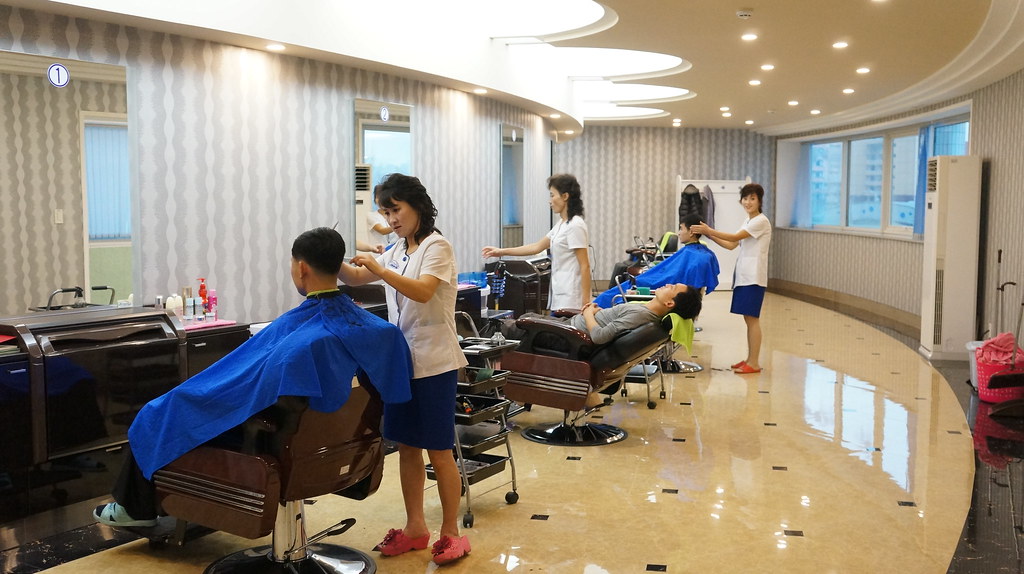
A barbershop at the Munsu Water Park in Pyongyang (Uri Tours, Creative Commons, Flickr)
North Korean beauty salons and sauna houses are increasingly rebranding themselves as premium service providers in 2026, bundling haircuts, massages, skin care treatments and laser procedures into package deals and introducing membership programs to draw well-heeled customers.
A Daily NK source in South Hamgyong province said state-run beauty salons and sauna houses in Hamhung, facilities historically limited to basic haircuts and baths, have introduced a series of upscale treatments in recent months as they compete for customers.
Beyond providing services tied to their original purposes, such as grooming and bathing, these facilities are now offering package deals that combine multiple treatments, along with prepaid membership options, marking an apparent shift in how they do business.
Salons once focused on haircuts and styling are expanding their facilities to offer skin care, facial massages and laser treatments, while sauna houses have added massage rooms offering foot and full body massages, as well as detox treatments, the source said.
“More people are getting skin care, massages and other treatments along with their haircuts and baths,” the source said. “Despite the high prices, these upscale treatments are popular.”
The source added that some facilities are promoting package deals that combine skin care, massages and haircuts, or encouraging customers to prepay for multiple visits. “The more people use them, the more discounts or extra treatments they receive, so quite a few people are interested,” the source said.
This shift appears linked to a broader rise in interest in personal appearance in North Korea, with consumers increasingly willing to spend on such treatments. Demand for skin care and cosmetic procedures has grown steadily not only in Hamhung but in major cities such as Pyongyang, Sinuiju and Chongjin, the source said, prompting related service facilities to gradually upgrade their offerings.
Out of reach for ordinary North Koreans
However, access to these facilities and services remains limited to a segment of North Korea’s wealthy class, the source noted. Premium treatments carry price tags well beyond what most North Korean people can afford, and many require payment in foreign currency or a lump sum upfront.
“In the past, these convenience facilities weren’t really meant for people’s convenience, either, but now they’re openly turning into places for people who spend a lot of money,” the source said. “In the past, the facilities existed but weren’t functioning. Now they’re operating, but the problem is that ordinary North Korean people don’t have the money to use them.”
Ultimately, the increasing sophistication of these convenience facilities appears aimed not at improving daily life for the broader population, but at expanding services for a wealthy few, turning such facilities into a stark symbol of the widening class divide inside North Korea.
Read in Korean
Reporting from inside North Korea
Daily NK operates networks of sources inside North Korea who document events in real-time and transmit information through secure channels. Unlike reporting based on state media, satellite imagery, or defector accounts from years past, our journalism comes directly from people currently living under the regime. We verify reports through multiple independent sources and cross-reference details before publication.
Our sources remain anonymous because contact with foreign media is treated as a capital offense in North Korea — discovery means imprisonment or execution. This network-based approach allows Daily NK to report on developments other outlets cannot access: market trends, policy implementation, public sentiment, and daily realities that never appear in official narratives.
Maintaining these secure communication channels and protecting source identities requires specialized protocols and constant vigilance. Daily NK serves as a bridge between North Koreans and the outside world, documenting what’s happening inside one of the world’s most closed societies.