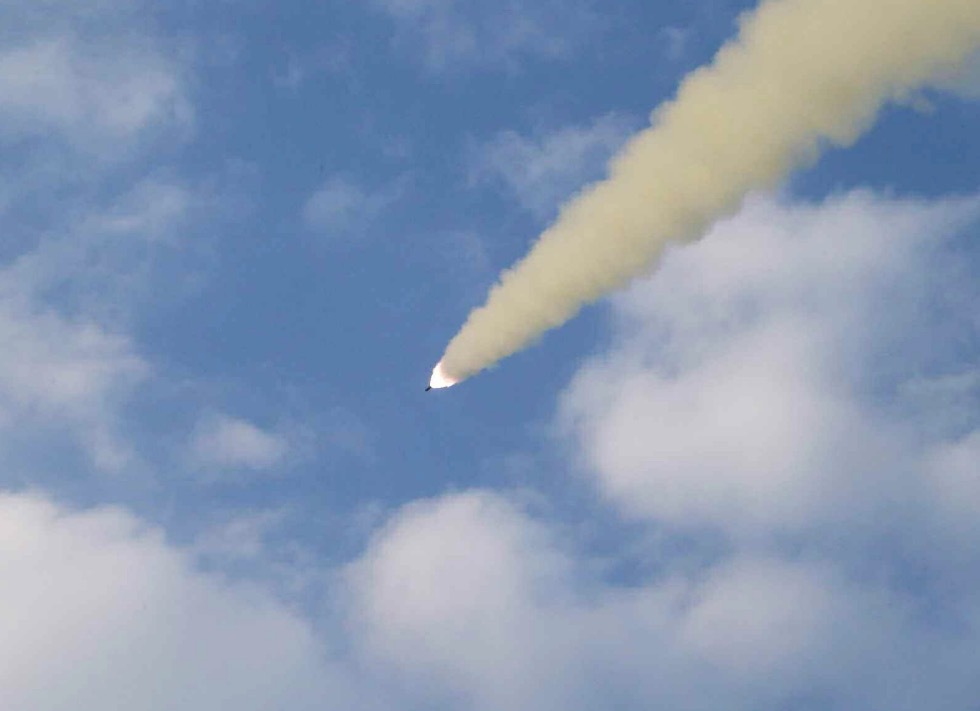
Regardless of what President Trump’s recent social media was intended to achieve or to whom it was really targeted, it has brought back heightened interest in US-North Korea relations. In the past three days alone, a major US-South Korea joint military exercise has been curtailed, and media attention has surged around Trump’s renewed quest for a meeting with Kim Jong Un by end of year. For its part, Pyongyang has issued two responses that stopped short of rejecting Trump’s overtures while making clear just how far apart the two sides remain. It also carried out a salvo of short-range ballistic missile launches despite the downscaled military drills and Trump’s friendly overtures, underscoring the difficult road ahead.
North Korea’s latest responses indicate that Pyongyang is leaving room for US engagement, however small, while reaffirming the price of admission is high and that its terms of diplomacy with Washington have changed. This leaves important questions about what it would see as the purpose of new talks and how that might, or might not, align with US and allied interests.
Neither an Aye Nor a Nay: Baiting Washington for More Concessions
North Korea issued two back-to-back pronouncements on August 19. Early that morning, North Korea published a “KCNA [Korean Central News Agency] commentary,” which denounced the annual US-South Korea joint military drill, the Ulchi Freedom Shield (UFS), and pledged to exercise the “right of self-defence … to completely neutralize the enemies’ military threat” with “newly-developed strength.” Although the commentary did not mention Trump’s earlier social media directive to scale back US-South Korean joint military exercises, its publication despite South Korean media reports the previous evening that the UFS would likely be curtailed seemed to throw cold water on Trump’s overtures.
On that same evening, Kim Yo Jong issued a rare “stand [립장]” on “major international affairs,” in which she directly responded to Trump’s recent overtures, including his claim that he received a response from Kim Jong Un. She implied that engagement may be possible if the United States takes further and more fundamental steps to change what Pyongyang considers US “hostile policy,” which likely includes ceasing US-South Korea joint military exercises altogether.
Kim Yo Jong downplayed the UFS curtailment and depicted the very act of conducting US-South Korea joint military exercises as “hostility.” She also portrayed Japan’s military expansion as a “serious threat” and, more broadly, accused the United States and its “followers” of continuing “hostile military activities” against North Korea. Most notably, she said: “If the U.S. calculates that it can propagate its recent measure [the downscaling of the US-South Korea exercises] as the one of so-called good faith, they will not get desired answer.” In effect, Kim Yo Jong was telling Washington that scaling back one exercise was insufficient: If it wants the “desired answer,” it will have to do more to demonstrate a fundamental change in what Pyongyang considers US “hostile policy.”
She concluded her pronouncement by noting that it was “very reasonable, appropriate and essential” to contain the “forces threatening” North Korea’s security, echoing the earlier KCNA commentary. North Korea’s missile launches the next day, carried out shortly after Chinese Foreign Minister Wang Yi’s departure from Seoul, were consistent with that message.
An Unlocked Door Is Not an Open Door
Though she has set a hard-to-reach bar for engagement, Kim Yo Jong did not altogether reject Trump’s overtures. Although she referred to Trump simply by his name, dropping the presidential title she has typically used in the past, she toned down her usual pointed sarcasm when discussing Trump’s claim that Kim Jong Un had responded to him, refrained from criticizing Trump personally, and once again recalled the two leaders’ “excellent” personal relationship. On balance, her pronouncement leaves some room for positive interpretation.
But how does it fit into its broader US policy direction?
North Korea had already raised the bar for engagement at the Ninth Party Congress in February 2026. Compared with Kim Jong Un’s September 2025 formulation—dropping the denuclearization demand and recognizing “the reality”—the revised language called on Washington to “respect” North Korea’s nuclear-armed status and withdraw its “hostile policy.” The shift was significant: Asking for US “respect,” even if only political, went beyond simply dropping the denuclearization demand, while the elastic concept of “hostile policy” potentially raised the threshold even further.
Pyongyang’s rhetoric since the Party Congress has reinforced that harder line. The Congress branded Washington “the chieftain that mercilessly destroys the existing international order” and said it remained “utterly unchanged in its original hostile view on the DPRK.” The following month, Kim escalated criticism of the United States, accusing it of “state-sponsored terrorism and aggression” around the world. In the days leading up to the UFS, North Korea issued an unusual spate of authoritative pronouncements and commentary attacking the United States and its security partnerships with Seoul and Tokyo.[1]
The rhetorical trend has coincided with a broader emphasis on military and defense affairs. Since at least 2024, Kim’s public activities have been heavily oriented toward military and defense affairs, even as the regime has emphasized civilian economic development.
Against this backdrop, Kim Yo Jong’s August 19 pronouncement appears to reaffirm, rather than substantially harden, the position Pyongyang has been building for months: Personal affinity for Trump can coexist with an adversarial posture toward the United States and its allies. This may be particularly meaningful when North Korea is simultaneously threatening South Korea and Japan, both US treaty allies. Leaving the door open to Trump, in other words, should not be mistaken for a broader softening toward Washington.
Thinking Bigger
Significantly, Kim Yo Jong deliberately situated North Korea’s policy toward the United States among a broader set of regional and global security concerns.
One striking aspect of her “stand” is that she did not dive straight into Trump’s overtures or US-North Korea relations even though those were the obvious hook. She instead took a broad framing, starting with the Middle East and moving on to Europe and the Russo-Ukraine war, Japan, and the US-South Korea military exercises, and concluding with US-North Korea relations. By opining on key global and regional security concerns shared by Russia and China—while voicing explicit support for Moscow and taking positions broadly aligned with Beijing’s views—she also seemed to highlight Pyongyang’s growing security alignment with the two countries amid its confrontation with the United States, South Korea, and Japan, which North Korea has referred to as a US-led “axis of confrontation.” By placing US-North Korea relations in a wider strategic context, Kim Yo Jong’s pronouncement seemed to reflect Pyongyang’s increasingly expansive view of its relationship with Washington as one element of a larger regional and global strategic contest.
This broader framing tracks not only with North Korea’s growing alignment with Russia and China, but also with its expanding self-perception as a regional and global actor. It is also reflected in Pyongyang’s increasingly prominent justification of its nuclear deterrent as a means of protecting regional peace and stability, rather than solely its own security. Both the KCNA commentary and the Kim Yo Jong “stand” explicitly tie North Korea’s strong national defense to regional security.
This raises a more fundamental question, beyond whether Kim Jong Un is willing to meet Trump again: What does North Korea now believe the purpose of engagement with the United States should be? In 2018 and 2019, the two sides at least discussed pathways to improved ties involving denuclearization alongside potential security, political, and economic benefits for North Korea. Today, North Korea insists that its nuclear-armed status is irreversible, touts its alliance with Russia, shows growing alignment with China on security issues, and increasingly casts its military power as contributing to regional security and stability. If improved ties with Washington no longer hold the same strategic value for Pyongyang, the purpose and possible scope of another round of Trump-Kim diplomacy may be considerably narrower.
Conclusion
A steady stream of high-level North Korean statements and commentary indicates that Pyongyang will approach the United States within a wider strategic framework than it did during Trump’s first term. Its strengthened nuclear capabilities, deepening ties with Russia and China, and growing self-perception as a consequential regional and global player mean Kim Jong Un would approach Trump from an unprecedented position of strength for North Korea. The question, therefore, is not simply whether Trump and Kim can get back to the negotiating table, but whether they still have enough common ground to make getting there meaningful.