- A map produced by Mongabay cross-references Recife’s water supply schedules with census data from the Brazilian Institute of Geography and Statistics (IBGE), revealing racial, gender and class disparities in access to water.
- In peripheral communities home to large Black populations, piped water may be available for as little as 91 hours a month, leaving residents with dry taps for up to 15 consecutive days.
- These same neighborhoods face a dual water crisis, suffering chronic shortages while remaining the most vulnerable to floods and landslides.
- A partial privatization of water services promises to address the shortfall, but critics warn the concession could deepen existing inequalities.
See All Key Ideas
RECIFE, Brazil — In Ibura de Baixo, a neighborhood tucked into the South Zone region of Recife, Northeast Brazil, 27-year-old Jeyne Araújo’s day begins well before dawn. At 4 a.m., while the Pernambuco state capital sleeps, she scrapes buckets and drums across the floor outside her home. The sound marks the start of a daily scramble against scarcity: With running water flowing for only six hours a day, she must stockpile every drop before the taps run dry.
The water Araújo manages to collect is far from the clean supply one would expect from a public utility. It smells strongly of chemicals and is too unpleasant to drink or cook with immediately. It froths into a thick, soapy white foam as it splashes into the bucket. “It arrives so full of chlorine that you can’t do anything with it,” she tells Mongabay.
The poor quality of the tap water has taken a serious toll on her family’s health, says Araújo. For six months, her 9-year-old son, Wesley, suffered constant bouts of vomiting and stomach pain. Doctors at Recife’s Areias Hospital traced the intestinal infection back to porridge prepared with tap water. To keep her son safe, Araújo now uses part of her monthly Bolsa Família, a government social welfare program benefit of 950 reais (around $180), to buy jugs of bottled water at 6 reais ($1.12) each — an expense that further strains her already meager budget.
Inside the house, stacks of dirty dishes fill the sink, a visible measure of the household’s water shortage. With water flowing unpredictably between 8 a.m. and 4 p.m., every chore becomes a race against the tanks running dry. “You have to save the leftover water to flush the toilet, because if you throw it away, there’s no water left for anything else,” Araújo says. The work is physically demanding. Every time the taps run dry, she must scrub away the black sludge that settles at the bottom of the drums.
Araújo’s hardships extend beyond dry taps. Civil Defense authorities, who manage emergencies in the city, classify Ibura as an area of high hydrological risk (R3) and very high risk (R4), and the neighborhood still carries the scars of recent disasters. During the 2022 floods, Araújo lost her partner when he stepped on a live wire submerged in floodwaters in a neighborhood alley. She says utility workers took an hour and a half to shut off the power grid after the first emergency calls.
Mongabay contacted Neoenergia, Recife’s electricity distributor, for comment, but the company did not respond.
Dirty dishes pile up in Jeyne Araújo’s sink, a daily reality shaped by water scarcity. Image by Yamini Benites.
Mapping the water shortage
Araújo’s situation illustrates what experts describe as environmental and water racism: A reality in which skin color, gender and postal codes dictate who has access to tap water and who is left to manage thirst and climate hazards in neglected neighborhoods.
This selective scarcity is the outcome of systematic exclusion. By cross-referencing supply schedules from the Pernambuco Sanitation Company (Compesa) with microdata from the IBGE’s 2022 census, a “water map” produced by Mongabay suggests that water rationing in Recife falls along stark racial, gender and class lines.
Of the 311 locations surveyed across the Pernambuco capital in July 2026, 236 face chronic supply interruptions. The data show that shortages disproportionately affect Black women in neighborhoods where average monthly per capita income ranges from 1,100 to 2,300 reais ($206–$430 at the time of writing).
Under criteria set by the National Water and Basic Sanitation Agency (ANA), service interruptions lasting six hours or longer qualify as intermittent. Under the agency’s benchmark, water should be available for more than 18 hours a day — more than 540 hours in a 30-day month.
Yet peripheral areas analyzed by Mongabay receive barely 17% of that benchmark. Ibura, Araújo’s neighborhood, has the lowest water access in the city. Inhabited mostly by Black and mixed-race women with an average monthly income of 1,116 reais ($209), it receives only 91 hours of water per month.
The neighborhood of Linha do Tiro, perched on the hills of Recife’s North Zone region, illustrates how water access intersects with climate risk. According to Mongabay’s mapping, residents there receive between 100 and 268 hours of water per month, depending on the sector — again less than half the regulatory minimum.
What makes Linha do Tiro even more vulnerable is its designation under the Civil Defense’s 2026 Contingency Plan: Almost the entire neighborhood falls within high-risk (R3) and very high-risk (R4) zones for floods and landslides. It creates a cruel contradiction: Residents live in constant fear of mudslides rushing down the hillsides during heavy rains, yet their taps stay dry for days on end.
Houses in Linha do Tiro are flanked by steep hillsides, many lacking retaining walls, leaving residents torn between water shortages and the threat of landslides. Image by Yamini Benites.
The city’s geography lays bare this social divide. While peripheral areas ration water by the bucket, affluent neighborhoods such as Boa Viagem — which has the second-highest real estate prices per square meter in Recife — Apipucos and Espinheiro enjoy near-uninterrupted service, recording more than 700 hours of supply each month, according to Mongabay’s analysis.
In these enclaves of water security, residents are predominantly white, and average incomes climb to between 7,000 and 16,000 reais ($1,309 and $2,992). The contrast is stark along the boundary between Apipucos and neighboring Alto Santa Terezinha: Homes only a few meters apart enjoy abundant water in the former neighborhood while those in the latter are restricted to a schedule of just 100 hours per month.
Antônio Miranda, a civil engineer and member of the Permanent Technology Committee at the Regional Council of Engineering and Agronomy (CREA), describes the disparity as “profoundly disrespectful.” Drawing on nearly 50 years of professional experience, he says that while wealthier families bypass state failures by drilling deep wells, building private systems or buying water trucks, peripheral communities endure a “permanent calendar of water rationing from January to January.”
Pernambuco has the lowest per capita water availability of any Brazilian state. With an average of just 1.27 million liters (335,000 gallons) of water per capita per year — a mere 3.6% of the national average — the state’s reserves resemble those of desert regions, according to data from the Pernambuco Water and Climate Agency (Apac).
This structural scarcity, which worsens inland in the state’s semi-arid areas, explains why intermittent service is a fixture in Recife, turning the management of a scarce resource into a driver of deep racial and social inequality.
Jugs of bottled water in Jeyne Araújo’s home. After her son fell ill from chlorinated tap water, she began buying drinking water despite her limited income. Image by Yamini Benites.
An added layer of precariousness
In Cacique Chicão, an informal settlement in another part of Ibura, water insecurity collides with a complete lack of basic infrastructure. Unemployed kitchen assistant Alessandra Maria da Silva, 51, has lived for nine years in a wooden stilt shack. Reaching her front door means balancing on abandoned railway tracks, the only dry path over a pool of stagnant water and floating trash.
She says municipal construction work worsened conditions by installing pumps that push raw sewage directly in front of residents’ homes. “Where are you supposed to run, when this is the only way in or out?” she says.
Silva lives in an area classified as very high hydrological risk (R4), meaning it is severely prone to flooding. Without piped water indoors, she relies on a makeshift hose hooked to a decommissioned main line. The water pressure is so weak that by 8 p.m., supply stops reaching her single outdoor tap.
The 51-year-old has diabetes and a hernia that prevents her from working. She also suffers recurring gastrointestinal problems and skin infections. Her conditions are exacerbated by persistent dampness and the lack of clean water needed for basic hygiene.
Alessandra Maria da Silva balances on abandoned railroad tracks to reach her house in Cacique Chicão. Image by Yamini Benites.
The floods that devastated Cacique Chicão in 2022 stripped Silva of more than just belongings; they took irreplaceable memories. As water mixed with raw sewage flooded her shack, she lost all her identification documents and the only photographs and clothes she kept in memory of her daughter, who died in a car accident.
Survival in these environmental crisis zones plays out under the tension of two competing government policies. On the one hand, the city attempts to manage immediate disasters through its 2026 Contingency Plan (Placon), a Civil Defense protocol that coordinates emergency responses during extreme weather. But while Placon is a stopgap designed to save lives during floods, long-term dignity hinges on the universal access targets set by Brazil’s Basic Sanitation Legal Framework.
Updated in 2020, the federal sanitation law requires that 99% of the Brazilian population have access to treated water and 90% to sewage collection and treatment by 2033.
Privatization controversies
Ahead of a reelection bid, Pernambuco Governor Raquel Lyra signed a partial concession contract for water services with water and sanitation company BASA Saneamento. Signed in April 2026, the deal involves 17.4 billion reais ($3.3 billion) in projected investments across 151 municipalities. It drew swift criticism from experts and advocacy groups, who warn the model risks entrenching historical inequities in water access.
According to Anderson Quadros, president of the Association of Higher-Level Employees of Compesa (Procompesa), the workers’ association at the state’s water utility Compesa, the arrangement outsources water distribution and sewage collection — the system’s most lucrative segments — to the private sector. Meanwhile, it leaves water production and extraction, the costliest operations and the most exposed to climate disruption, in the hands of state-run Compesa.
Anderson Quadros, president of Procompesa, says privatization cannot resolve water intermittency in Recife’s vulnerable neighborhoods. Image courtesy of Anderson Quadros.
“People say the private [sector] will invest 19 billion reais [$3.6 billion], but this target does not appear in any contractual clause. It is merely a reference figure,” Quadros tells Mongabay. Without contractual obligations to fund specific infrastructure projects, concessionaires tend to prioritize profit and delay work in hard-to-reach areas, he adds.
Contacted by Mongabay, BASA Saneamento rejected claims that the contract is weak, stating “that the contract provides for an investment of 15.4 billion reais [$2.9 billion] over 35 years.” The company added that “the funds will be allocated according to priorities defined by technical criteria, and the company’s objective is to fully meet the expansion targets in all 151 municipalities served, following planning guidelines that include peripheral areas and hillsides.”
Quadros notes that private profit motives ignore the engineering challenges and steep costs of piping water up steep hillsides. He cites the record of a public-private partnership with sanitation firm BRK in Greater Recife, where, over a period of 13 years, the company “didn’t go up a single hill” to expand sewage networks.
Under the new concession, Quadros says, investment will likely stay concentrated in flat, profitable areas, leaving peripheral neighborhoods — often mapped as high-risk flood zones — excluded from services.
In a statement sent to Mongabay, the Pernambuco state government rejected claims that the private operator will bypass hard-to-reach communities, asserting that there is “no contractual provision authorizing differential treatment based on the economic profitability of locations.”
Lost dignity
On the slopes of Linha do Tiro, steep terrain makes water shortages even harder to endure. For 44-year-old domestic worker Joana*, the neighborhood’s rugged topography poses a daily barrier to dignity. She lives on constant alert: During rainy months, she fears mudslides rushing down the hillsides; during the dry season, taps stay dry for days. Joana requested anonymity because she accesses the public water system through an informal, clandestine connection.
Under a rationing schedule of two days with water followed by three days without, Joana manages a 1,000-liter (264-gallon) storage tank. “You turn down the tap and say: ‘Boy, girl, watch how long you’re in the shower to save water,’” she says of the instructions she gives her children to avoid hauling buckets from neighborhood wells. Shortages have lasted up to 15 consecutive days with no water at all.
On rainy days, Joana, her husband and their children stay awake watching the unstable hillside beside their home, while also dealing with chronic water shortages. Image by Yamini Benites.
Mongabay joined Joana on a walk to fetch water during one of these dry spells: a steep trek down broken asphalt, past active landslide scars and along narrow, elevated concrete walkways to a neighbor’s well. Balancing heavy buckets and drums on the return climb requires grueling effort, which she shares with her young children.
For Joana, living on the hillside was not a choice but rather the only option. The family used severance pay from her husband’s former job as a doorman to build, “little by little,” the three-room house where they live today.
Under a rationing system of two days with water followed by three dry days, Joana manages a 1,000-liter (264-gallon) water tank. Image by Yamini Benites.
Paying out of pocket
The push for self-reliance in the face of government neglect shapes the story of Maria do Bom Parto Albino da Silva, known as Fia. A resident of Linha do Tiro for two decades, she has ended up paying out of pocket for a basic service the state failed to provide.
Fia pooled money with her family to drill a tube well to provide a water source, spending 800 reais ($149) on drilling and submersible pumps. But this self-reliance has limits: The well water’s safety remains uncertain, forcing her to buy bottled drinking water and reserve the well water strictly for cleaning and hygiene.
For Fia, running water brings stability to her neurodivergent son, 31-year-old Gabriel. He focuses intensely on household chores, finding comfort in constantly washing dishes and scrubbing the stove. Without the well, official rationing schedules would upend his daily care and mental health.
Yet the family’s home remains vulnerable to erratic weather. During torrential downpours, they scramble to hoist household appliances onto Styrofoam blocks — safeguards frequently chewed through by small rodents, locally called catitas, that thrive along unpaved, sewage-strewn alleys. “Last rainy season it was constant rain,” Fia says. “Today there’s a torrential downpour and tomorrow the sun is blazing hot. That’s when we and the children get sick.”
The state government defends the concession, arguing that public management cannot achieve universal sanitation. But Procompesa’s Quadros points to the track record of Brazil’s National Sanitation Plan (Planasa) in the 1970s, which doubled sanitation coverage nationwide in 15 years through public investment funded by the National Housing Bank (BNH). “The problem was never technical incompetence, but the disruption of public financing mechanisms,” he says.
Maria do Bom Parto, known as Fia, a resident of Linha do Tiro, drilled a tube well by pooling money with her family. The supply is steady, but water quality is uncertain. Image by Yamini Benites.
Recent national sanitation figures raise alarms. During the new sanitation framework’s first five years, nationwide water coverage contracted by 0.5% instead of expanding. Annual growth in sewage coverage slowed from a historical average of 6% to just 2%, according to a report published by the Trata Brasil Institute.
Quadros describes the Pernambuco model as a financial arrangement designed backward, prioritizing upfront fees and private profits over the long-term sustainability of the system. The state government announced the transfer of 1.3 billion reais ($241 million) from the concession fee to 151 municipalities.
Quadros also warns of threats to Compesa’s financial viability. While the state utility’s production cost is estimated at 2.12 reais ($0.4) per 1,000 l (264 gal) of water, the concession set the wholesale tariff at just 1.84 reais ($0.34) per 1,000 l. “With this rate, Compesa will rack up 5 billion reais [$930 million] in losses within four years,” he says, suggesting that weakening the utility may be an effort to justify its full privatization later.
In response, the state administration said in a statement to Mongabay that the model guarantees Compesa more than 1.5 billion reais ($280 million) in immediate compensation, alongside a dedicated “Sanitation Universalization Account” for utility investments. Officials added that objections raised by opposition groups were reviewed by the State Audit Court (TCE), an independent, state-level body that audits public money and spending, which dismissed the complaints as unfounded.
Yet Quadros points out a significant loophole: These concession funds reach municipal coffers without any legal requirement that they be reinvested in sanitation. “This money can be used by mayors for public plazas, highways or even concerts by famous artists,” he says. The Pernambuco government told Mongabay through its press office that regional sanitation boards passed resolutions requiring these funds to be used preferentially for sanitation.
In the Cacique Chicão settlement, shacks lack indoor plumbing. Residents rely on shared pipes and faucets on the street. Image by Yamini Benites.
Protecting water sources
The dry taps in Recife’s peripheries stem from a degraded environmental system sustaining the metropolitan area.
Greater Recife relies on seven main dams: Pirapama, Tapacurá, Botafogo, Gurjaú, Duas Unas, Bita and Utinga. It also depends on the Beberibe aquifer, a high-quality groundwater reserve tapped by private wells that faces growing threats from contamination and saltwater intrusion.
Maria do Carmo Sobral, a civil engineer and professor at the Federal University of Pernambuco (UFPE), warns that the city has reached its physical limit for surface water extraction: “The last major water source was Pirapama. We have no other river to tap within a 40- to 50-kilometer [25- to 31-mile] radius.”
Ensuring that tap water does not make residents sick requires protective measures that go well beyond hydraulic engineering. Sobral, who has coordinated international watershed planning projects, emphasizes the need to restore riparian forest buffers of at least 100 m (328 ft) around reservoirs to prevent rainfall from washing sediment and pollutants into the supply.
Pirapama, the last watershed tapped in Greater Recife and Compesa’s largest water producer. Image by Aluísio Moreira/SEI via Wikimedia Commons (CC BY-SA 2.0).
Vigilance is also vital against eutrophication — excessive algae growth that impairs water quality, fueled by agricultural runoff, industrial waste and effluent from sugarcane mills. Given Pernambuco’s severe water deficit, freshwater is a precious resource, and healthy watersheds are essential for Compesa’s treatment plants to function effectively.
Under the new concession model, watershed preservation remains in public hands. Sobral says achieving universal water access, particularly for communities on hillsides and peripheral areas, demands an urgent shift in strategy: Rather than focusing solely on expansion, authorities must invest in water reuse systems and tackle distribution leaks, which currently claim 50% of treated water.
In a statement, BASA Saneamento says it “is preparing a technical assessment of water loss that will serve as the basis for an Investment Plan in Loss Reduction.”
In Ibura de Baixo, decisions made by policymakers could break the cycle of hardship defining Araújo’s life. Her children still carry trauma from the 2022 disaster, panicking whenever storms trigger fresh flooding. Two years ago, floodwaters reached halfway up their front door. Trapped between dry taps and drowning streets, Araújo remains caught between two extremes of the same crisis.
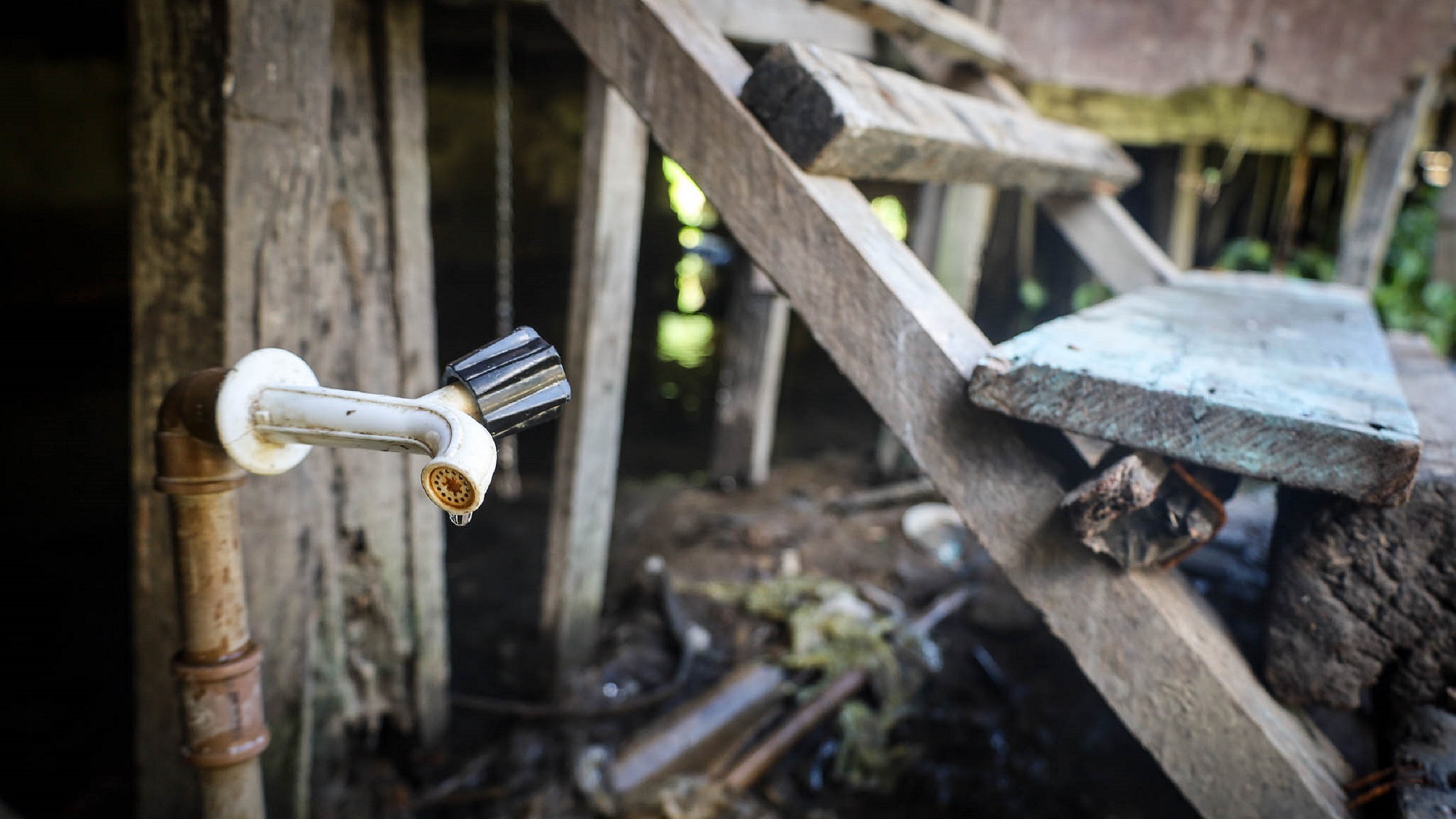
Banner image: A water tap in the Cacique Chicão settlement in Recife’s Ibura neighborhood. Image by Yamini Benites.
Cite this article
Adriana Amâncio, Áthila Galindo, Yamini Benites (2026). Water rationing in Recife, Brazil, falls along racial lines. Mongabay Conservation news. DOI: https://doi.org/10.66709/news-334914