- A new project off the Hawaiian island of O‘ahu tests an unusual method of shielding coastal communities and infrastructure from destructive waves: an artificial reef intended to act as a set of speed bumps.
- By January 2027, 60 huge concrete structures will be sunk off Kalaeloa Harbor, an industrial port on West O‘ahu, to protect the coastline from storm surge and erosion.
- The project also aims to provide shelter for corals and eventually create habitat for reef-dwelling fish and other marine life.
- This “living breakwater” was designed to facilitate ongoing community participation, and could be replicated at other locations in the Hawaiian archipelago.
See All Key Ideas
On Sept. 8, Hurricane Lowell ripped across the Pacific Ocean and around Hawai‘i, sloshing huge waves onto O‘ahu’s west flank and spitting baseball-sized chunks of coral through the window of at least one home.
Hawai‘i and its coastal highways, which loop several of the U.S. state’s seven inhabited islands, have been bruised by increasingly intense storms fueled by warming seas due to human-caused climate change and the current “super” El Niño. But a project in a western harbor on the island of O‘ahu is testing an unusual method for calming the ocean to shield communities and infrastructure.
“It’s the first artificial, call it a hybrid, reef designed to protect coastlines, so to reduce coastal erosion from wave energy,” Ben Jones, the project’s lead coordinator and director of ocean science and technology at the University of Hawai‘i’s Applied Research Laboratory, told Mongabay by phone.
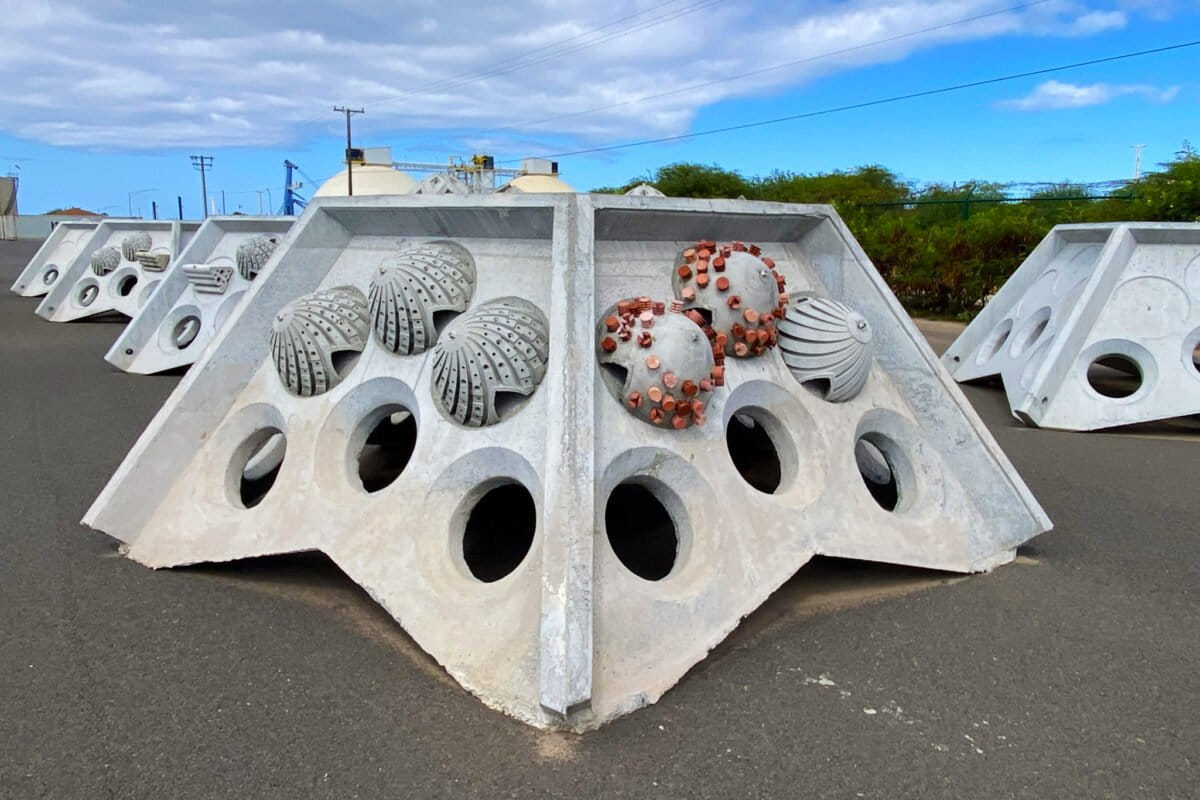
On Sept. 18, while the island was still wringing itself out from Lowell, the project team sank the first of 60 huge concrete structures 64 meters (210 feet) off Kalaeloa Harbor, an industrial port on West O‘ahu. Eight of the structures, which each weigh 4 metric tons, had been placed as of Oct. 20, Jones said, a feat of engineering that required a special shallow-water catamaran to float the pieces out to their final resting places.
A large wave caused by Hurricane Lowell crashes on the west side of O‘ahu, Hawai‘i on Sept. 8, 2026. Image by AP Photos/Craig Fujii/Honolulu Civil Beat.
The project was funded with $27 million from the Defense Advanced Research Projects Agency (DARPA), the U.S. Department of Defense’s research arm. It is one of two breakwater projects that have come to fruition under DARPA’s “Reefense” program established in 2022 to innovate on tried coastal infrastructure like seawalls and rock pile “rubble mound” breakwaters, which can smother habitats under rocks and cement and scour or erode the seafloor and beaches with redirected wave energy.
“Traditional coastal infrastructure has a lot of issues with it,” Catherine Campbell, deputy director of the Biological Technologies Office at DARPA, told Mongabay by video call.
“It’s expensive. It doesn’t last that long. It needs to be repaired, and so we said, ‘is there another way … to do this that would be more self-sustaining?’”
The first objective is to protect the coastline from punishing waves, the University of Hawai‘i’s Jones said. The concrete pieces, placed in rows, will act like speed bumps. The project team tested a roughly quarter-scale model of the design in a huge wave tank at Oregon State University, on the U.S. mainland, and found around 80% of wave energy dissipated.
However, the structures in Kalaeloa Harbor will span only about 50 m (164 ft), whereas the full design would need to stretch roughly a kilometer (0.6 miles, or 3,281 ft) to substantially protect a coastal area from erosion, Jones said. The Kalaeloa Harbor project is a prototype meant “to prove that you can do it,” he said.
Once all the structures are placed by January 2027, the team will start measuring wave disruption.
The hybrid reef system in Kalaeloa Harbor will transplant living coral onto 60 engineered, concrete reef-mimicking structures. The project aims to reduce wave energy, strengthen shorelines and improve coastal resilience. Image courtesy of Hawaii Department of Transportation.
A beach near Kalaeloa Harbor, O‘ahu, Hawai’i. Image by Pete Markham via Flickr (CC BY-SA 2.0).
A new home for corals
The project’s other objective is to create shelter for new coral reefs. The porous, concrete frames were retrofitted with “helix recesses” — artful, crevassed ceramic domes and shelves designed by scientists at the University of Hawai‘i’s Institute of Marine Biology to serve as friendly places for corals to attach. Researchers from the University of California, San Diego’s Scripps Institution of Oceanography will also plant special underwater speakers that play recordings from healthy reefs to encourage coral settlement and growth.
“I don’t see any other project as ambitious as this that will benefit our community — if it goes well,” Alika Peleholani Garcia, a fisher and CEO and founder of Kuleana Coral Restoration, a nonprofit organization in the community of Kapolei that will help to transplant corals onto the structures, told Mongabay by phone.
The team prepared for the breakwaters by moving large corals, mostly lobe coral (Porites lobata) and cauliflower coral (Pocillopora meandrina), from the seafloor to make way for the structures. The corals will soon be planted onto the ceramic edifices.
The ReefCat Deployment System transports the reef-mimicking structures offshore and carefully lowers them onto the seabed for installation. Images courtesy of the Hawaii Department of Transportation.
The planted corals will have to contend with “a ton of wave energy” — the norm for this side of the island, Garcia said. But he added he’s “optimistic” that in a few years growing corals will be established on the structures, attracting fish and other marine life.
“In Hawai‘i we have other artificial reefs that’s just slabs of concrete thrown in the water. There’s a lot more attention in these [Kalaeloa structures] being biologically and ecologically compatible” with coral growth, he said.
Largely because of the intense wave activity, the area has little coral coverage to begin with, according to the project’s final environmental assessment. The breakwater site, an area of about 831 square meters (8,945 square feet), was home to a few corals, a dense population of rock-boring urchins (Echinometra mathaei) and small reef fish.
The environmental review concluded the project would have “no significant impact.”
The concrete structures will be anchored in place using a drill system with less sound disturbance and footprint than a pile driver, Jones said. After significant storm events, the Hawaii Department of Transportation (HDOT) will, from the shore, monitor for “structural displacement,” according to a June 2026 state Department of Land and Natural Resources report.
A coral reef assemblage within Lalo, also know as French Frigate Shoals, part of the Hawaiian Islands National Wildlife Refuge and the Papahānaumokuākea Marine National Monument, that contains some of the same coral species identified in Kalaeloa Harbor. From left to right: Cauliflower coral (Pocillopora meandrina), lobe coral (Porites lobata), and finger coral (Porites compressa). Image by Lindsey Kramer/USFWS via Flickr (CC BY-NC 2.0).
Cauliflower coral (Pocillopora meandrina) is one of the species that will be transplanted onto the hybrid breakwater reef once it is fully installed in Kalaeloa Harbor. This image shows cauliflower coral in Shark Island lagoon at Lalo, also known as French Frigate Shoals, part of the Hawaiian Islands National Wildlife Refuge and the Papahānaumokuākea Marine National Monument. Image by Mark Sullivan/USFWS via Flickr (CC BY-NC 2.0).
Community participation
The marriage of coastal protection and restoration is important to local people — as is accountability, Anthony Makana Paris, chair-at-large of Neighborhood Board No. 34 Makakilo Kapolei Honokai Hale, told Mongabay. Kalaeloa Harbor is a major industrial hub plagued for decades by heavy-metal contamination and stormwater violations.
“When we listen to the stories of our old-timers, they remember when the limu, or the seaweed, was so pervasive you would get caught up in it when you walked into the water,” Paris said, “which is not the case today.”
“The community has rallied to try and get better treatment,” Paris said, and “create community benefit agreements with major developers.” The Kalaeloa breakwater project team will send progress reports every six months to a hui, a coalition of community and industry stakeholders, which includes Neighborhood Board No. 34 and Kuleana Coral Restoration.
Once installed, ownership of the breakwater will be handed over to the HDOT and the first year of operations paid for with $915,000 in state funds. The money is drawn from Green Fee funds, a 0.75% tax on accommodations like hotel rooms and cruise ship lodgings that funds environmental and resilience projects.
This breakwater design could eventually be deployed in other Hawaiian waters, state Representative Darius Kila, who chairs the Hawai’i House of Representatives’ transportation committee, told Mongabay by phone.
“It’s clear that nobody wants to see another seawall or have restricted shoreline access,” Kila said. “So this is a way for us to one, protect that shoreline access and then, two, also give our struggling reef colonies an opportunity to thrive.”
Banner image: Components of the hybrid reef system being installed in Kalaeloa Harbor, which will integrate 60 engineered, concrete reef-mimicking structures with living coral. Image courtesy of Hawaii Department of Transportation.
Marine artificial upwelling, problematic climate solution slow to advance
Citations:
Norris, B. K., Reguero, B. G., Bartolai, J., Yukish, M. A., Rhode-Barbarigos, L., Haus, B. K., … Beck, M. W. (2025). Designing modular, artificial reefs for both coastal defense and coral restoration. Coastal Engineering, 199, 104742. doi:10.1016/j.coastaleng.2025.104742
Saengsupavanich, C., Ariffin, E. H., Yun, L. S., & Pereira, D. A. (2022). Environmental impact of submerged and emerged breakwaters. Heliyon, 8(12), e12626. doi:10.1016/j.heliyon.2022.e12626
Feedback: Use this form to send a message to the editor of this post. If you want to post a public comment, you can do that at the bottom of the page.
Cite this article
Jules Struck (2026). How a ‘living breakwater’ in Hawai‘i aims to create coral habitat and protect coastline. Mongabay Conservation news. DOI: https://doi.org/10.66709/news-334947