Twenty years after a helicopter crash killed some of Nepal’s most prominent environmental figures, the nation is celebrating ecological gains while grappling with a void in visionary leadership, reports Mongabay’s Abhaya Raj Joshi.
On Sept. 23, 2006, a Russian-built Mi-8 helicopter crashed near the high-altitude mountain village of Ghunsa, killing all 20 passengers and four crew members. The victims included Gopal Rai, the minister of forests and soil conservation; other senior government officials; a Finnish diplomat; a USAID official; and key WWF staff. They had traveled to Ghunsa to hand over management of the Kanchenjunga Conservation Area, in the northeastern corner of Nepal, to local communities. The crash occurred the next day as the group was taking off from Ghunsa.
“For the community, this was the beginning,” said Ghana Shyam Gurung, now country representative for WWF Nepal. Seven WWF staff died in the crash, the single greatest loss of life in the history of the organization.
Among them were Harka Gurung, Chandra Gurung, and Mingma Norbu Sherpa, and their loss left an institutional vacuum.
“We didn’t just lose people that day. We lost the pace we were moving at,”
said Sarita Jnawali, a former conservationist with the National Trust for Nature Conservation (NTNC).
Shiv Raj Bhatta, an ecologist at the Department of National Parks and Wildlife Conservation, who lost key supervisors in the crash, recalled the immediate aftershock. “I wondered how we would ever produce people of that height again,” Bhatta said.
The community-based conservation framework championed by that generation laid the groundwork for major ecological gains over the next two decades.
Nepal’s forest cover expanded from roughly 40% in the 1990s to more than 46% today, driven by more than 23,000 community forest groups managing 2.5 million hectares (6.2 million acres) of land. And the country’s tiger population more than tripled from 121 in 2010 to 429 this year. The rhino population grew from 645 in 2015 to 752 in 2021.
But these population recoveries also brought challenges.
A 2026 study of Nepal’s Terai Arc Landscape documented 245 tiger attacks on humans between 2010 and 2024, with 141 fatalities. In Taplejung district, site of the 2006 helicopter crash, data from Phungling municipality point to up to 330 families abandoning their hill settlements amid crop losses by monkeys.
Former forest ministry secretary Krishna Chandra Paudel described the loss as “a wound that left a deep scar,” adding that official government commemorations have largely lapsed over the past decade.
WWF’s Gurung said conservation in Nepal needs a breakthrough on the scale of the 1990s shift to community-based management, one built around climate and water. “The world ahead is about water,” he said.
Read the full story by Abhaya Raj Joshi here.
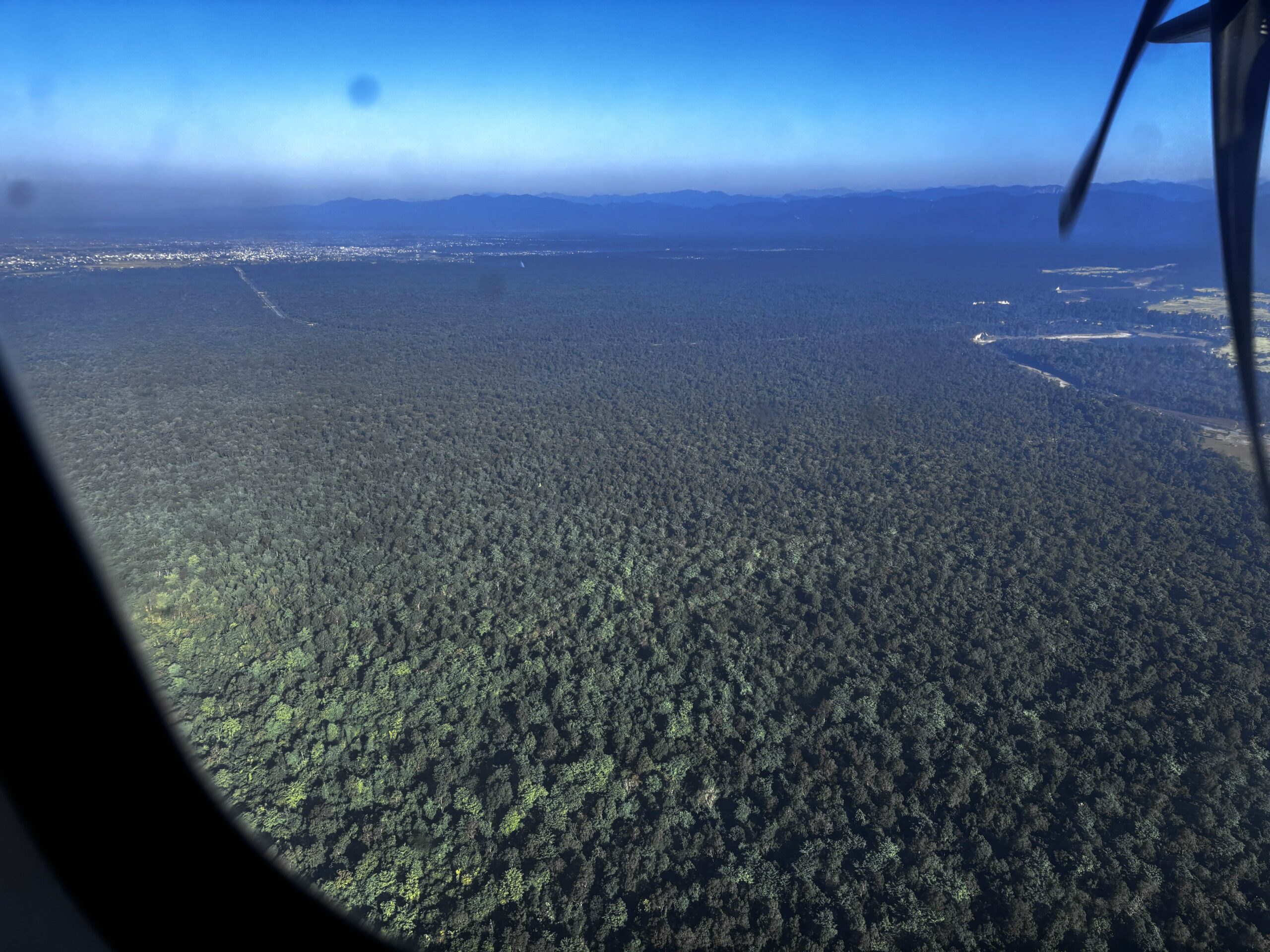
Banner image: A forest in western Nepal photographed from an airplane. Image by Abhaya Raj Joshi/Mongabay.