- Loctaguna Organics, a Lusaka-based operation supplies organic produce to Newrest Zambia, a catering company that supplies meals to airline companies.
- Their farm runs on agroecological principles which includes collecting food waste from the airlines to use as compost.
- Recycling the food waste helps cut farming and waste-management costs, according to the company.
- It offers a glimpse of how even a small-scale operation can meet market needs in a sustainable way.
See All Key Ideas
LUSAKA, Zambia — A passenger finishing a salad on a flight out of Lusaka may not know where the vegetables came from — or where some of the organic waste generated during meal preparation ends up.
The answer to both questions could be: A 10-hectare (25-acre) farm on the outskirts of Zambia’s capital run by Loctaguna Organics. The farm supplies vegetables and herbs to Newrest Zambia, a catering company that supplies meals to airline companies operating out of Lusaka. Some organic waste from the catering operation is then returned to Loctaguna, where it is used as compost.
The farm runs on an agroecology model. Loctaguna produces vegetables, fruits, herbs and animal products without synthetic fertilizers or pesticides, employing 12 people.
“The most fundamental part of this whole process is soil health, promoting the soil health,” Loctaguna founder Kanangwa Newlove said.
Goats and pigs are part of the Loctaguna Organics ecosystem. The droppings from the livestock are used to produce manure and the residues from the meals are fed to the pigs. Image by Chisapi Kumbutso for Mongabay.
Newlove’s journey into agriculture followed a decade-long career in business and marketing. “I used my gratuity from COMACO to set up operations on this farm,” she told Mongabay referring to COMACO Limited, where she worked as a sales and marketing operations manager.
Her transition from business to farming has shaped Loctaguna’s approach to connecting organic production with commercial markets.
Through a partnership with Kasisi Agricultural Training Centre, she also promotes agroecological farming among small-scale farmers, seeking to strengthen local food systems and responsible farming practices.
Loctaguna combines composting, livestock, agroforestry and other resource-recycling practices to reduce its reliance on external farm inputs. Newlove said the farm also uses natural pest-control methods. Leaves of the Symphytum officinale plant (also known as comfrey) are fermented in water for two weeks to produce a liquid that can deter pests. Newlove told Mongabay that adding flowers from the Tithonia genus strengthens effectiveness in eradicating the pests.
“We’re just using very simple technologies that don’t need a lot of capital, to be honest,” she said. “It’s just smart thinking, and I think this is the future for Africa, for farming.”
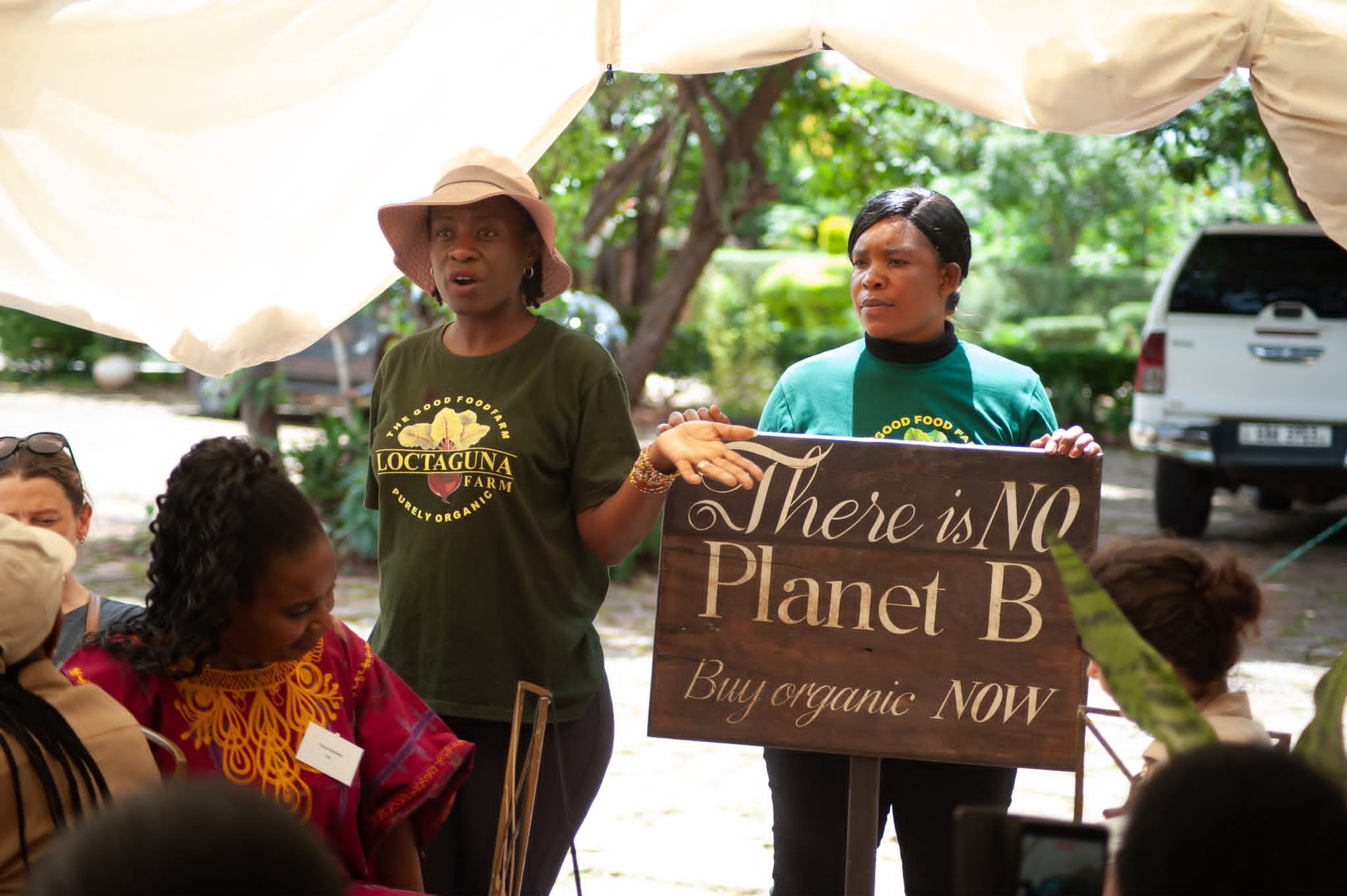
Kanangwa Newlove. Image by Chisapi Kumbutso for Mongabay.
An internal analysis that compared the costs of a Loctaguna farming operation growing onions on one hectare (2.5 acres) of land to that of a conventional farming setup found the farm’s costs were 35% lower. Newlove also says the farm’s garbage-collection costs fell by 35%, while pig-feeding costs dropped by 45% after the farm began using food waste collected during produce deliveries.
“When we deliver produce, we collect waste on our way back, so there is no extra transport cost,” she said.
At the center of the system is Loctaguna’s worm-composting operation. Tea bags, cardboard and organic scraps are processed by worms into nutrient-rich compost. Newlove describes the resulting fertilizer as “the most expensive fertilizer” — despite costing almost nothing to produce.
Loctaguna supplies Newrest with radishes, asparagus, cherry tomatoes and several varieties of lettuce, including lollo rosso, iceberg, lollo bionda and oak leaf. For Loctaguna, the relationship also provides access to a commercial market that can be difficult for small-scale organic producers to supply consistently.
A member of the Loctaguna Organics team prepares fresh green salads as a visitor looks on. Image by Chisapi Kumbutso for Mongabay.
The company obtained an “organic” certification from Ubumi PGS Zambia Organics, a Lusaka-based group that relies on a participatory verification method to certify that organic agricultural practices are being followed.
The farm’s circular model, however, operates alongside the challenges of running an agricultural business, including finding and retaining reliable workers. Newlove said occasional petty theft and unreliable labor have made staffing a challenge.
Newlove said income from the Newrest partnership and on-site produce sales is sufficient to operate the farm. “The money I make from the partnership and also from selling our produce here is enough to effectively run the farm,” she said.
Newlove did not disclose how much the Newrest Zambia partnership contributes to the farm’s income.
She said Loctaguna pays its workers above the recommended farm-worker wages stipulated under Zambian labor regulations. “We are one of the few farmers paying more than what is recommended for farm workers under the labor laws,” Newlove said.
Banner Image: Organic manure is used in the production of the crops grown on the farm. Image by Chisapi Kumbutso for Mongabay.
FEEDBACK: Use this form to send a message to the author of this post. If you want to post a public comment, you can do that at the bottom of the page.