The Asian hornet is spreading across Luxembourg, with beekeepers warning that bee colonies face an increasingly serious threat from the invasive predatory species.
Organic beekeeper Geoffroy Vigneron, who keeps hives for Neumünster Abbey among other clients, was forced to evacuate six colonies from Luxembourg City last August after discovering five hornets lying in wait outside a hive entrance.
Looking up, he found the explanation: an 80-centimetre nest had been built on the abbey’s church steeple, less than 50 metres away. He loaded the hives onto a trailer and drove them to Remich. In 2024, ten of his colonies near the Pfaffenthal-Kirchberg funicular had already been lost to the hornets.
The beehives are located on the terraces opposite Neumünster Abbey. In October, an 80-centimeter-long hornet’s nest was hanging from the top of the church tower © Photo credit: Eva Krins
The ministry of the environment’s current approach focuses on eliminating nests in spring, before the hornets build larger secondary nests – often high in trees or on towers – later in the season. Property owners are responsible for removal, though the government announced in early April it would contribute between €50 and €300 towards pest control costs.
Vigneron is sceptical that this will be enough. He favours trapping young queens in spring, arguing that each queen caught prevents one autumn nest. The Belgian province of Wallonia has taken that approach, distributing 80,000 traps this spring.
Commercial traps costing €10–20 are available online, but the ministry advises against them, saying they are not sufficiently selective and risk catching native insects. A pheromone-based trap that targets only the Asian hornet is under development.
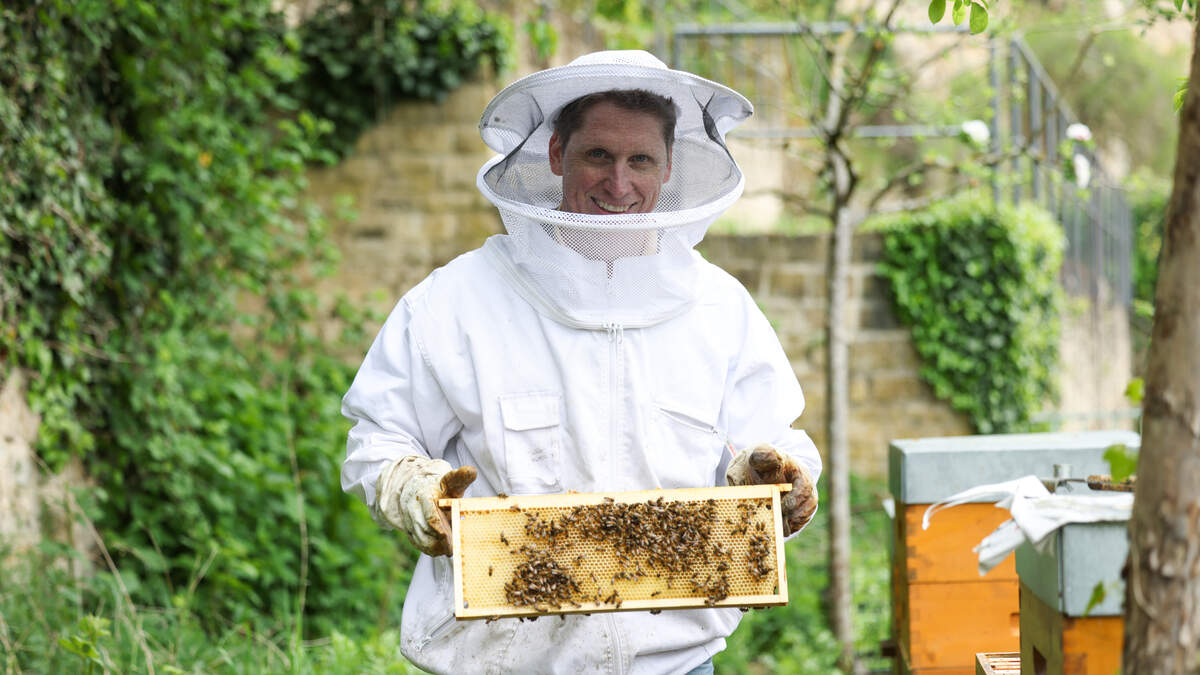
The bee colonies – here with the color-coded queen – are Geoffroy’s pride and joy. He would like to make a living from beekeeping full-time, but for now it’s too risky for him. © Photo credit: Eva Krins
The association natur&ëmwelt operates a nationwide advice hotline (29 04 04-333). Residents of Luxembourg City can use a dedicated hornet hotline (4796-3839) or report nests by email at vespavelutina@vdl.lu or via the CityApp. The city will remove nests free of charge.
Vigneron, who works as an IT expert and runs the beekeeping operation as a side business with his father – together managing 120 colonies across Luxembourg and France – hopes one day to make it his main profession. For now, the Asian hornet is one more obstacle. “If this continues,” he said, “there will soon be no safe places left. Then you won’t know where to put the beehives.”
(This article was originally published by the Luxemburger Wort. Translated using AI and edited by Kabir Agarwal.)