Benghazi – Libya’s publishing industry is facing growing economic challenges that have driven up book production costs and retail prices. Publishers depend on imported paper, and printing costs are tightly linked to foreign currency exchange rates as well as shipping and customs fees. These obstacles threaten both the sustainability of local book production and the spending power of Libyan readers.
At the Benghazi International Book Fair, representatives from several Libyan publishing houses shared their views on rising book prices. They spoke about how fluctuating exchange rates, printing expenses, and shipping fees impact the affordability of books. While opinions varied on the benefits of printing domestically versus abroad, all agreed that exchange rates are a key factor in production costs.
Ali Jaber, manager of Al-Jaber Publishing, Printing, Distribution, and Advertising, explained that printing costs are similar in Tripoli, Benghazi, Egypt, and Tunisia because all presses use imported paper. Quality may vary depending on the print shop, but location has little effect on the basic expense. Imported paper, he said, is the main driver of prices.
Jaber noted that books are often priced according to the US dollar on the parallel market. This is because Libyan publishers and bookstores cannot open official letters of credit to import materials, making production costs dependent on unofficial exchange rates.
He provided an example: in 2010, producing a book cost about $5, equivalent to 7.5 dinars at the time. Today, the same dollar amount is nearly 50 dinars, even though book prices have mostly remained stable. Previously, publishers enjoyed higher profit margins, but rising production costs and the strong dollar have reduced revenues.
Jaber added that most Libyan books are still priced lower than those from participating Arab publishers. While some imported books start at 100–200 dinars and can reach up to 1000 dinars, most Libyan titles range from 30 to 50 dinars, with the most expensive rarely topping 80 dinars. Although purchasing power remains a concern, he observed that book prices have increased less than those of many food items.
On shipping, Jaber explained that most Libyan publishers work with printers in Egypt and Tunisia. Contrary to some assumptions, shipping books from Cairo to Benghazi can be cheaper than between some Libyan cities—about 100 dinars per parcel. Meanwhile, sending a parcel from Benghazi to Tripoli may cost even more, depending on available courier services. The main issue with cross-border shipping is the delay, as book shipments might take up to 45 days to arrive. This causes problems for publishers needing to meet exhibition deadlines.
Jaber also pointed out that printing in Egypt gives Libyan publishers more flexibility for participating in Arab and international book fairs. Shipping from Libya to places like Sharjah, Algeria, Istanbul, Jordan, or Syria is costly and logistically difficult due to limited options and reliance on air freight. Printing in Egypt allows publishers to store books there and use Egyptian shipping companies, which reduces logistical burdens.
Hussein Al-Adouli, of Al-Fadhil Publishing, echoed concerns about the impact of a strong US dollar on the cost of printing and book prices. With limited printing presses in Libya, many publishers send work abroad, especially to Egypt or Jordan. Higher foreign currency exchange rates increase printing, shipping, and customs costs, expenses ultimately borne by readers. Because Libyan publishers must secure foreign currency from the parallel market, book prices fluctuate with the dollar.
Saleh Emara of Al-Hadhara Publishing in Tripoli said that printing in Egypt is sometimes cheaper due to lower labor costs and greater choice in paper and binding, including hardcovers. However, he noted that Libyan printers offer higher quality, which raises local production costs. Some publishers still choose Egypt for high-demand books like university textbooks, where affordability is important. Academic works and institutional publications are often printed locally despite their higher costs, owing to superior quality.
Emara explained that the cost of paper and ink is also tied to the dollar. Fluctuations in currency markets are a major reason for rising book costs. Shipping charges have increased even within Libya, mainly due to diesel shortages and higher transport costs between cities.
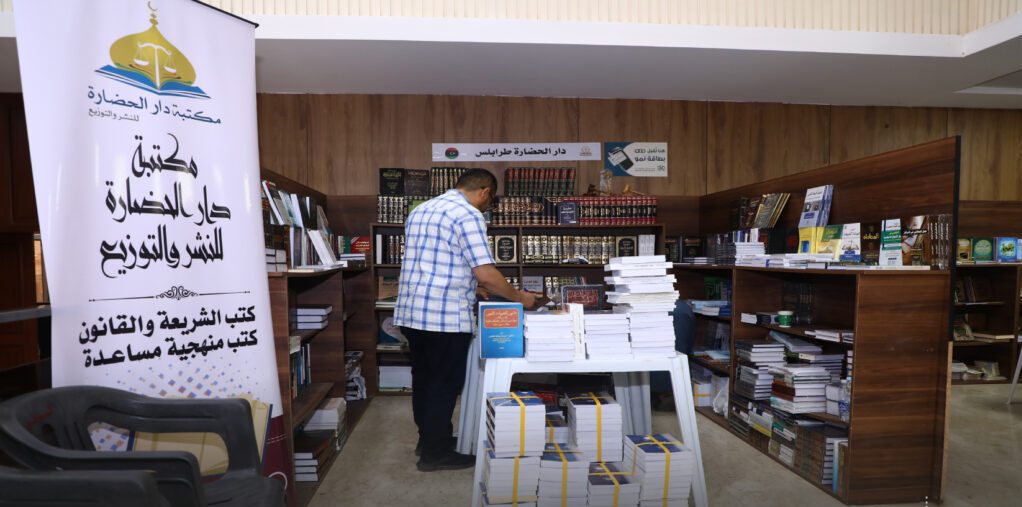
Despite these difficulties, Libyan publishers continue to release new titles and participate in cultural exhibitions. Al-Hadhara, for example, is presenting its first book at the fair: “Studies in Libyan Criminal Legislation and Islamic Jurisprudence” by Professor Mustafa Ibrahim Al-Aradi of the Libyan Academy’s Khoms branch. Another new release by Dr. Magdi Shabaani, “A Study of Jurisdictional Conflicts from a Constitutional Perspective,” will also be on display, along with several other upcoming titles.
The comments of publishing representatives make clear the many factors that affect the price of Libyan books—including reliance on imported paper, unstable exchange rates, labor costs, print quality, and rising logistics fees. Some say the cost of printing is similar at home and abroad due to the need to import paper, while others find foreign printing more economical because of cheaper labor, especially in Egypt. However, many publishers still value the higher local printing quality.
Publishers called for improved access to foreign currency, easier import procedures, and better shipping services to reduce production and distribution costs. Such measures, they said, are critical for the survival and development of Libya’s publishing industry.