Baghdad (IraqiNews.com) – An exclusive report published on Wednesday, June 10, 2026, by Baghdad’s prominent Al-Mada newspaper revealed a rare unified consensus within the ruling Coordination Framework regarding a sweeping, high-stakes economic reform strategy.
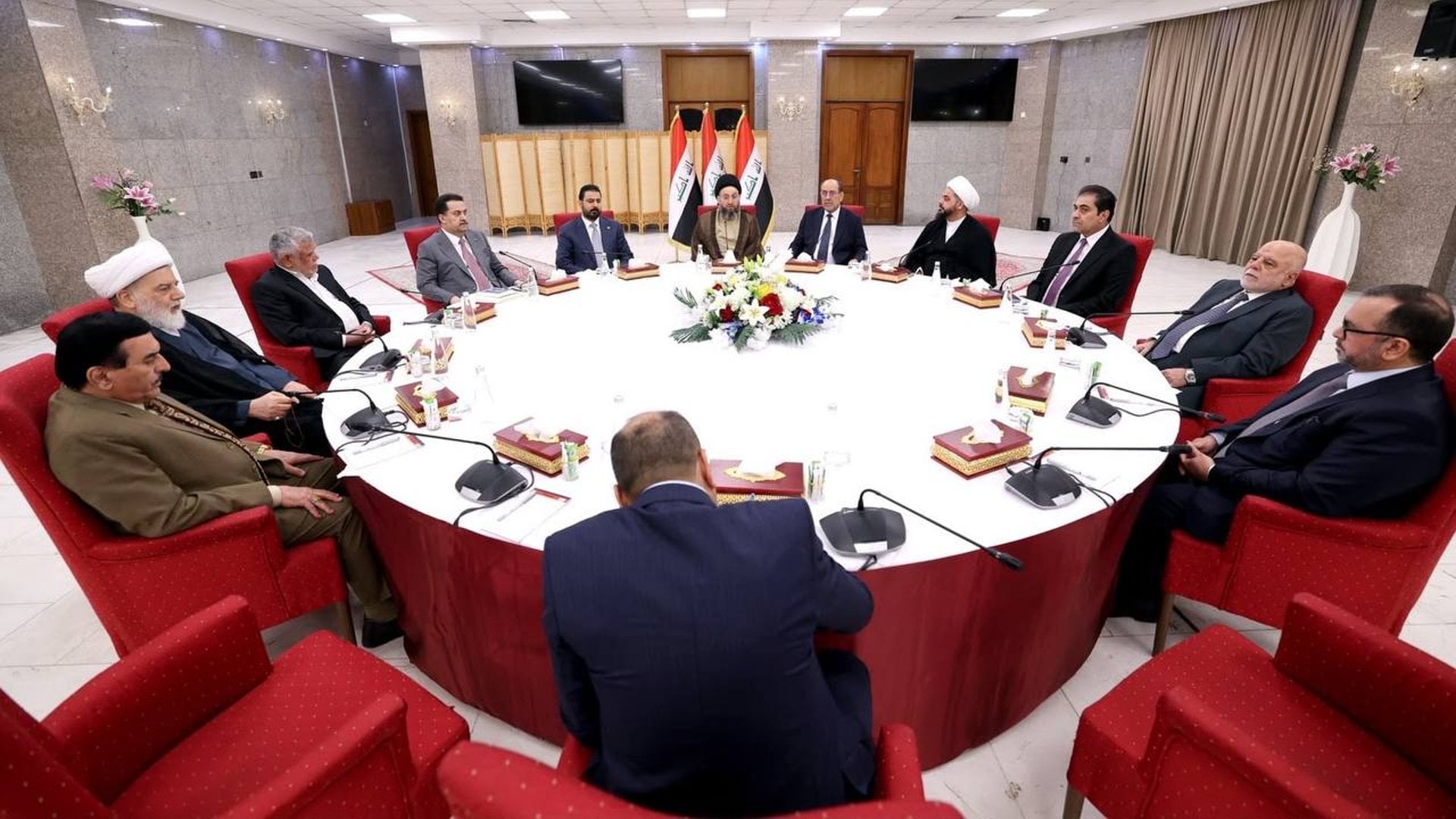
Gathered at the Jadiriyah residence of Wisdom Movement (Al-Hikma) leader Ammar al-Hakim, the major political factions unanimously backed a bold economic blueprint presented by Prime Minister Ali Falih al-Zaidi.
Designed to steer Iraq away from its traditional rentier state framework and historic socialist mentality, the aggressive plan addresses a ballooning $83 billion public debt and introduces stark interventions targeting the US dollar exchange rate, state assets, and public sector graft. The core immediate pillar of the Zaidi administration’s proposal centers on heavy financial re-engineering to control severe operational deficits.
The plan proposes a deliberate upward adjustment of the official US dollar exchange rate, representing a complete pivot from the 2023 policy enacted by the previous administration under Mohammed Shia al-Sudani, which fixed the rate at 1,300 IQD per $100—a stabilization move that critics estimate cost the treasury roughly 15 trillion IQD annually in added deficit spending. The reversal follows warnings from Foreign Minister Fuad Hussein regarding the emergency printing of 25 trillion IQD to sustain current civil service payrolls.
To tackle the staggering $83 billion public debt portfolio—which includes over 96.6 trillion IQD ($73.3 billion) in domestic debt and $10 billion in foreign liabilities—the government plans to transfer the ownership of struggling, debt-ridden state-owned production enterprises to private or collaborative management.
However, this proposed offloading of public property has drawn immediate warnings from domestic economic experts. Nabil al-Marsoumi, professor of economics at Al-Maaqal University in Basra, cautioned that under-regulated privatization in high-corruption environments historically acts as a funnel for state asset destruction rather than fiscal rescue.
Al-Marsoumi highlighted that a severe valuation gap often manifests between an enterprise’s true market worth and its fire-sale price, noting that a state facility valued at over $100 million could easily be offloaded for $25 million, generating a fresh nexus for institutional graft reminiscent of similar asset-liquidation disputes dating back to 2016.
The Prime Minister’s economic strategy relies heavily on a parallel judicial and law-enforcement cleanup to reclaim looted public assets, aiming for an estimated windfall of $50 billion. Reclaiming funds hidden domestically and internationally by past and present senior officials will be orchestrated via the newly established Supreme Integrity Council, bypassing standard bureaucratic delays.
Active precedents have already set this strategy in motion, beginning with the recent arrest of Adnan al-Jumaili, which yielded significant seizures of real estate, cash, and weapons. This was quickly followed by the June 9 sentencing of former MP Jamal al-Karbouli to one year in prison, accompanied by a judicial order to repay $4.5 million stolen from an Iraqi Red Crescent Society Saudi hospital grant.
Whispers within political corridors now hint at the potential questioning of former high-ranking ministers and cabinet chiefs, though factions closely aligned with past administrations dismiss these maneuvers as standard internal Coordination Framework friction.
The Zaidi administration is explicitly linking domestic security to macroeconomic rejuvenation, projecting an influx of $50 billion in direct Western and Arabian Gulf investments. However, international financial institutions and sovereign funds have made these capital injections strictly conditional on Iraq establishing absolute state control over weaponry.
During an executive assembly with provincial governors, Prime Minister al-Zaidi reinforced that neutralizing unauthorized armed factions and implementing unified military integration protocols is non-negotiable. Despite encountering active resistance from certain paramilitary factions refusing state demobilization and integration frameworks, the administration maintains that an open-market economy cannot coexist with fragmented security lines.
Coordination Framework leader Amer al-Fayez confirmed to Al-Mada that the Prime Minister has formally requested broad, expedited legislative mandates from the Council of Representatives to rapidly overhaul the country’s antiquated banking laws and monetary regulations. Al-Fayez noted that while prior governments routinely paid lip service to welcoming international corporations, the current landscape benefits from a higher baseline of domestic security stability combined with an aggressive political will to reshape banking architecture.
Following the conclusion of the Monday evening session, the Coordination Framework released an official communiqué pledging its absolute “legislative, political, and media backing” to ensure the total execution of al-Zaidi’s structural reforms, fast-track the remaining ministerial appointments, and tackle the country’s systemic electricity and labor bottlenecks.