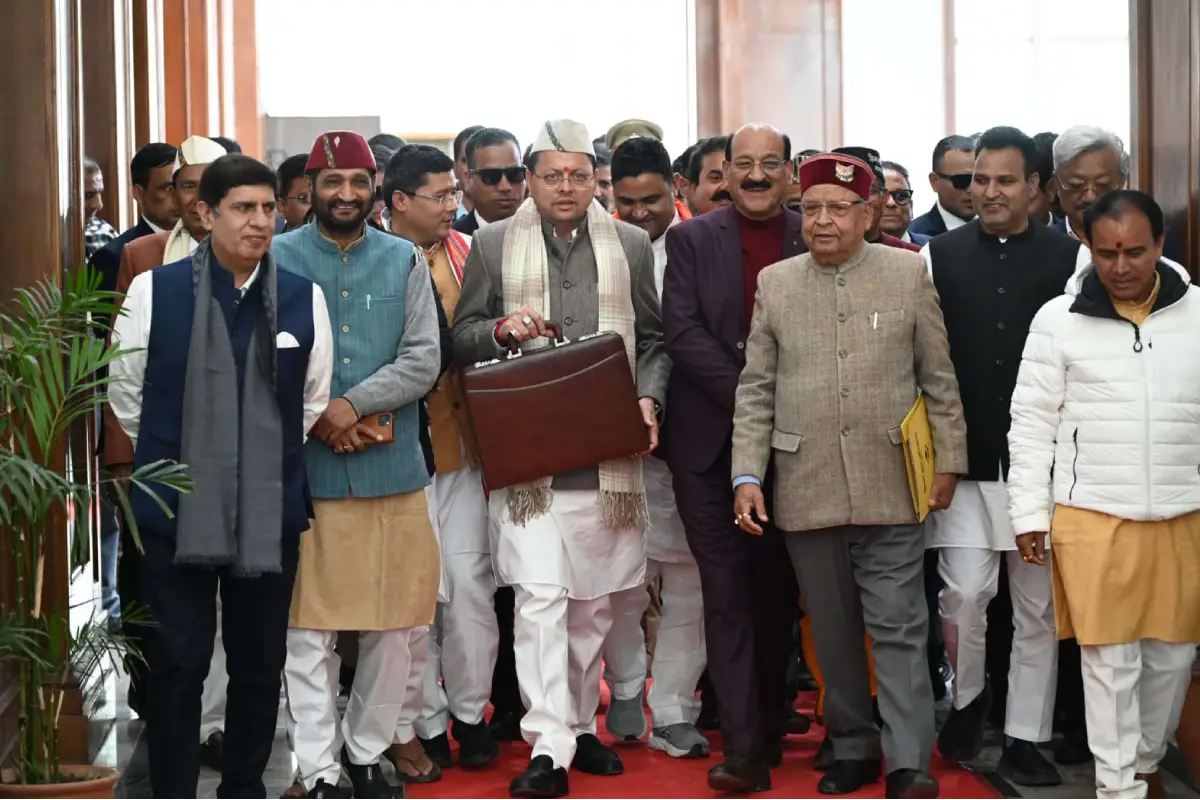
The Uttarakhand government has proposed a supplementary budget of ₹7,844.18 crore for the financial year 2026–27, with a focus on infrastructure development, farmers’ welfare, drinking water supply, urban development and strengthening local bodies. Prepared for the Legislative Assembly session at Bhararisain in Gairsain, the supplementary budget aims to accelerate ongoing development projects and address key infrastructure needs across the state.
Of the total allocation, ₹4,164.32 crore has been earmarked for capital expenditure and ₹3,679.86 crore for revenue expenditure. With the supplementary budget added to the original budget of ₹1,11,703.21 crore, the state’s total budget outlay will rise to ₹1,19,547.39 crore.
₹721 Crore Proposed for Rural and Urban Local Bodies
In a significant provision for grassroots development, the government has proposed increasing the share of state tax revenue allocated to rural and urban local bodies from 10.5% to 12.5%, in line with the recommendations of the Sixth State Finance Commission. An allocation of ₹721 crore has been proposed to strengthen the financial position of Gram Panchayats and urban local bodies and enable them to meet local development requirements.
The supplementary budget also includes ₹500 crore under a special assistance scheme for infrastructure expansion. Around ₹270 crore has been earmarked for the energy sector, including transmission and distribution systems and the Khurpia Farm project. Other provisions include approximately ₹100 crore for Asian Development Bank-funded urban development projects, ₹55 crore for police residential and non-residential buildings, ₹22 crore for judicial infrastructure and ₹5 crore for Panchayat buildings.
For rural connectivity, ₹31 crore has been proposed for the Public Works Department under the Pradhan Mantri Gram Sadak Yojana (PMGSY), including road maintenance, while ₹30 crore has been allocated to the Rural Development Department.
₹1,100 Crore for Procurement of Paddy and Wheat
Farmers’ welfare and strengthening the rural economy feature prominently in the supplementary budget. The government has proposed ₹1,100 crore for the procurement of paddy and wheat from farmers under the food procurement scheme.
To promote climate-resilient agriculture, particularly in rain-fed and hilly regions, ₹70 crore has been allocated for the JICA-assisted Uttarakhand Climate-Resilient Rain-fed Agriculture Project. The government has also proposed approximately ₹35 crore for the Pradhan Mantri Micro Food Processing Enterprises Upgradation Scheme (PMFME), aimed at supporting small food-processing enterprises and improving the value addition of agricultural produce.
Additionally, ₹20 crore has been earmarked for the Deendayal Upadhyay Sahkarita Kisan Kalyan Yojana and ₹9 crore for the Farmers’ Pension Scheme. To diversify rural livelihoods, the budget includes approximately ₹28 crore for the Trout Promotion Scheme and ₹1 crore for a new beekeeping policy. Another ₹9 crore has been proposed for the construction of cattle shelters, known as gau sadans.
These allocations are intended to support agricultural procurement, strengthen cooperative-based assistance, promote local enterprises and expand alternative income opportunities for rural communities.
₹290 Crore for Kumbh Infrastructure, ₹30 Crore for Ganga Corridor
The supplementary budget also prioritises infrastructure for major religious and cultural events. Approximately ₹290 crore has been proposed for facilities related to the upcoming Divya Kumbh in Haridwar.
A further ₹30 crore has been allocated under capital expenditure for the Haridwar–Ganga Corridor project, while ₹20 crore has been proposed for arrangements related to the Nanda Raj Jat Yatra, one of Uttarakhand’s significant religious and cultural pilgrimages.
In the drinking water sector, ₹300 crore has been allocated to address outstanding payments to contractors under the Jal Jeevan Mission and other essential requirements. Another ₹110 crore has been proposed for a KfW-funded project under the Drinking Water Department.
The budget also provides approximately ₹48 crore for interventions addressing land subsidence in Joshimath and other vulnerable areas, highlighting the need to strengthen disaster response and infrastructure resilience in the Himalayan region.
₹122.69 Crore Approved for Ramganga River Dam Project in Gairsain
In a major development for drinking water infrastructure, administrative and financial approval of ₹122.6891 crore has been granted for the construction of a dam on the Ramganga River to supply drinking water to Gairsain in Chamoli district and surrounding areas.
The approval follows an announcement by Chief Minister Pushkar Singh Dhami. According to the government order, the total project cost stands at ₹12,268.91 lakh, including a previously sanctioned amount of ₹24.76 lakh for the first phase.
An initial instalment of ₹2.454 crore has been authorised from the State Contingency Fund to facilitate the commencement of work. The amount will subsequently be adjusted against funds received under the Special Assistance to States for Capital Investment (SACI) scheme for the financial year 2026–27. Further funding for the project is also envisaged under the same scheme.
The project is intended to strengthen drinking water availability in Gairsain and neighbouring areas, address the needs of a growing population and improve long-term water resource management in the hill region.
Strict Quality and Financial Monitoring Mandated
The government order lays down detailed safeguards for the project’s execution, with particular emphasis on construction quality, technical assessment, transparency and financial discipline.
Structural designs and drawings must be examined and verified by a recognised institution. The concerned authorities have also been directed to undertake site inspections, assess soil and geological suitability, and select the most economical and technically viable option for the drinking water scheme.
Construction materials, including cement, steel, sand, gravel, bricks and pipes, must undergo testing in laboratories accredited by the National Accreditation Board for Testing and Calibration Laboratories (NABL), in accordance with applicable Indian standards. Third-party quality inspections have also been made mandatory.
The implementing agency must ensure that the water source can meet the minimum required supply throughout the project’s design life. Arrangements must also be made to maintain an uninterrupted water supply to downstream villages affected by construction, both during implementation and after completion.
To improve accountability, the project site must display an information board carrying details such as the sanctioned cost, approval year, implementing agency, contractor and scheduled completion date. Photographs and videos documenting the work before, during and after construction must be maintained.
The project details must also be uploaded to the PM GatiShakti portal, and the executing agency must sign a memorandum of understanding in the prescribed format. Regular reports on financial and physical progress will be submitted to the government.
The order further requires strict adherence to applicable procurement regulations, including the Uttarakhand Procurement Rules, 2025. Expenditure must remain within sanctioned limits, and any additional work must receive approval from the competent authority. Funds released for the 2026–27 financial year must be utilised by March 31, 2027.
Focus on Long-Term Development in Hill Regions
Chief Minister Pushkar Singh Dhami has reiterated the state government’s commitment to developing essential infrastructure in the hill regions through a planned, transparent and quality-focused approach.
The Ramganga River dam project is expected to strengthen the drinking water infrastructure of Gairsain and surrounding communities, while the wider supplementary budget seeks to support development across agriculture, rural connectivity, energy, urban amenities and public welfare.
Through these additional financial provisions, the state government aims to accelerate ongoing projects, improve access to essential services and create a stronger foundation for sustainable development across Uttarakhand.