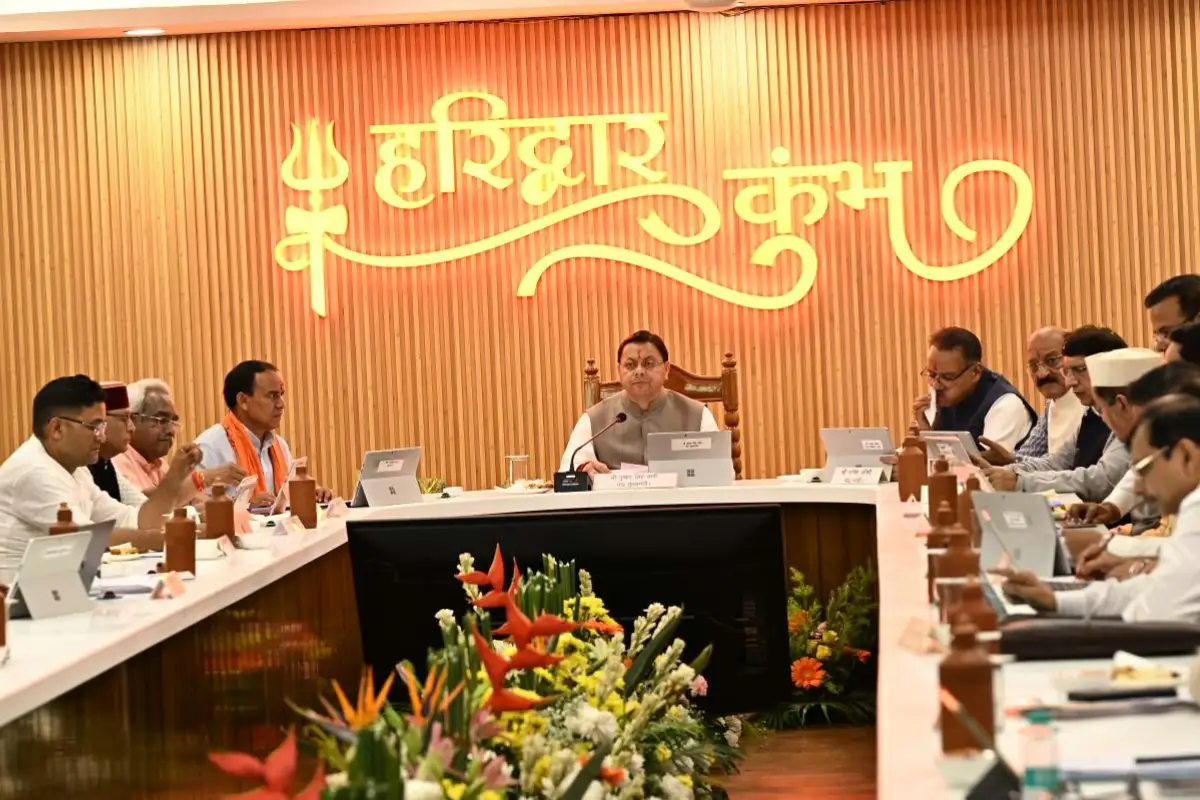
Haridwar, October 12, 2026: The Uttarakhand Cabinet, chaired by Chief Minister Pushkar Singh Dhami, held a meeting at the Mela Control Auditorium in Haridwar on Monday, October 12 and approved a series of key proposals aimed at strengthening infrastructure, improving governance, promoting investment, enhancing disaster preparedness and advancing public welfare.
The decisions include new recruitment rules for retired Agniveers, approval of floodplain zoning regulations, proposed legislation to modernise fire and emergency services, the establishment of a society for the development of an ancient studies and research institute, and the launch of the Mukhyamantri Rajya Bal Veerta Puraskar Yojana to honour courageous children.
The Cabinet also approved amendments to existing laws, extended the tenure of 215 positions under water and sanitation missions, and cleared several administrative and housing-related proposals.
Key Decisions Taken by the Uttarakhand Cabinet
1. Centre’s Support for Uttarakhand’s Development Acknowledged
The Cabinet expressed gratitude to Prime Minister Narendra Modi and the Government of India for their continued support towards Uttarakhand’s overall development. Considering the state’s unique mountainous terrain, border location and strategic importance, the Cabinet also expressed the expectation of continued central assistance in line with the state’s development priorities and requirements.
2. Society Approved in Principle for Madan Mohan Malaviya Institute
The Cabinet granted in-principle approval for the formation of a society to facilitate the development and expansion of the Shri Madan Mohan Malaviya Prachya Shodh Sansthan, located in Rishikul, Haridwar.
The institute is proposed to be developed as a centre for yoga and meditation, Ayurveda studies and research, astrology and oriental studies, fine arts, Hindu studies and philosophy, and spiritual tourism. The initiative aims to promote India’s traditional knowledge systems, ancient sciences, cultural heritage and modern research.
3. Amendment to Investment and Infrastructure Development Law Approved
The Cabinet approved an amendment to Schedule III under Section 49 of the Uttarakhand Investment and Infrastructure Development (Development and Regulation) Act, 2023.
Under the proposed provision, 92 per cent of the proceeds generated through the disinvestment and monetisation of assets belonging to public agencies, local bodies, state public-sector undertakings and financially autonomous institutions will be allocated to the respective public agencies.
The measure is intended to improve asset management and accelerate infrastructure development across the state.
4. Second Uttarakhand Jan Vishwas Amendment Bill, 2026 Cleared
The Cabinet approved the introduction of the Second Uttarakhand Jan Vishwas (Amendment of Provisions) Bill, 2026, in the state Legislative Assembly.
The proposed legislation seeks to improve the ease of doing business by decriminalising certain minor offences, replacing criminal penalties for minor technical and procedural violations with civil penalties and administrative action, and removing obsolete and unnecessary legal provisions.
The initiative is aimed at simplifying regulatory processes and creating a more business-friendly environment.
5. Uttarakhand Floodplain Zoning Regulations, 2026 Approved
The Cabinet approved the Uttarakhand Floodplain Zoning Regulations, 2026, to regulate land use and development activities in flood-prone areas.
The regulations will establish detailed procedures, standards and mechanisms for implementing the Uttarakhand Floodplain Zoning Act, 2012.
The objective is to preserve the natural flow of floodwaters while reducing risks to human life, property and critical infrastructure.
6. Third Session of the Fifth Uttarakhand Assembly Approved
The Cabinet approved convening the third session of the Fifth Uttarakhand Legislative Assembly in 2026.
Chief Minister Pushkar Singh Dhami has been authorised to decide the date and venue of the session.
7. Uttarakhand Fire and Emergency Services Bill, 2026 Cleared
The Cabinet approved the introduction of the Uttarakhand Fire and Emergency Services Bill, 2026, in the Legislative Assembly.
Prepared in line with the Government of India’s Model Fire Service Bill, 2019, the proposed legislation seeks to overhaul the existing legal framework governing fire services.
The move aims to strengthen emergency response capabilities in view of expanding industrial activity, rapid urbanisation, disasters and the growing risk of fire-related incidents.
8. New Recruitment Rules for Retired Agniveers Approved
The Cabinet approved the Uttarakhand Horizontal Reservation Rules, 2026, for the employment of retired Agniveers in direct recruitment to uniformed Group C posts under state services.
The earlier rules, introduced in 2025, provided 10 per cent horizontal reservation for retired Agniveers, along with relaxations in the maximum age limit and physical efficiency test requirements.
The new rules will supersede the previous framework and incorporate revisions in line with the latest Central Government guidelines. The approved changes include relaxations in the written examination and physical standards test.
The decision is intended to facilitate the recruitment and rehabilitation of former Agniveers into state government services.
9. Financial Powers in the Culture Department Revised
The Cabinet approved an amendment to the relevant provisions of Volume I of the Uttarakhand Financial Handbook concerning the delegation of financial powers.
Under the amendment, the Director, Art and Culture Department, will be replaced by the Director General, Directorate of Culture, Uttarakhand, as the designated head of the department for the relevant financial powers.
The change is intended to align financial authority with the department’s existing administrative structure.
10. Tenure of 215 Swajal and Water and Sanitation Mission Posts Extended
The Cabinet approved the continuation of 215 positions under the Project Management Unit of the Swachh Bharat Mission (Gramin), Swajal and the State Water and Sanitation Mission for the period from March 1, 2026, to February 28, 2027.
The positions include 189 posts under Swajal and 26 under the State Water and Sanitation Mission.
The salaries and honoraria of the personnel concerned will continue to be paid by the State Water and Sanitation Mission, as before.
11. Relaxation Granted for Access Road to Affordable Housing Project in Haridwar
The Cabinet approved a relaxation in the minimum prescribed width of the access road for a proposed affordable housing project in Sisona village, Bhagwanpur tehsil, Haridwar district.
The project, spread over approximately 8.1169 hectares, is proposed in line with the Pradhan Mantri Awas Yojana and the housing policies of the Central and state governments.
For approval of the project’s layout plan, a relaxation of three metres has been granted, allowing the existing six-metre-wide access road in place of the prescribed nine-metre-wide road.
12. Correction in Land Survey Number Approved in Udham Singh Nagar
The Cabinet approved the correction of an error in the survey number recorded in a government order dated November 10, 2023, concerning the conversion of 24,280 square metres of land from industrial to residential use in Bhauna Islamnagar village, Bajpur tehsil, Udham Singh Nagar district.
The incorrectly recorded survey number 321/1A will be replaced with the correct number, 321/2A.
13. Mukhyamantri Rajya Bal Veerta Puraskar Yojana Approved
The Cabinet approved the Mukhyamantri Rajya Bal Veerta Puraskar Yojana to recognise and honour courageous children across Uttarakhand.
The scheme will recognise children who demonstrate exceptional courage, bravery, perseverance, humanitarian concern and the ability to act decisively in challenging circumstances.
The initiative aims to encourage such children and make their actions a source of inspiration for others.
Focus on Development, Governance and Public Welfare
The Cabinet’s decisions reflect the Uttarakhand government’s focus on infrastructure development, regulatory reforms, disaster preparedness, employment opportunities for retired Agniveers, cultural and research initiatives, and welfare-oriented schemes.
Several proposals will now move to the next stage of implementation, including bills to be introduced in the Legislative Assembly and administrative measures to be carried out by the concerned departments.