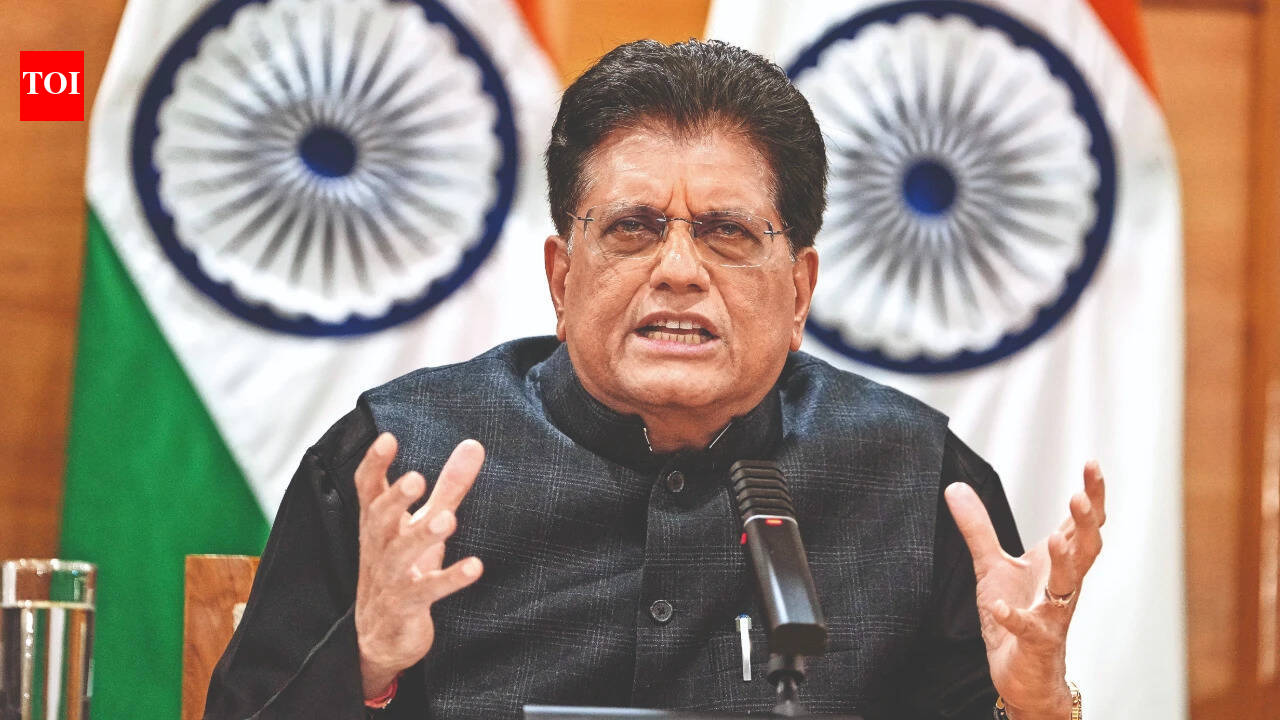
File photo: Union commerce minister Piyush Goyal Union commerce and industry minister Piyush Goyal on Wednesday said India was working to rebuild its relations with China, while stressing that the future of the engagement remained open.He also said India was willing to enter into joint ventures with any country, provided it received a fair deal and there was continuity in engagement.“We are open to all countries around the world as long as we get a fair deal, as long as we ensure continuity in the engagement, and as long as the geopolitical situation does not deteriorate. I think we had some concerns in the past. We are working to develop relations with China once again, but the last word has not yet been scripted on this journey,” Goyal said at the Bloomberg New Economy event, according to news agency PTI.His remarks come as China remains India’s second-largest trading partner, with bilateral trade increasing in the last financial year even as the trade deficit widened.
India-China trade grows, deficit widens
Bilateral trade between India and China rose 7.9% to $151.10 billion in 2025-26, up from $118.39 billion in 2024-25.India’s exports to China grew 36.62% to $19.47 billion during the last fiscal year, compared with $14.25 billion a year earlier. Imports from China increased 16% to $131.62 billion.India’s trade deficit with China widened to $112.16 billion in 2025-26 from $99.21 billion in the previous financial year. The deficit remains an area of concern for India.Investment is another issue in bilateral ties. India has tightened its foreign direct investment (FDI) policy for countries that share a land border with it, including China.Prime Minister Narendra Modi met Chinese President Xi Jinping on September 12, on the sidelines of the Brics Summit.
Goyal flags supply-chain vulnerabilities
Speaking about the broader geopolitical environment, Goyal said partnerships with other countries would become increasingly important.“Everybody has recognised the importance of friends, and that’s going to be the most important critical element in the years to come,” he said.Recalling the Covid-19 pandemic, the minister said India had focused on self-reliance after facing difficulties in securing essential supplies from other countries.He said India had provided food grains and vaccines to more than 100 countries during the pandemic, but had itself faced shortages when global supply chains were disrupted.“During Covid, we really recognised the vulnerabilities that a nation like India, a large nation of 1.4 billion people, had to go through when supply chains were broken. We did not get adequate material for meeting our needs during Covid. Wherever we had placed orders for personal protective equipment or Covid kits or vaccines, we were let down miserably by all countries,” Goyal said.He also alleged that Western countries had refused to supply vaccines made by Pfizer and Moderna to India.“When we needed Pfizer and Moderna vaccines, the West refused to give it to us… They even refused to make an application to get the vaccine into the Indian market, even though we were willing to waive all the conditions. So, it’s a global phenomenon,” he said.Goyal said these experiences prompted Prime Minister Narendra Modi to give the call for Atmanirbhar Bharat, or self-reliant India.
India and Singapore discuss semiconductor cooperation
At the same event, Singapore’s deputy Prime Minister and minister for energy, trade and industry Gan Kim Yong said the two countries were discussing ways to strengthen India’s semiconductor industry.“We are also working on training and skilling of the Indian workforce so that we can support the growth of semiconductors,” he said, according to PTI.The India-Singapore trade pact came into force in 2005.Goyal also spoke about India-US relations at the event, describing the partnership as substantive and saying it would improve regardless of changes in political thinking in either country.He said the relationship extended beyond trade to defence, technology, critical minerals and people-to-people ties.The two countries are also negotiating a bilateral trade agreement, with discussions continuing over market access and tariffs.