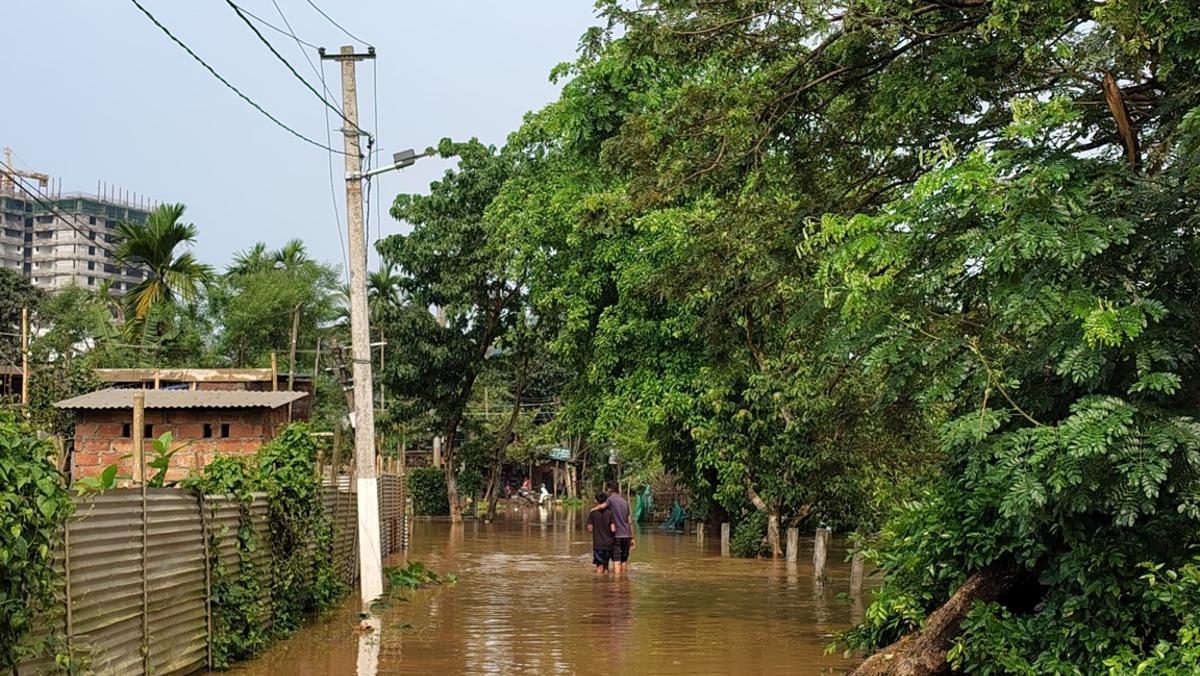
Every monsoon, Guwahati offers the country an uncomfortable lesson it keeps refusing to learn. Low-lying neighbourhoods are swallowed by floodwater. Traffic grinds to a halt on arterial roads. Families haul their belongings to upper floors, following rituals perfected over generations.
And somewhere in a government office, an official explains that the solution—a larger pump, a wider drain, a completed stretch of elevated road—is nearly ready. It has been nearly ready for about thirty years.
The story of flooding in Assam’s capital is not, at its core, a story about inadequate infrastructure. It is a story about a particular kind of civic ambition that has consistently overpromised and underdelivered, and about the gap between how cities imagine themselves and how they actually function under pressure.
How Guwahati made itself vulnerable
The Bharalu river, now reduced to a silted, sewage-choked drainage channel running through the city’s heart, was once a living waterway. The wetlands surrounding Guwahati, including Deepor Beel—internationally recognised under the Ramsar Convention—performed a function no engineering project has successfully replicated: absorbing the enormous volumes of water that the Brahmaputra basin receives during the monsoon months.
As the city expanded rapidly following its designation as Assam’s capital in 1972, these natural buffers were systematically destroyed. Wetlands were sold, drained, and built upon without coordinated drainage planning. Construction preceded infrastructure rather than following it.
The consequences were predictable in retrospect: by the 1990s, seasonal flooding of devastating intensity had become a permanent feature of life for hundreds of thousands of residents.
This is not a story unique to Guwahati. It is, in fact, the foundational error of rapid urbanisation across South and Southeast Asia—the assumption that natural systems can be replaced by engineered ones without cost or consequence.
The infrastructure that wasn’t, and what actually works
When national funds arrived under India’s urban renewal programme in 2005, Guwahati did what cities in its position inevitably do: it reached for the standard playbook.
Engineers designed an integrated drainage network premised on control, collection, and conveyance of stormwater. The 2009 Master Plan envisioned nothing less than a transformation of Guwahati into a globally competitive city.
The problem was structural, not technical. Large drainage systems cannot restore destroyed wetlands. Fixed infrastructure is, by definition, designed for anticipated conditions—and the conditions that accompany serious monsoon flooding are precisely those that exceed anticipation.
When the Bharalu overflows, pumps designed to drain water back into it become inoperable. On at least one documented occasion, a flooded neighbourhood remained waterlogged for three to four days because the technician who operated the drainage pumps was unavailable. The modern city, it turns out, is only as resilient as its most junior employee.
What has actually reduced flood damage in Guwahati over the past decade is unglamorous by design. Mobile, trolley-mounted pumps deployed by the Water Resources Department offer flexibility that fixed systems cannot: they go where the water is.
Elevated roads, micro-drainage channels, and mandated rainwater harvesting on larger properties have incrementally reduced the intensity of floods in neighbourhoods once considered perpetually at risk.
The more significant adaptations, however, have come not from the state but from residents themselves. Across the city, households have reorganised their domestic lives vertically—ground floors are now given over to parking and storage, with living quarters relocated above the flood line.
Businesses no longer stock goods at street level. In the informal settlements along the Brahmaputra’s banks, indigenous building traditions have proven their worth: homes on bamboo stilts and roads of bamboo matting that rise with the floodwaters rather than disappear beneath them.
These adaptations are practical, scalable, and evidence-based. They are also almost entirely absent from official flood governance frameworks.
The state continues to invest in the language and aesthetics of modern infrastructure even as its residents quietly develop a parallel, more modest architecture of resilience.
The politics of visibility—and a city ahead of its time
This divergence is not accidental. Large infrastructure projects offer something that bamboo stilts and mobile pumps do not: political visibility. Ribbon-cutting ceremonies, foundation-laying events, and inaugurations of pump stations serve important functions in democratic politics. The modest, adaptive, community-level responses that have proven effective in Guwahati offer none of these rewards.
The cost of this preference is borne, as it usually is, by those least able to absorb it. Large drainage projects have historically displaced peri-urban farming and fishing communities, destroyed the wetlands that provide free flood-mitigation services, and concentrated risk among lower-income residents who cannot afford to restructure their homes or relocate to higher ground.
The politics of infrastructure, in other words, routinely externalises the costs of failure onto those with the least political voice.
Researchers studying Guwahati’s flood governance have framed the city’s predicament in terms of two competing worldviews.
The first holds that nature can be understood, predicted, and controlled through sufficiently sophisticated engineering. The second accepts that hydrological systems are inherently unpredictable, that absolute control is an illusion, and that resilience requires flexibility rather than scale.
State actors, for the reasons described above, gravitate towards the first position. Academics, community organisations, and ordinary residents—those who live with the consequences of floods rather than managing them at a remove—have increasingly, if implicitly, adopted the second.
What makes Guwahati instructive is that it has not had the luxury of remaining committed to the first worldview. Under-resourced and largely peripheral to national infrastructure investment, the city has been forced to improvise.
The result is a heterogeneous, pragmatic patchwork—pumps alongside stilts, elevated roads alongside bamboo matting, state interventions alongside community adaptations—that, for all its apparent disorder, may constitute a more honest response to the problem of urban flooding than the tidy diagrams in any master plan.
Dhaka’s flood barriers are sinking. Jakarta’s sea wall has attracted criticism as an expensive gesture. River delta communities across Bangladesh and Vietnam are moving towards adaptive, distributed approaches and away from monolithic engineering solutions.
Guwahati, arriving at this conclusion through necessity rather than design, may find itself unexpectedly ahead of the conversation.
The city has not solved its flooding problem. But it has, perhaps, begun to ask more honest questions about what a solution would actually look like—and who would bear its costs if it failed.
That, in a country building cities at extraordinary speed, may be the most important contribution Guwahati makes next.
Also Read: Why has India’s dairy boom bypassed Mizoram?
Amit Kumar
Reporter, EastMojo
You just read a story that took days to report. Help us keep our reporters on the ground in the Northeast.
For Rs 83/month – less than a cup of coffee
Ad-free reading, support and keep important stories alive
Become a Member
OR
Support once (any amount)
or
Scan to pay via UPI