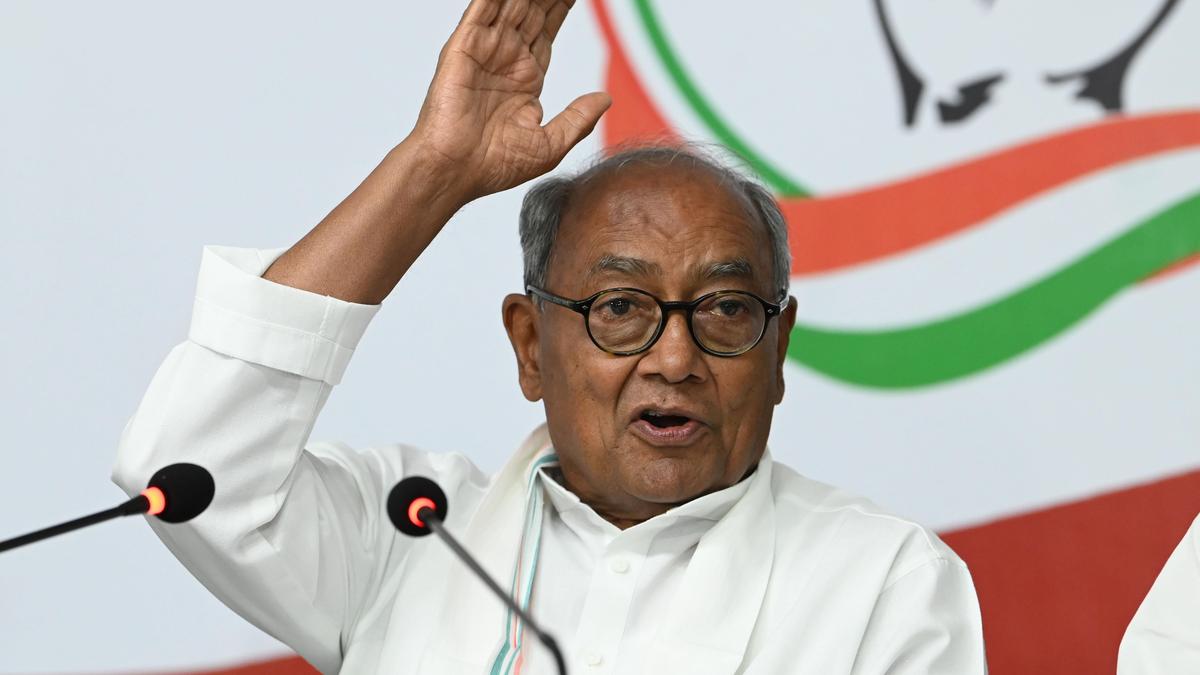
File photo of Congress leader and chairman of the Parliamentary Standing Committee on Education, Women, Children, Youth and Sports Digvijaya Singh.
| Photo Credit: The Hindu
Urging the government not to implement the three-language policy for Class IX CBSE students in the ongoing session, senior Congress leader Digvijaya Singh, in a letter to Prime Minister Narendra Modi, said enforcing the policy without adequate teachers, textbooks or transition time was likely to create ‘serious disruption’.
Mr. Singh, who also heads the Parliamentary Standing Committee on Education, Women, Children, Youth and Sports, compared implementation of this policy midway through the session with the “hasty implementation of CBSE’s On-Screen Marking System.”
He said he had received several letters from parents who had flagged genuine challenges in implementing the policy. “The sudden enforcement of this policy mid-session — without adequate teachers, textbooks, or transition time — is likely to create serious disruption, not unlike the chaos witnessed during the hasty implementation of CBSE’s On-Screen Marking (OSM) system, which adversely impacted lakhs of students across the country,” the Congress leader said.
Also Read : Language decorum: On the three-language formula in CBSE schools
Mr. Singh pointed out that the CBSE’s governing body, in its meeting in December 2025, had ratified the Curriculum Committee’s recommendation that ‘schools continue with the existing Scheme of Studies, especially with regard to language, until the release of graded textbooks of languages by NCERT’. Overriding the Governing Body’s decision, the CBSE issued a circular on May 15, 2026, asking for the implementation of third-language instruction in Grade IX from July 1, 2026. The NCERT, he said, had not yet released graded textbooks of language, and the CBSE had, therefore, recommended the use of the NCERT’s Grade 6 textbooks.
“It is not clear how and why the CBSE has so evidently overturned its Governing Body’s decision and in a way that threatens the academic planning of thousands of schools across the country,” Mr. Singh wrote. He further argued in the letter that the situation was particularly untenable for students in the Southern and North-Eastern States, where Hindi was not spoken and local tribal languages might not feature in the CBSE’s recognised language list.
Sanskrit had emerged as a popular third-language choice for many schools, but it should also be noted that there was a severe shortage of qualified Sanskrit teachers and appropriate textbooks, a situation that would defeat the very purpose of promoting this beautiful language, he said.
Published – June 07, 2026 10:10 am IST