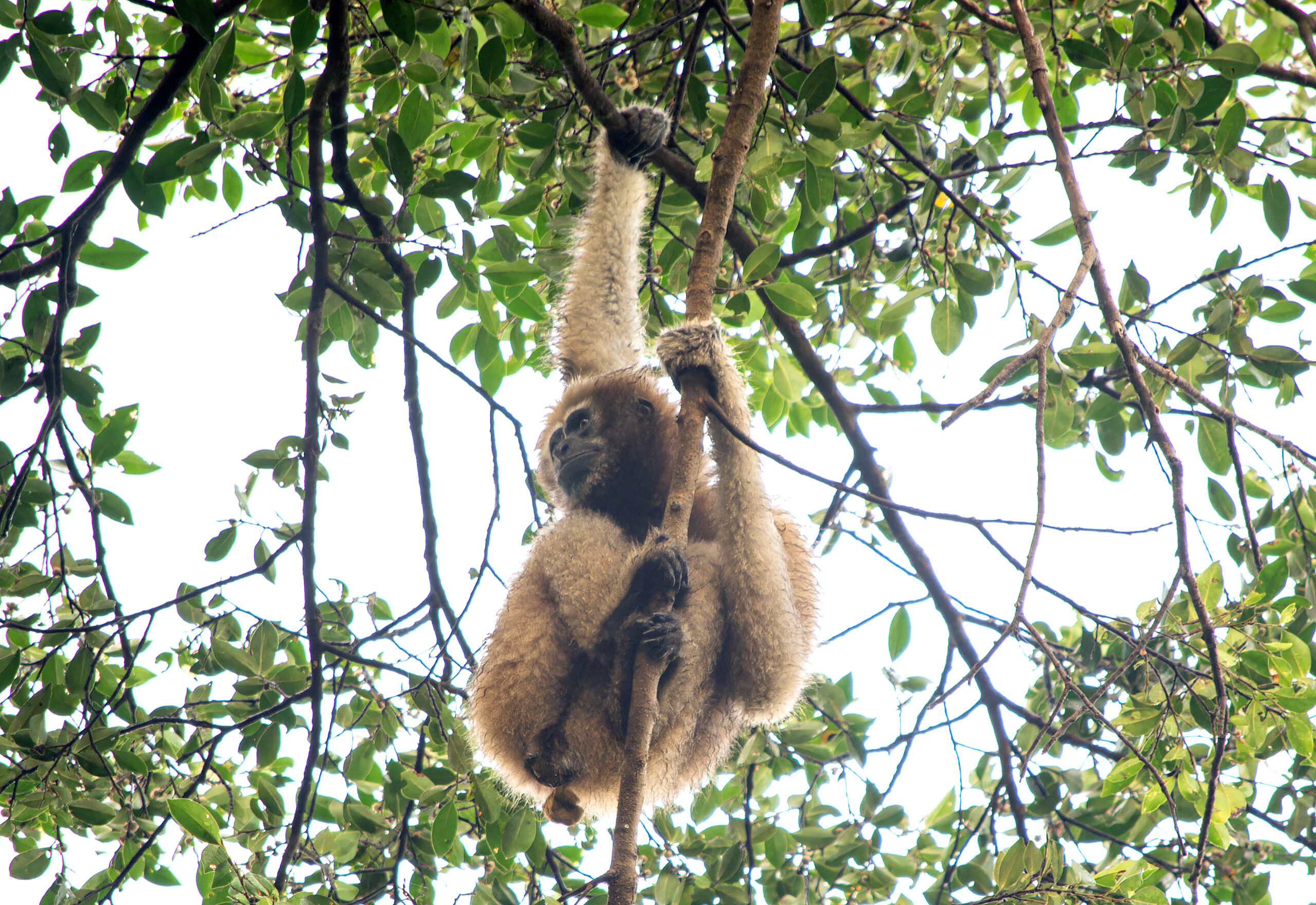
Guwahati: Deep inside the forests of southern Assam, the haunting calls of the hoolock gibbon still echo—but no longer across the vast stretches they once did.
A new study by Amir Sohail Choudhury, along with Nazimur Rahman Talukdar, Parthankar Choudhury, and Deborah Daolagupu, reveals a stark reality: only a fraction of Barak Valley and Dima Hasao now offers suitable habitat for India’s only ape.
Using satellite data, field surveys, and advanced modelling, the researchers mapped where these elusive primates can survive—and where they no longer can.
The study recorded around 250 hoolock gibbons in 88 groups, with an average group size ranging from 2.14 to 3.4 in selected areas of Barak Valley and Dima Hasao.
Since the surveys did not cover the entire region, the actual population may be higher. Historical estimates, however, underline a far sharper long-term decline.
In 1979, John G. Tilson estimated as many as 16,700 gibbons in Barak Valley alone, a figure now considered outdated.
A more conservative estimate by Anwaruddin Choudhury in 1996 placed the population at 1,100 to 1,300 in Barak Valley and 600 to 700 in Dima Hasao—numbers that continue to serve as a baseline.
Today, the habitat itself is shrinking. At best, just over 31% of the landscape remains suitable, dropping to around 16% under stricter ecological conditions, according to the study.
The message from the research is clear: gibbons require dense, uninterrupted forests to survive. “Denser forest cover with minimal human disturbance is essential for suitable habitat,” the authors note, pointing out that forest canopy is the single most critical factor influencing their presence.
Not every green patch counts—fragmented or degraded forests simply cannot support these canopy-dependent primates.
At the same time, the study highlights intensifying human pressure on these habitats. “The probability of gibbon presence decreases with increasing anthropogenic disturbance,” it states, linking roads, settlements, and land-use changes directly to their decline. Expanding agriculture, highways cutting through forests, and monoculture plantations such as tea, rubber, and areca are steadily reshaping the landscape, pushing gibbons into smaller, more isolated pockets.
Southern Assam, part of the Indo-Burma biodiversity hotspot, remains one of the last strongholds of the species in India. But that stronghold is under growing strain. Forest loss and fragmentation are steadily reducing viable habitat, leaving behind disconnected patches instead of continuous stretches of forest.
Beyond highlighting the crisis, the study also offers a way forward. “This work can serve as a foundation for future conservation planning and habitat management,” the researchers state, stressing the need to prioritise forest protection, reduce human disturbance, and identify overlooked forest patches that still support gibbon populations.
The hoolock gibbon is more than just a species—it is a signal of forest health. Where it thrives, ecosystems remain intact. Where it disappears, something has already gone wrong.
In southern Assam, that signal is fading. The forests are still there—but for the gibbons, much of it is no longer home.
Also Read: Tipra Motha Tsunami: Five takeaways from TTAADC polls
Roopak Goswami
Reporter, EastMojo
You just read a story that took days to report. Help us keep our reporters on the ground in the Northeast.
For Rs 83/month – less than a cup of coffee
Ad-free reading, support and keep important stories alive
Become a Member
OR
Support once (any amount)
or
Scan to pay via UPI