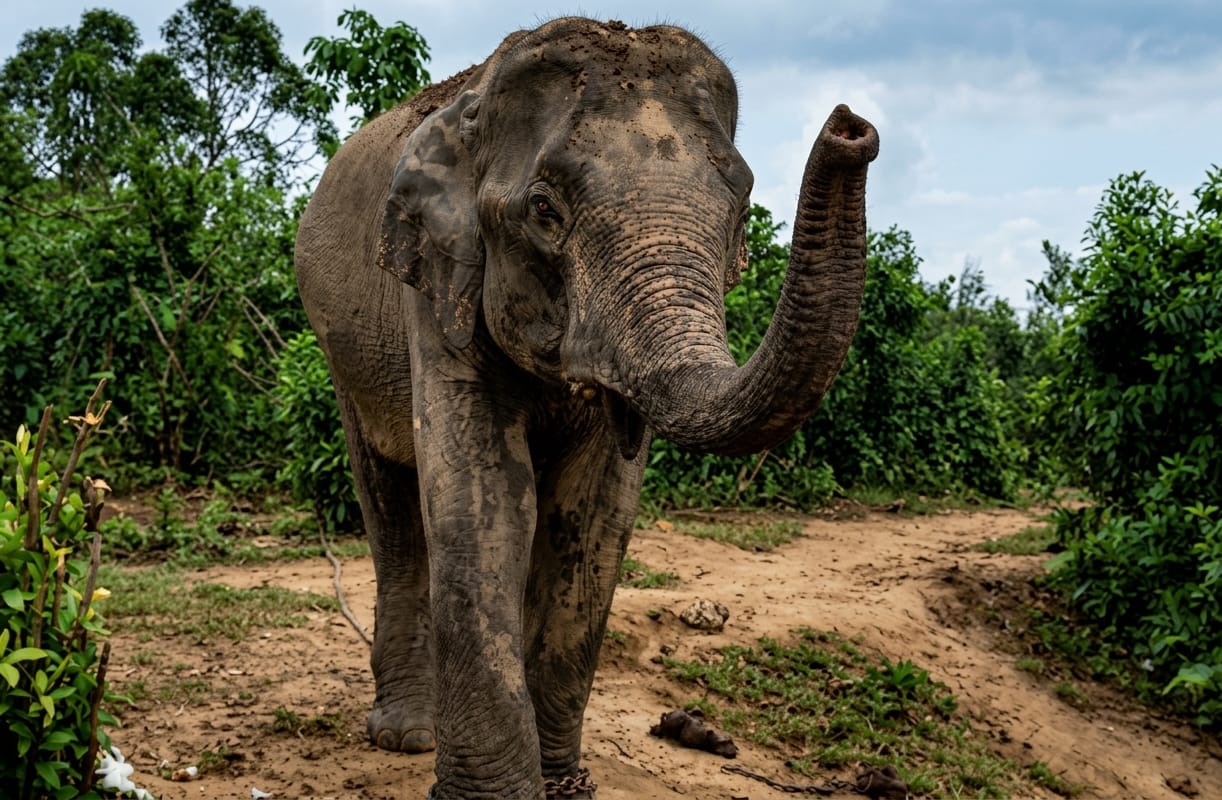
Dibrugarh, Apr 20: Once again, organised wildlife crime against elephants has come to light in eastern Assam’s Tinsukia district. Suspected poachers removed both tusks from a domesticated elephant named Mangal Singh on April 15.
The incident took place in the Lakhipathar forest area under the Digboi Forest Division.
The incident, which came to light late, has sparked widespread outrage and prompted authorities to launch a high-level investigation.
“How is it possible that the tusks were removed without administering anaesthesia to the animal? We suspect that many people are involved in this nefarious act. It is highly suspicious and has once again raised serious questions about the forest department,” said a source.
PREMIUM STORIES FROM EASTMOJO
2000+ readers have backed us to keep journalism free. You can too.
SUPPORT US
The attackers are believed to have taken advantage of heavy rainfall during the night of April 15 to execute the operation, sawing off both tusks while the animal was still alive before fleeing the scene.
According to Mahout Latu Moran, the elephant had been kept in the area for grazing over the past two years by its owner where the incident occurred.
The elephant, considered one of the oldest in the district, belonged to Hunjoy Duaniya.
“Hunjoy Duaniya and caretaker Latu Moran were summoned and interrogated as part of the ongoing investigation,” said the source.
Principal Chief Conservator of Forests (PCCF) Sandeep Kumar said the case was being treated as a top priority due to widespread public concern and assured a strong, result-oriented probe.
Wildlife activist Debojit Moran questioned the role of the forest department. “We suspect that the whole incident has been staged. Some forest officials may also be involved. It appears to be part of a larger wildlife nexus, carried out in an organised manner to conceal facts. Taking advantage of Bihu, the crime was executed by wildlife criminals,” he said.
“We demand an impartial inquiry into the incident and urge all environmental groups to raise their voices against organised wildlife crime occurring in parts of eastern Assam,” Moran added.
Forest officials said that while the injured elephant was located on April 15, official intimation only reached the division on April 16. Authorised veterinary treatment was not provided until April 17, meaning the animal had been bleeding for nearly three days.
Officials confirmed that a formal case has been registered under the Wildlife (Protection) Act, 1972. Authorities have since launched a comprehensive investigation, deploying field teams and expanding surveillance in and around the Upper Dehing Reserve Forest.
Sources said ivory smuggling is an organised crime involving multiple actors motivated by financial gain. The illegal trade is not limited to India but forms part of a larger international network.
“Now the elephant Mangal Singh has been kept in Dholijan. The animal is having difficulty eating, and veterinarians are keeping a close watch on its health,” said a forest official.
In a separate incident, a 13-month-old elephant calf died on Sunday in the Kumsang Reserve Forest under the Doomdooma Forest Division in Tinsukia, triggering allegations of negligence and a possible nexus involving veterinarians who conducted a free treatment camp.
According to reports, the calf, named Lakhmini, was treated a day earlier at a veterinary camp organised in collaboration with Wildlife SOS.
Locals have alleged that the animal was administered an expired injection, leading to its death, though officials said the exact cause will be confirmed only after a post-mortem examination.
Also Read: Assi and the unsettling question of what society has become