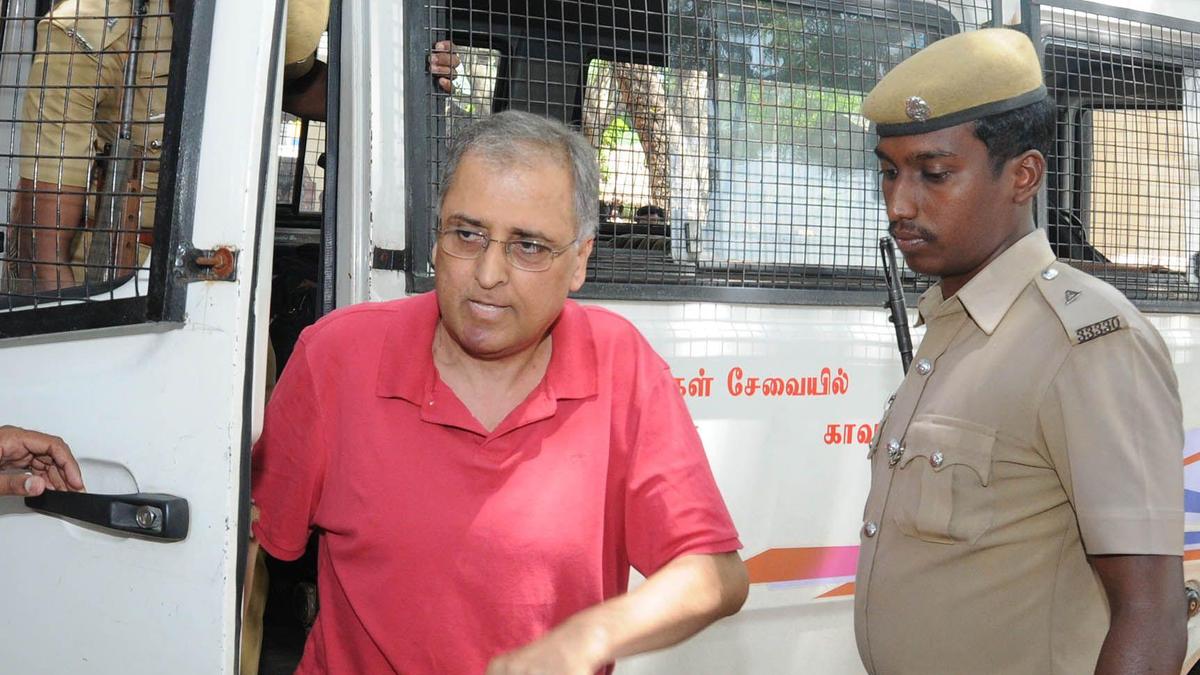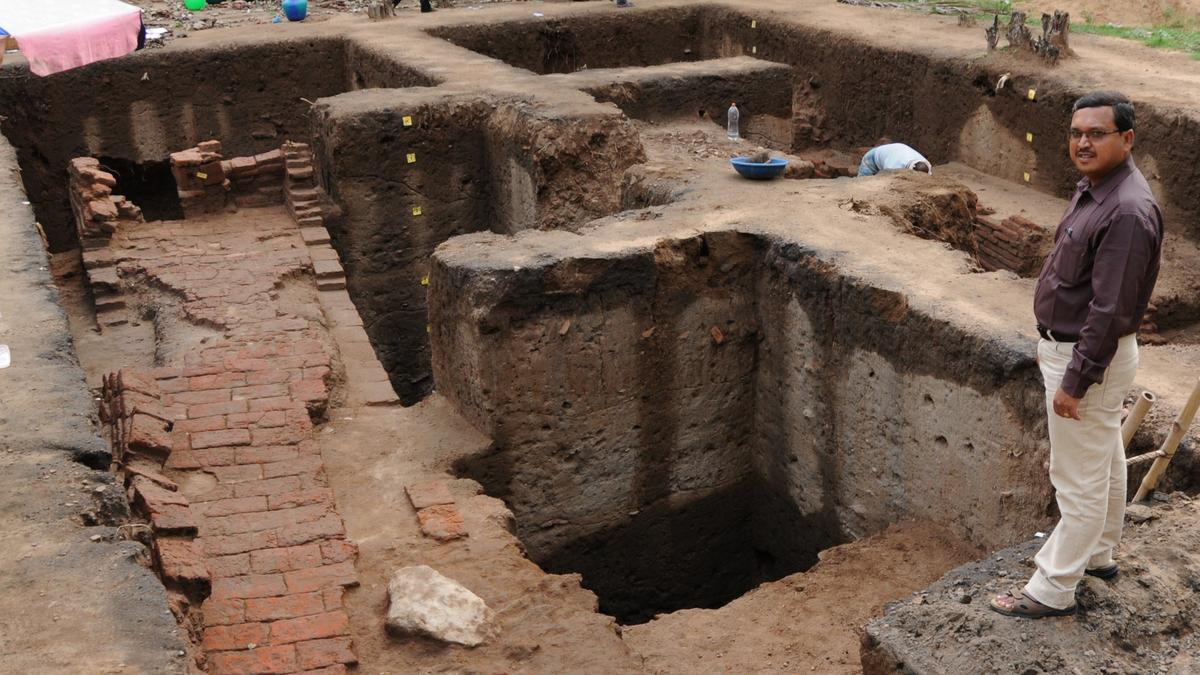
K. Amarnath Ramakrishna at the Keezhadi excavation site. File photo
| Photo Credit: R. Ashok
Archaeologist Amarnath Ramakrishna says he stands by his report on the excavations at the ancient site of Keezhadi in Sivaganga district. In his response to the Archaeological Survey of India (ASI), which had requested that he rewrite and resubmit his report, Mr. Ramakrishna firmly defended his conclusions.
“The view expressed by you regarding further examination of the sequence is against the well-reasoned and conclusive findings of the excavation at the site,” he wrote in a letter to Hemasagar A. Naik, Director (Exploration and Excavation) at the ASI.
Mr. Naik had cited suggestions made by two experts and asked Mr. Ramakrishna to revise his report by incorporating the necessary corrections, in order to proceed further.
Chronology of the Keezhadi excavation
According to Mr. Naik, the three chronological periods identified in the excavation require proper nomenclature or re-orientation. Additionally, the proposed time bracket for Period I (8th century BCE to 5th century BCE) requires more concrete justification.
Mr. Ramakrishna, who led the Keezhadi excavation, clarified in his response that he had already accepted the suggested changes in nomenclature and had communicated them to the ASI in a letter dated April 10, 2023.
“The chronology of the Keezhadi excavation has been evaluated in accordance with standard archaeological procedures. The periodization of the site was reconstructed based on stratigraphic sequences, cultural deposits, material culture, and Accelerator Mass Spectrometry (AMS) dating obtained during the excavation,” said Mr. Ramakrishna, who submitted his report in January 2023.
More than two and a half years later, the ASI has now asked him to resubmit the report to make it “more authentic.”
In his reply, Mr. Ramakrishna explained that the final conclusions presented in the report were based on detailed findings and were supported by comprehensive documentation. He stated that the chronological sequence of the Keezhadi site was clearly explained in the original report.
Responding to the ASI’s request for layer numbers to be marked for comparative consistency analysis, he said this would be done if any such data was found to be missing.
Mr. Ramakrishna also emphasised that all relevant maps, plates, and drawings had been provided in high-resolution formats, both in soft and hard copies, to the ASI at the time of submission. “Hence, there is no chance of anything being missing. However, if anything is found to be missing, it will be corrected,” he added.
Published – May 24, 2025 10:49 am IST