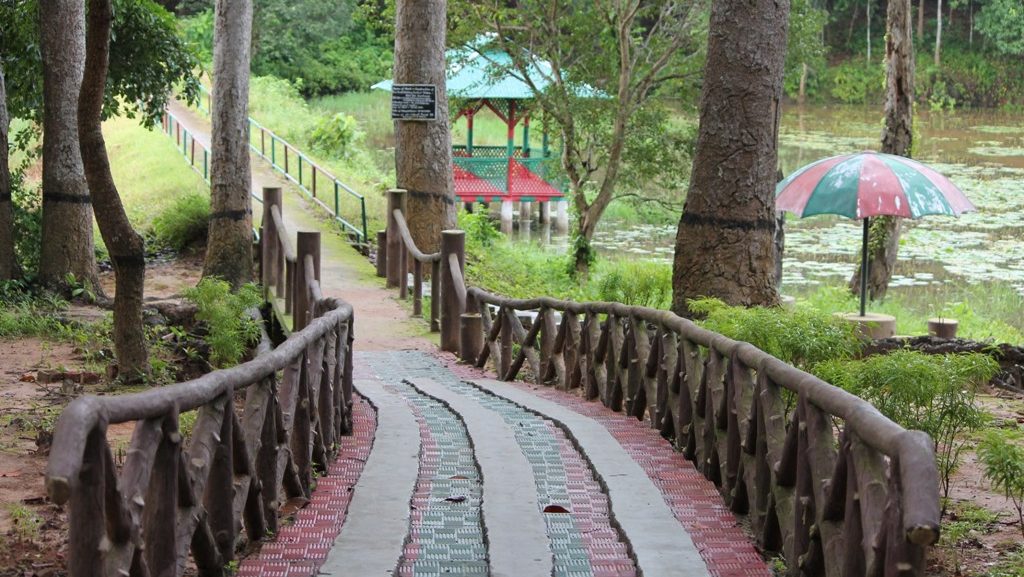
One of Northeast India’s lesser-known yet ecologically significant protected areas, nestled in the lush landscapes of Tripura, is the Trishna Wildlife Sanctuary. Spread across approximately 163 square kilometres in the South Tripura district, Trishna Wildlife Sanctuary is a rich mosaic of forests, grasslands, and water bodies that together support an impressive diversity of flora and fauna.
Trishna Wildlife Sanctuary came into being in 1988. It primarily came up to conserve the endangered gaur, which remains its flagship species. The sanctuary hosts a stable population of these massive herbivores, making it one of the few places in the region where visitors have a good chance of spotting them in their natural habitat. Apart from gaurs, the sanctuary is home to a variety of mammals including spotted deer, wild boar, golden langur, hoolock gibbon, and several species of primates.
One of the defining features of Trishna is its rich vegetation. The forest cover is predominantly tropical semi-evergreen, interspersed with patches of moist deciduous forest. Bamboo groves are abundant, contributing both to the ecological balance and to the livelihood of local communities. The sanctuary also contains several perennial water bodies and natural lakes, which not only enhance its scenic beauty but also support aquatic biodiversity and act as vital water sources for wildlife.
Birdlife in Trishna is particularly noteworthy. The sanctuary attracts a wide range of resident and migratory birds, making it a paradise for birdwatchers. Species such as pheasants, hornbills, and various waterfowl can be spotted, especially around the lakes and wetlands. Reptiles like pythons, turtles, and lizards are also found here, adding to the sanctuary’s ecological richness.
Tourism in Trishna Wildlife Sanctuary remains relatively low-key compared to more commercial wildlife destinations, which works in its favor by preserving its pristine environment. Visitors can explore the sanctuary through designated forest trails and watchtowers that offer panoramic views of the landscape. The best time to visit is between October and March, when the weather is pleasant and wildlife sightings are more frequent.
Accessibility to Trishna is fairly convenient. It is about 100 kilometres from Agartala, the state capital. From Agartala, visitors can hire taxis or use local transport to reach the sanctuary.
Beyond tourism, Trishna plays a crucial role in conservation and environmental education. It serves as a living laboratory for researchers and a platform for raising awareness about biodiversity protection. Local communities increasingly involve themselves in conservation efforts, ensuring a more sustainable and inclusive approach to wildlife management.
In essence, Trishna Wildlife Sanctuary is not just a refuge for wildlife but a testament to the ecological wealth of Northeast India. Its tranquil environment, rich biodiversity, and conservation significance make it a must-visit destination for nature lovers seeking an offbeat and meaningful travel experience
Related
!function(f,b,e,v,n,t,s)
{if(f.fbq)return;n=f.fbq=function(){n.callMethod?
n.callMethod.apply(n,arguments):n.queue.push(arguments)};
if(!f._fbq)f._fbq=n;n.push=n;n.loaded=!0;n.version=’2.0′;
n.queue=[];t=b.createElement(e);t.async=!0;
t.src=v;s=b.getElementsByTagName(e)[0];
s.parentNode.insertBefore(t,s)}(window, document,’script’,
‘https://connect.facebook.net/en_US/fbevents.js’);
fbq(‘init’, ‘609578899588292’);
fbq(‘track’, ‘PageView’);