There isn’t an expat in Budapest who hasn’t, at some stage, been asked why they’re here. What brought them to Hungary? The degree of incredulity with which the question is posed varies – generationally, situationally, and geographically.
Back in the mid-1990s, in the town of Komló in Baranya County in southern Hungary, young people meeting any one of the five foreigners in the town tipped the scale. Why would anyone willingly move to a town that was essentially dying?
One of those five foreigners was a young Welsh woman, Jaci Harvey.
Harvey was one of 15 teachers from the UK who came to Hungary in the mid-1990s as part of a programme run by the Baranya-Devon Társaság (Baranya-Devon Society). Their job was to teach native English in the schools and modern language methodologies to Russian retrainees, teachers certified to teach Russian who now found themselves obsolete. Post-1989, thousands of Russian-language teachers were given the choice to retrain in either English or German. Many chose English. It was tough. They’d teach a full programme for three days and then go to university to study their new language for two, bringing back what they’d learned to apply in the classroom.
It was even more difficult because they were no longer teaching a language they loved. Russian, they said, was beautiful. German and English? Not so much.
With the National Curriculum changing the UK, Harvey and her sister wanted to give it time to settle down. Eager to try something new and see somewhere different, they found the programme in Baranya and volunteered.
‘We were picked up in Budapest, taken to Pécs, given an ice-cream, and then fetched by our school principals’, Harvey recalls. She and her twin sister were placed in Szilvási Általános Iskola (Szilvási Primary School) in Komló. They shared a 35 m2 apartment and were paid 25,000 ft a month (more than most teachers at the time).
‘It was like living in a goldfish bowl’, Harvey tells me. ‘Everyone knew us. People were so friendly. And helpful. And curious.’
This was before mobile phones and Google Translate. On their first night in the town, the girls searched for a phone box to call home. Realisation that they were in a very different place began to dawn.
They communicated using dictionaries. A neighbour, Emmi néni, referred to her Maygar-Angol dictionary as her bible. The woman behind the fruit and vegetable stall in the supermarket taught them the Hungarian names for her produce, humorously refusing to sell them anything until they’d mastered the pronunciation. The kids at school traded Hungarian animal names for English equivalents. Today, Harvey wonders if there are adults left in Komló who speak English with Welsh vowels.
One evening, a local driver crashed into Harvey and her UK reg car. The police were called and faced with minimal Hungarian and a dictionary, suggested that she present herself at the station early the next morning before they went off shift. It would be easier, they said, to do the paperwork themselves than to do a handover. The upshot was that the police decided they needed better English and signed up for English lessons.
It was an immersive experience, far removed from what was happening in the nation’s capital.
Komló’s population was in decline. It was in a period of profound economic and psychological transition. The town had expanded quickly during the socialist period thanks to the Mecsek coalfields. Largely a planned town, the apartment blocks, schools, shops, and cultural and sports facilities all grew alongside the mines. In every sense it was a company town, with one main employer.
Under socialism, jobs were more or less guaranteed. But seemingly overnight, that changed. The post-1989 industrial restructuring gave rise to unemployment and insecurity. Mines began to close. What does an unemployed miner do?
It would be 20 years before the Komló mine finally shut its shafts in 2000, but the wind down was slow and telling. And in that time, many people left. When a town that has for generations identified as a mining town sees the very fabric of its identity stripped away, it tears at its core.
Times were tough. ‘You couldn’t plan a meal’, Harvey remembers. ‘You went to the supermarket every day, bought what was on the shelves, and cooked what you had.’ People were poor. Kids came back after the holidays delighted to have received a bottle of shampoo for Christmas. Their neighbour had to borrow 8000 ft to bury her husband.
The original 15 kept in touch. Without any way to contact each other, they had a standing arrangement to meet in a bar in Pécs each Wednesday. Whoever showed, showed. Decades later, they’re still in touch.
Harvey stayed in Komló for two years before moving to Pécs to teach secondary-school students at the Magyar-Német Nyelvű Iskolakőzpont (now Koch Valéria Iskolakőzpont). She then returned to the UK to pursue a master’s in training the trainer. She’d very much enjoyed that part of her job while in Hungary and wanted to further qualify in it.
Faced again with the question of where to go and what to do, Harvey was drawn back to Hungary. She felt it was somewhere she knew. The British Council was looking for someone to both train teachers and teach English, so she moved back, this time to Budapest.
Here, again, she met Russian retrainees who were now much further along their path. Armed with more experience, better qualifications, and the wisdom that comes with age and maturity, this was when Harvey grew professionally and came into her own.
Two years later, she moved to BISB (British International School Budapest), where she is Head of EAL (English as an Additional Language) and teaches ESL IGCSE and English B courses.
Harvey experienced the best of Hungary, in reverse. Instead of moving first to the capital and then moving to the country as so many expats do, she started in a country town, then a regional city, before ending up in the capital.
She witnessed the rapid pace of change. A county that had no ATMs where every car was a Trabant had ATMs, Volkswagens, and Nokia phones in six years.
Kids with limited access to Western TV modelled their dress on MTV. ‘Anything Western represented freedom and progress,’ Harvey says. She remembers the first McDonald’s opening in Pécs and the excitement that came with it. Eating there was expensive and somewhat of a status symbol. She recalls when roundabouts were introduced and the dilemma of whether they’d be British and yield to those on the roundabout or the then-traditional French ronds-points giving way to those entering.
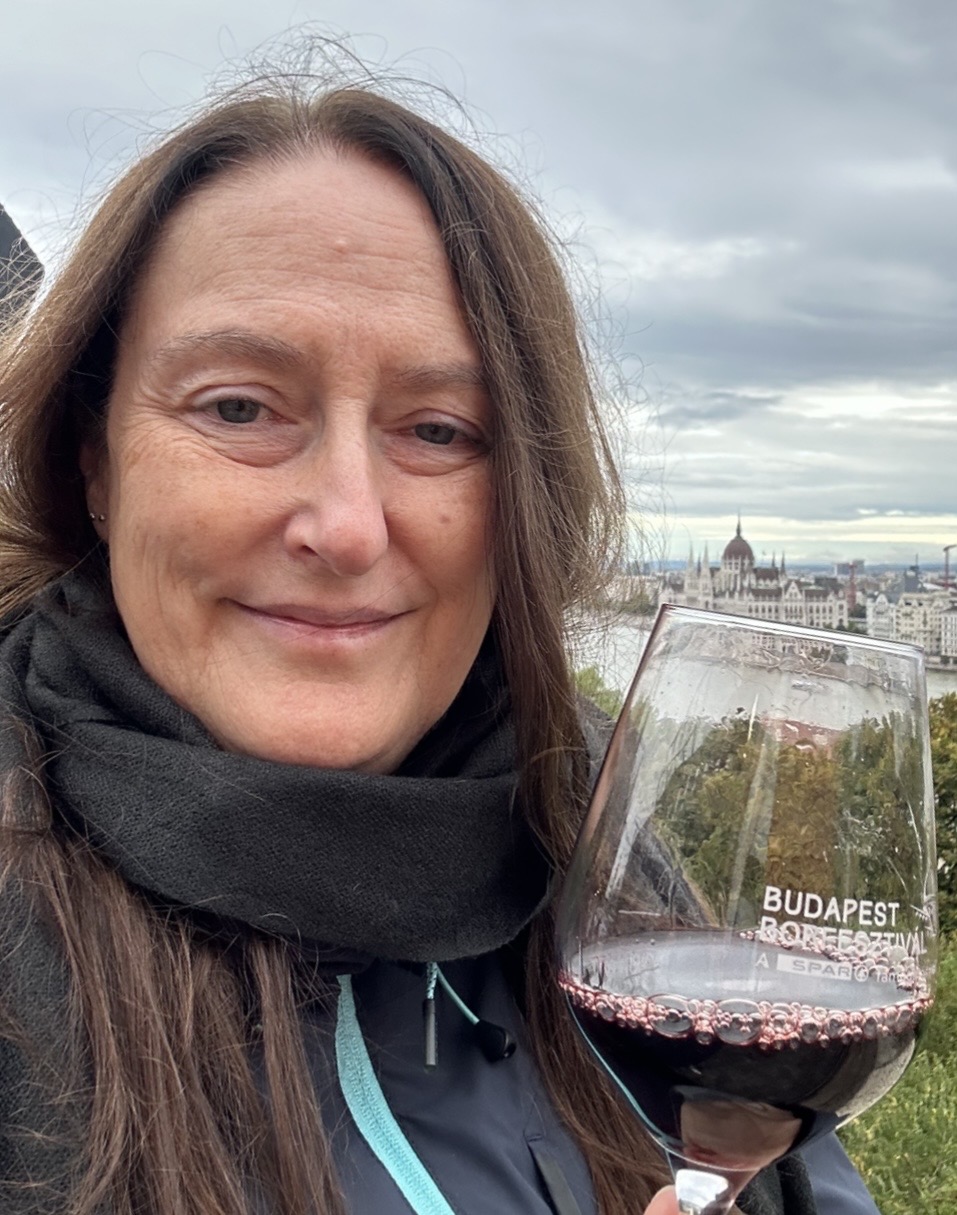
Life in Budapest couldn’t be more different. Being a vegetarian is certainly easier. In the mid-90s in Baranya, she’d eaten more than her fill of fried cheese. She recalls the almost euphoric excitement when Hungary joined the EU in 2006. As the political climate changed, she retreated from the Hungarian world, cocooning in an expat bubble, very different from the immersive experience of Komló. With the excitement of this year’s election and a similar sense of euphoria on the streets, she’s slowly emerging, determined to re-engage with the language and the culture she loves dearly.
And while she speaks fondly of her days in Komló and is movingly grateful for the experience, Budapest is now her home. Her heart? That’s still in Pécs.