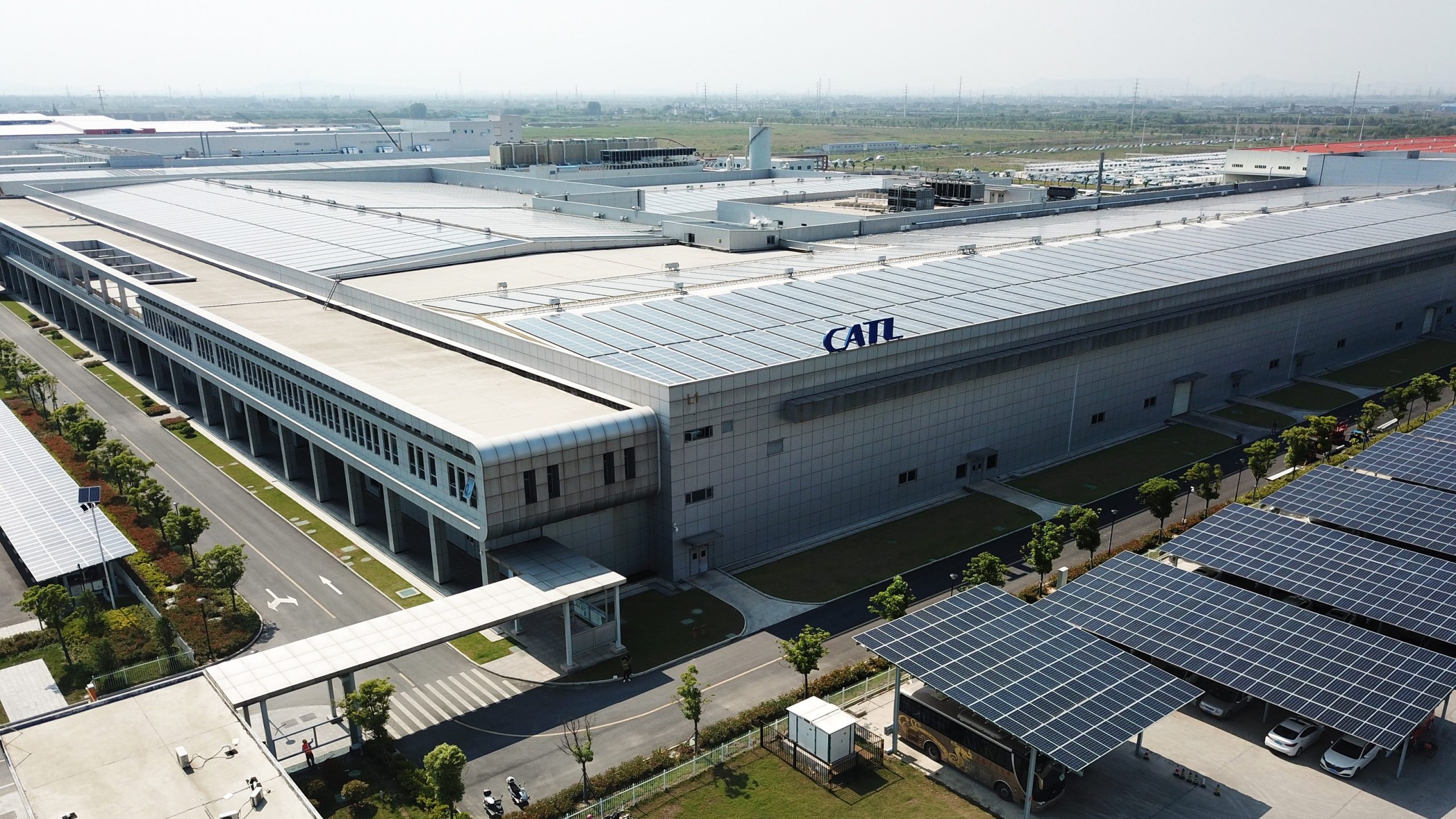
But SEMCORP is not the only Chinese company facing trouble. In May, CATL’s Debrecen plant had its industrial wastewater pretreatment permit revoked and faced fines for illegally discharging some “green liquid.” On July 20, Hungary’s new government has also announced a comprehensive review of BYD’s investment project at its Szeged plant, originally scheduled to begin production by the end of 2025 but has now been postponed to the fourth quarter of 2026.
Prime Minister Viktor Orbán (2nd R), Wang Weizhong, governor of China’s Guangdong Province (L), Wang Chuanfu, Chairman and CEO of BYD (2nd L), and Stella Li, Vice President of BYD (R), are pictured on May 15, 2025, on the occasion of the signing of a strategic cooperation agreement with the Chinese company BYD. Photo: MTI/Miniszterelnöki Kommunikációs Főosztály/Fischer Zoltán
From battery separators and cells to complete vehicles, virtually none of the leading players in China’s new energy industry chain in Hungary have been spared this summer, pointed out the Chinese news site. In just a few months these companies have gone from being honored guests to now facing public investigations.
The report mentions that following the polluted liquid leak in Debrecen, Hungarian environmental authorities continued to take regular samples from monitoring wells, stormwater basins, and waste liquid storage tanks for testing. Reports show that aluminum concentrations in the groundwater on the factory premises exceeded the local legal limits. More than a dozen heavy metals—including arsenic, lead, cadmium, nickel, cobalt, zinc, chromium, and lithium—were also detected. The source of the pollution was pinpointed to the core production area within the factory.
Penalties followed in quick succession. On June 24, the government of Hajdú-Bihar County suspended production on the grounds of violating environmental permits and causing soil contamination; at the same time, SEMCORP was fined 1 million forints (EUR 3000). On July 3, all production, operations and warehousing activities were halted.
James Heng-Kuang Si, managing director of SEMCORP Hungary Kft., delivers a speech at the groundbreaking ceremony at the Debrecen-based separator foil manufacturing plant for lithium-ion batteries on September 13, 2021. Photo: MTI/Czeglédi Zsolt
The incident also caused a stir in Hungarian politics, the TISZA party leader Péter Magyar even took the opportunity to ask the mayor of Debrecen Papp to resign.
The Chinese article recalls that Hungary boasts the geographical advantage of being located at the heart of Europe, adjacent to automakers in neighboring countries. During the tenure of former Prime Minister Viktor Orbán, EV batteries were designated a national strategic priority, and the government adopted a “fast-track” approach—including tax breaks and streamlined environmental impact assessments—to attract investment. Viktor Orbán has designated the lithium-ion battery industry as a pillar of the national economy, promoting investment models that prioritize expedited processing and allow for “build first, comply later.” Over the past few years, approximately 26 billion euros in foreign investment has poured into the battery sector. Among these, CATL invested 7.34 billion euros in Debrecen—the largest single investment in Hungarian history—while EVE Energy, Sunwoda, and SEMCORP also entered the market one after another. In just a few short years, Hungary leaped to become Europe’s second-largest producer of car batteries.
In April of this year, during the Hungarian general election, previous pollution incidents were brought to light. After the Orbán government was ousted, Péter Magyar wanted to make his mark by setting his sights on China’s new energy vehicle and battery factories. “In reality, it is impossible for anyone to be fully compliant. When the Orbán government first brought these industries in, they lowered the bar,” admitted the industry insider. “This is precisely what gives the new government the confidence to take action. When it comes to asserting authority, there is never a shortage of targets—and now, SEMCORP is one of them.” As the Chinese website noted, the current ruling party also plans to establish a new supreme body in September to oversee and penalize polluting industries, and to push for a shift from fixed-amount pollution fines to fines calculated as a percentage of revenue.
In addition to battery companies, BYD is also facing scrutiny. On July 15, Péter Szijjártó, Hungary’s former foreign minister who had spearheaded the Orbán government’s “Eastern Opening” strategy for nearly 12 years, resigned his parliamentary seat to join BYD. Five days later, the Magyar government announced an investigation into BYD’s projects in Hungary and vowed to scrutinize all subsidies, tax breaks, and environmental exemptions granted to multinational corporations during the Orbán era.
As the Chinese news portal noted, this turmoil is clearly not just about environmental issues. For Chinese companies expanding overseas, the lesson is quite clear.
Policy continuity in Europe is not as strong as it is in China. Different political parties represent the interests of different groups, and when a new government takes office, many issues will be reevaluated.
Therefore, compliance is not merely a cost item for companies—it is a matter of survival. Any flaw could turn into a catastrophic disaster when policy winds shift, closed its report 35kr.com.
In fact the Chinese author of the above article underestimates just how little the entire scandal is purely about environmental issues. Battery production clearly does have its environmental costs, a fact that environmental groups and climate change obsessed governments often seem to ignore when pushing for EV transition, while simultaneously mandating exit from combustion engines. Yet the article rightly points out that the German dominated EU has, in fact, turned a blind eye to these concerns because EV investment in Hungary was essential for the seamless functioning of the German car industry.
From a Chinese perspective it is perhaps more difficult to decipher that the entire issue around the battery industry’s environmental impact is little more than a smokescreen for the deconstruction of the Orbán government’s political and economic legacy by the TISZA government. One could endlessly quote arguments and counter-arguments here, while in some cases even environmental groups have admitted that they could not measure pollution exceeding legal limits. Yet the dispute is overwhelmingly of a political nature, where Péter Magyar’s populist government is trying to play the green card in order to portray the previous FIDESZ administration as selling out Hungarian national interest without proper regard for environmental concerns. That is exactly how this issue has appeared in their election campaign. At the same time, they themselves are handing over the Hungarian energy sector to foreign investors, such as Germany’s E.ON, and investing in inefficient and environmentally costly wind turbines.
With his enthusiasm on wind-farms, Energy Minister István Kapitány is spearheading Hungary’s energy transition in yet another environmentally costly direction. Photo: MTI/Kovács Márton
However, it is not only Chinese investment that is feeling the Magyar government’s punitive crusade against foreign investors attracted by Viktor Orbán’s so called “Eastern Opening” policy. Well placed sources told Hungary Today that other Asian industrial giants present in the country are facing the same scrutiny wrapped in a cloak of environmental concern. Instead of the expedited environmental licenses that where issued within four to five days during the previous government, they have to wait for up to a month now. Constant audits of their finances and contracts signed with the previous government have also introduced an element of uncertainty and unpredictability that may force them to reconsider their continued investment in the Hungarian market, and may even deter others from investing in the country altogether.
The Magyar regime may very swiftly find out how easy it is to loose investor confidence by systematically undermining “policy continuity” with their predecessors. At the same time, rebuilding trust and a sense of predictability with the international business continuity will take way more time and effort, regardless of how strong the political back-winds are from Péter Magyar’s EU mentors.