The controlled sinking of the barges has begun, and water levels at the pumping station have already risen by one centimetre, while a continuous drop in water levels continues to be recorded in the main channel of the Danube — the Prime Minister announced on Saturday morning in Paks, at a press conference held beside the nuclear power plant’s cold-water canal.
Péter Magyar stressed that without intervention, water levels in the Danube would fall so low by Sunday night that one of the two still-operating turbines would have to be shut down, with a complete shutdown to follow later. The sinking of the barges and the construction of a sill are intended to prevent this, he said.
“Our goal is to maintain the operation of the two functioning turbines and, through the construction of the sill, to raise the Danube’s water level sufficiently so that the turbines can be brought back online gradually and safely,” the Prime Minister stated.
The Prime Minister outlined that the cabinet decided on Wednesday to launch the Paks investment aimed at raising the Danube’s water level, based on the plans received, the projected water level data, and the known meteorological forecasts. The work consists of two parts: the construction of a sill, for which 145,000 cubic metres of rock will be used, and the positioning, securing, rotation, and controlled sinking of two barges, each 80 metres long, placed side by side.
Péter Magyar said the water level in the area was around minus 120–122 centimetres. According to forecasts, on Sunday night or Monday morning the water level in the main channel of the Danube could drop to minus 132 centimetres, at which point one of the two still-operational turbines would have to be shut down.
Based on water management forecasts, the water level could fall to as low as minus 140 centimetres within five to six days, which would necessitate a complete shutdown of the nuclear power plant, he said. “We must prevent this from happening, and we will prevent it,” he declared. He recalled that just a few weeks earlier, the Paks nuclear power plant had come within millimetres of having to be shut down.
The plant’s eight turbines are capable of a combined output of 2,000 megawatts, but currently only two turbines are operating, generating approximately 500 megawatts, he explained. A prolonged shutdown of Paks would be a “massive blow” to the Hungarian economy, businesses, the population, and the national budget alike, he added.
Experts examined several possible solutions. Among those considered were blocking the nuclear power plant’s cooling water intake channel with wing walls or stones, as well as raising the water level using pumping stations, Péter Magyar reported.
The Hungarian Atomic Energy Authority and the relevant authorities considered these to be poor solutions from a nuclear safety standpoint, he said. He stressed that “maintaining our country’s nuclear safety is the single most important priority,” and for this reason those proposals were rejected, and the decision was made together with the experts to construct a sill weir instead.
The last similar operation was carried out in 1995, near Dunakiliti, though under easier conditions, with more time for planning and construction, the Prime Minister recalled. He said “the Danube has now given us only a few days.”
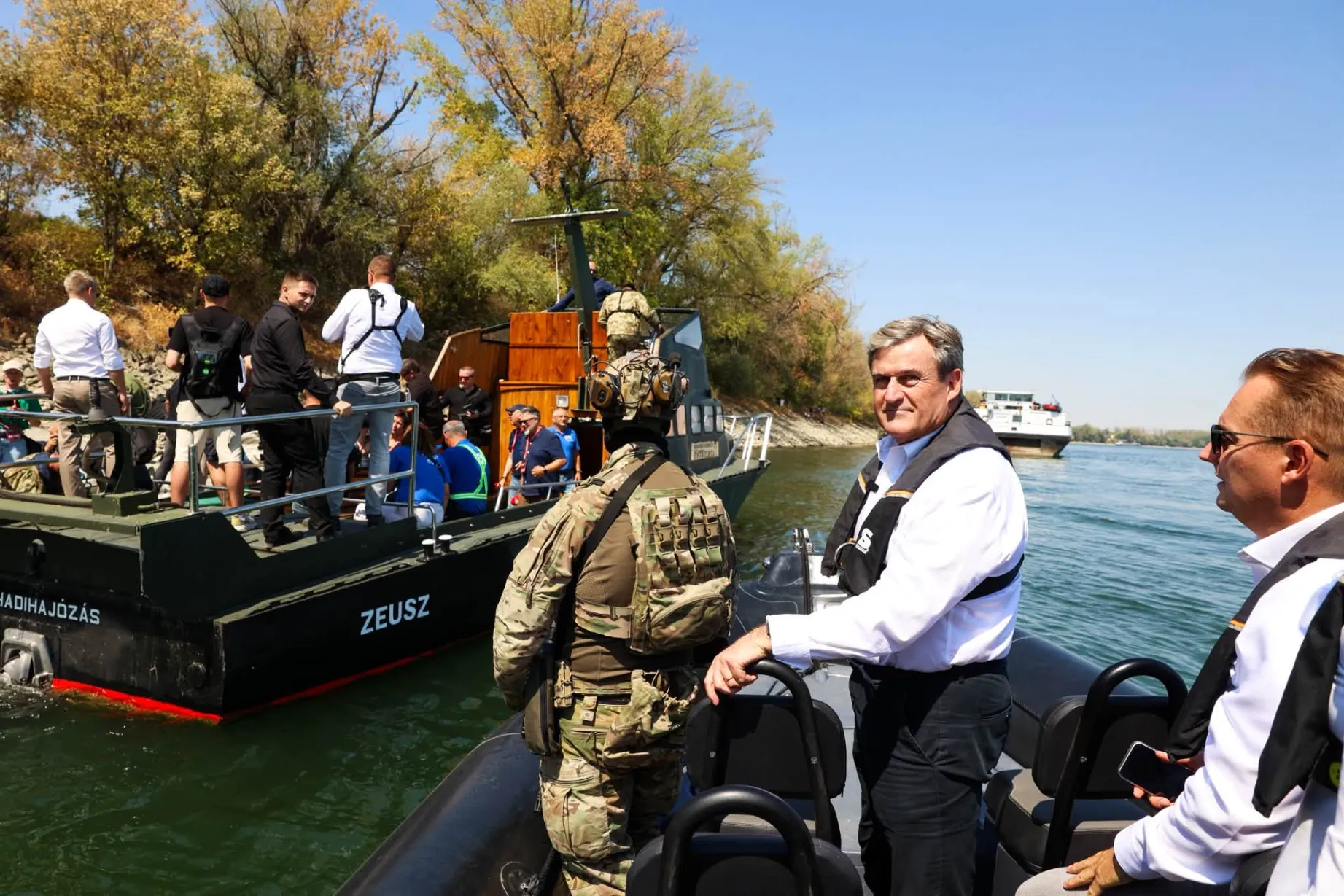
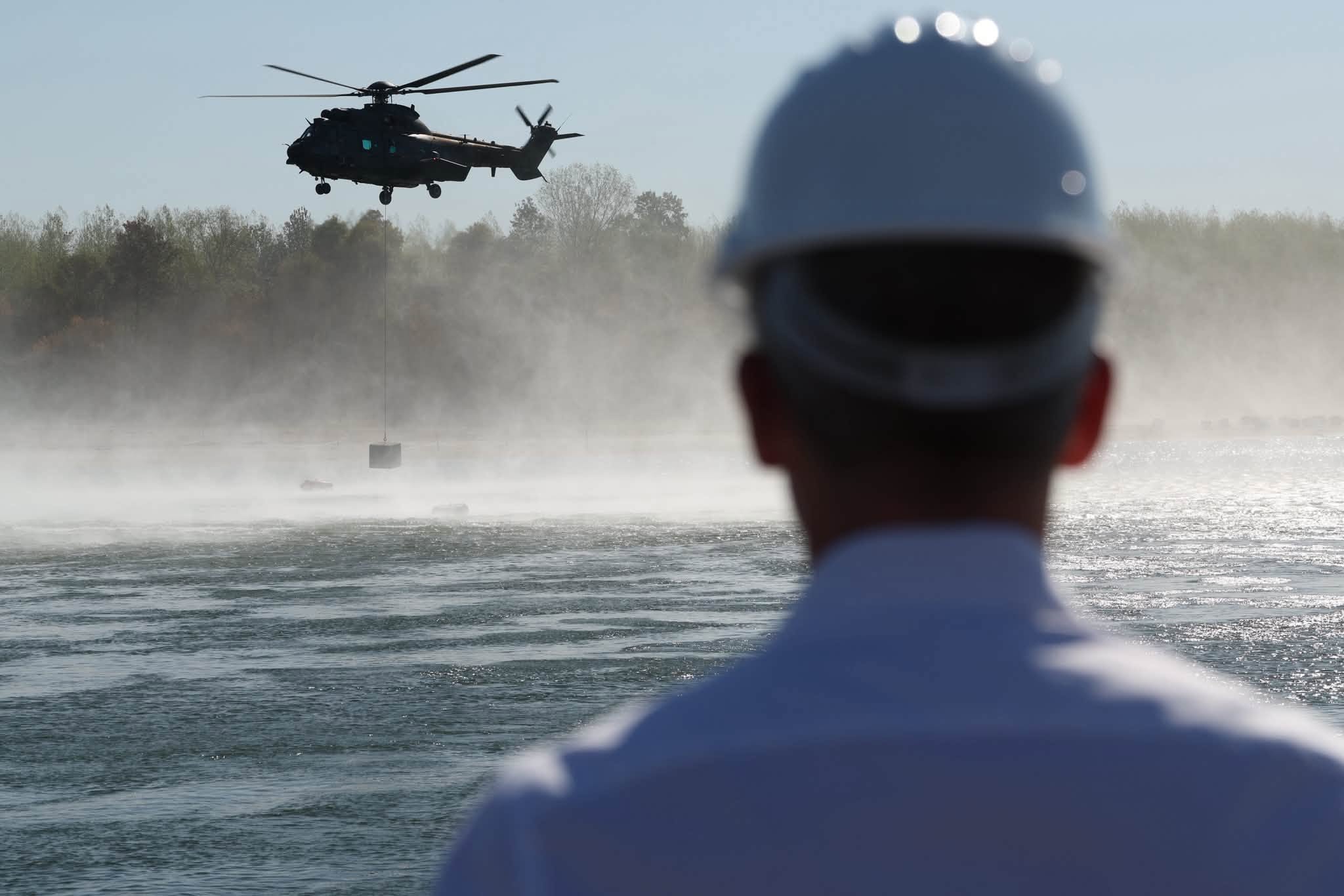
The work is progressing well, according to plan, and at an increasingly rapid pace, he reported. Around five thousand tonnes of rock will arrive in Paks and Dunaszentbenedek throughout the day, and work is proceeding simultaneously on both banks of the Danube, he added. According to Péter Magyar’s account, the two barges arrived from Mohács, and water management specialists have been working for two days on the necessary dredging, securing, and positioning. On Saturday morning, their controlled, monitored, and supervised submersion began — initially by around 20 centimetres.
The Prime Minister called the investment a national matter, one which he said requires full national unity. Hundreds of soldiers, police officers, water management specialists, contractors, industrial divers, engineers, and planners are working together on the project, he stressed.
Péter Magyar described it as regrettable and telling that neither the former prime minister nor the leaders of other parliamentary parties had accepted his invitation to view the investment securing the power plant’s operation. He stated that, to their knowledge, all of them are holidaying abroad at this time.
He added that “they did not offer help of their own accord (…), they did not call for full national unity (…) they flooded the internet with disinformation and lies” and tried to mislead their fellow citizens.
Péter Magyar also spoke about what questions he would have asked Viktor Orbán, the president of Fidesz, had he gone to Paks. Among other things, he said he would have asked why the upgrade to the Paks water intake and pumping system — recommended by experts following the record-low water levels in 2018 — had never been carried out, an upgrade which, he said, would have cost 10 billion forints and ensured the full operational capacity of the Paks nuclear power plant even at water levels on the Danube lower than those currently being experienced.
He would also have asked the prime minister why the possibility of constructing a sill had not been examined and prepared earlier, and “why and how Hungary ended up, after 16 years of governance, in a situation where the sinking of two 80-metre barges and the preparation of contingency plans are needed to maintain the operational capacity of Paks.” He would further have expected an answer as to why no strategic reserve water intake system had been developed that would be capable of serving all four Paks units even during a historic drought.
He would also have asked the prime minister why Hungary’s energy system had not been prepared for the possibility that Paks output could temporarily drop significantly, and why sufficient energy storage capacity had not been built up. Finally, he said he would have asked Viktor Orbán whether he truly considers Hungary’s energy security a matter of national importance — and if so, why he did not go to Paks.
Brigadier General Pál Kádár, head of the Defence Administration Office, reported at the press conference that after the initial capacities had been established, the investment to raise the water level of the Danube was proceeding on schedule by Saturday, though there is a shortage of stone-carrying trucks.
He said that at any given time, 80 to 100 trucks are operating on both banks of the Danube between the quarries and the storage sites; these are two- and three-axle, steel-platform articulated vehicles. Work is carried out 24 hours a day.
Pál Kádár expressed his thanks to all those supporting the investment with offers of assistance, and said that by late Friday evening 112 such offers had been received, a number that has since grown to 176.
Answering questions, Péter Magyar stated that it would be irresponsible to name a precise date for when another turbine could be brought back online, or when the Paks nuclear power plant could resume full-capacity operation. According to the schedule, 30 days are available to install the 35,000 cubic metres of stone needed for the sill, followed by a further month in which 110,000 cubic metres of stone must be installed to preserve the stability of the waterworks.
After that, the plant’s management can consider gradually reconnecting the turbines. In addition, the scheduled maintenance of one of the units is currently under way and must be completed before reconnection.
The prime minister emphasized that the first task is maintaining nuclear safety. The second is avoiding a complete shutdown of Paks — that is, ensuring the continued operation of the two turbines currently running — followed by reconnecting as many turbines as possible. This requires increasingly rapid coordinated construction and flood defence simultaneously.
Responding to a question about the risks of sinking the barges, Péter Magyar explained that the barges had been stabilized with two five-tonne anchors. In addition, the vessels were secured with thick steel cables to piles drilled eight metres deep and to concrete pillars. Everything had been doubly over-secured. Should they shift nonetheless, tugboats capable of stabilizing and repositioning the barges are standing by, he added.
Artificial intelligence was used for the translation of parts of the original Hungarian text.