
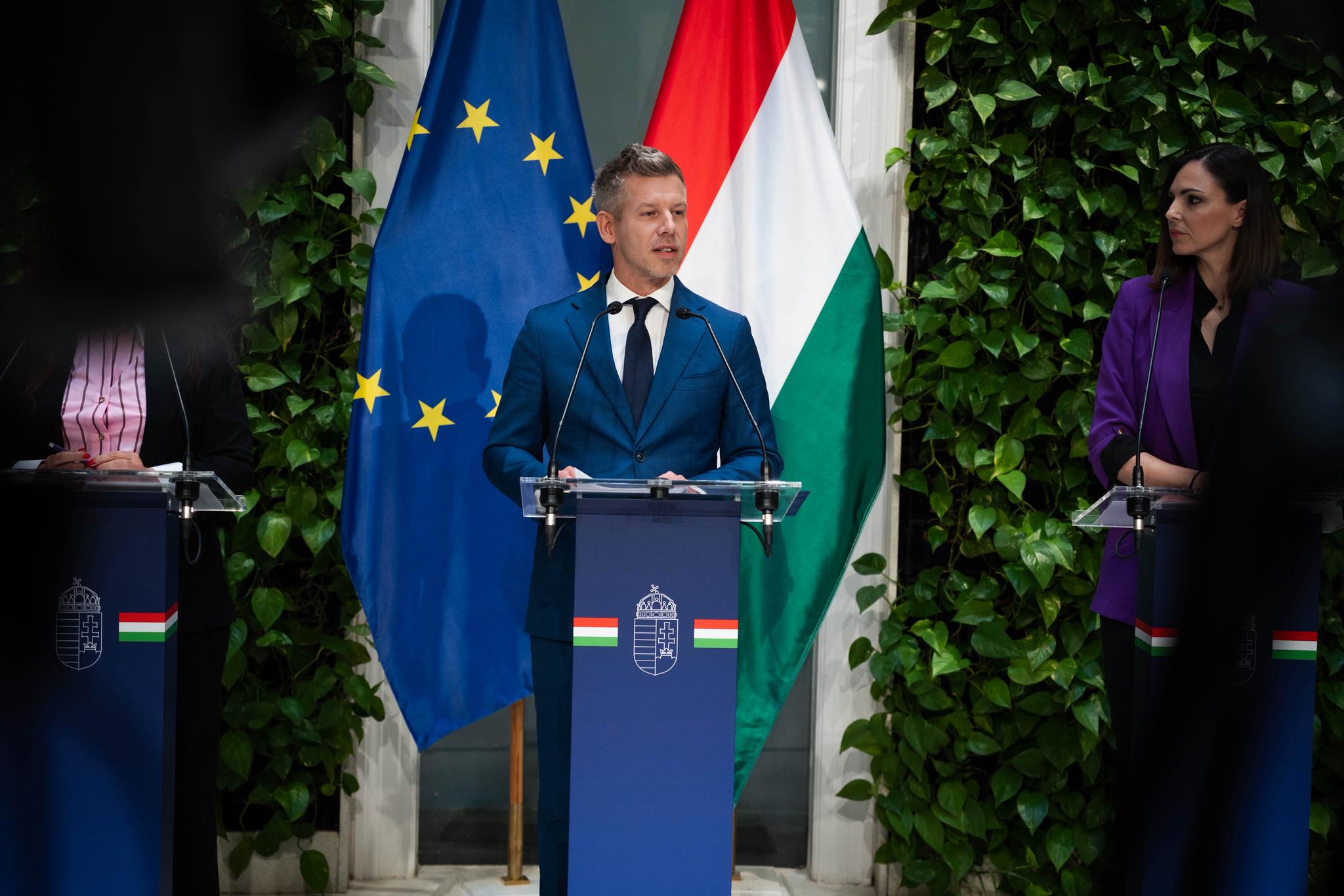
The government will publish on Tuesday on the government website the case file related to the pardon affair held by the Ministry of Justice, the prime minister announced on Monday at a press conference in Budapest following the cabinet meeting.
Péter Magyar said the government had reviewed the file from the infamous Bicske pardon case that had been held by the Ministry of Justice. Respecting personal rights, the file will be made public on Tuesday on the kormany.hu/igazsagtetel website, expected in the morning hours.
He said the file reveals that the then justice minister forwarded K. Endre’s pardon request to the Sándor Palace with a negative recommendation, but for reasons and motives still unknown, former President Katalin Novák “changed” this decision and sent it back to the Ministry of Justice.
The prime minister called on President Tamás Sulyok to “add the other piece of the puzzle” by the end of Tuesday’s working day and publish the more complete file available at the Sándor Palace, which would likely reveal the reasons why the former president granted clemency in a highly unusual manner despite the Ministry of Justice’s negative recommendation.
At the nearly three-hour press conference held at the Prime Minister’s Office building on Alkotmány Street, Péter Magyar said the government had examined the Ministry of Justice’s file on the notorious Bicske pardon case. Respecting personal rights, the file will be published Tuesday morning on the kormany.hu/igazsagtetel website.
He said the file shows that the then justice minister — Judit Varga, Péter Magyar’s former wife — submitted more than 40 pardon requests to the head of state, of which the ministry recommended approval in three cases, but forwarded K. Endre’s request negatively to the Sándor Palace. For still unknown reasons and motives, former President Katalin Novák “changed” the recommendation and sent it back to the ministry.
He pointed out that such a move is rare and last happened in 1998 in the infamous Kunos case, when then President Árpád Göncz altered the justice minister’s negative recommendation and returned it to the Ministry of Justice. He added that then Justice Minister Ibolya Dávid did not countersign the decision.
He stressed that in the Bicske case, however, the president’s altered document passed through “every level” of the Ministry of Justice and was approved throughout the ministry structure, including by State Secretary Róbert Répássy.
He also said the pardon request itself would be published, revealing which lawyer prepared and countersigned the document. In addition, they are examining whether background reports included in the file — containing statements from former employers about the convicted person’s behaviour — can also be made public. Péter Magyar described these as “utterly stomach-turning,” saying, “they practically wanted to give this criminal a laurel wreath,” with everyone claiming he had performed perfect work and fully supported granting clemency.
The prime minister again called on Tamás Sulyok to release the fuller Sándor Palace file by the end of Tuesday, arguing that it would likely clarify the reasons behind the unusual decision to grant clemency despite the justice ministry’s negative recommendation.
He stressed that every Hungarian, especially the victims, rightfully expects clarity after so many years on what reasons — and “at whose request, urging or threat” — led the former president to change the assessment of the request.
Péter Magyar also indicated that if Tamás Sulyok does not publish the file, people would rightfully expect an explanation and his immediate resignation. He noted that his resignation is expected by May 31 in any case.
Asked whether he possessed information suggesting the involvement of former prime minister’s wife Anikó Lévai in the pardon affair, the prime minister replied that it was irrelevant what information he may have, because even if such information exists, it belongs “to the category of urban legends, even within the NER.”
He said the parliamentary group of the Tisza Party would initiate the creation of a parliamentary inquiry committee and amend the relevant rules to make attendance mandatory. He proposed that those who fail to appear should first receive a substantial fine, “one that people in Hatvanpuszta would feel,” and if they still refuse to appear, police should compel attendance.
Péter Magyar said he expects that once the inquiry committee is established, those involved — including potentially the former president — will answer questions, because they will not accept the repeated explanation that “she made the decision herself and therefore it concerns only her.”
The Tisza Party will amend legislation governing pardon decisions so that if the president grants clemency and the justice minister countersigns it, both the decision and its reasoning must be made public, he announced.
Responding to a question, Péter Magyar also said the file contains no information explaining why then Justice Minister Judit Varga countersigned Katalin Novák’s decision. He stressed that by then they were no longer living together, so he has no exact information, but understood that the file containing around 40 cases had passed through department heads, senior officials, and deputy state secretaries before reaching the ministerial cabinet. According to him, nowhere in the file did it explicitly state that the president had altered the recommendation. He suggested it may have been an oversight but said only the person involved could answer.
He added that ministers sign many files daily, and it is the cabinet’s responsibility to inform the minister when they are signing an important, altered decision. He stressed that Judit Varga accepted responsibility for her decision.
With intensive work, all issues concerning European Union funds owed to Hungary could be resolved by the end of August, the prime minister announced.
Calling the matter a top priority, Péter Magyar said he had exchanged letters over the weekend with European Commission President Ursula von der Leyen, while negotiations between government members and Commission officials staying in Budapest until Friday were beginning at the same time.
He said he and Ursula von der Leyen agreed that “these funds belong here in Hungary, with the Hungarian people, in the Hungarian healthcare system, the Hungarian education system and infrastructure.”
Péter Magyar indicated that both sides are doing everything possible to sign a political agreement in Brussels next week that would allow outstanding issues to be resolved. He stressed that securing EU funds will require not only legal amendments but institutional reforms as well.
Responding to another question, he emphasised that the government would prioritise projects that are “truly useful for Hungarian society and Hungarian companies.” He noted that some expectations of the European Commission would not be fulfilled, including demands that contradict one another.
Regarding the EU fine imposed due to Hungary opting out of the migration mechanism, he suggested criminal liability may arise. He pointed out that some member states neither pay fines nor receive migrants.
“Nearly one billion euros have been lost here; the country has suffered enormous financial losses because of this,” he said.
He recalled that the Orbán government had planned to take out €16 billion in EU loans for defence spending, equivalent at the time to HUF 6,400 billion, allegedly with the goal of “funnelling money to friendly companies.”
He said the government would review which commitments related to the EU loan are necessary, which should be financed through borrowing, and which are unnecessary, referring for example to the HUF 1,300 billion commitment signed with 4iG before the change of government.
He stressed that stabilising public finances would have far-reaching consequences, and falling market interest rates may even eliminate the need for the EU loan.
Asked whether the SAFE loan programme could change during review and affect this year’s planned drawdown, Péter Magyar said he would not rule out that some planned investments are genuinely necessary and could be funded. The goal remains for Hungary to use only what is needed and “not pour money into oligarchs’ laps but spend it on real investments,” he said, adding that he neither knows nor wishes to speculate on whether this would alter the debt management agency’s plans.
Péter Magyar also said that before the cabinet meeting he spoke by phone with European Council President António Costa, whom he informed that the Hungarian government had begun talks with its Ukrainian counterpart to restore the “cultural, educational and language rights” of the Hungarian minority in Transcarpathia.
“We are not asking for more than what every minority in Europe deserves,” the prime minister declared, adding that “it would be a huge achievement if, after 10–11 years, the Hungarian minority could finally regain the ability to exercise its basic human rights.”
Responding to another question, he announced that the government had tasked Finance Minister András Kármán with reviewing documents in which media entrepreneur Gyula Balásy relinquishes all ownership stakes in his event management and communications companies and offers them to the state. He also said enforcement proceedings had been launched against the entrepreneur’s companies over unpaid VAT obligations.
He said the cabinet does not wish to negotiate with the entrepreneur but instead requests that Gyula Balásy submit full documentation so the government can examine whether the companies genuinely hold assets worth tens of billions of forints or merely last-minute contracts awarded by associates of Antal Rogán. “The devil is in the details, especially when it comes to the NER,” he said.
“If this mafia figure truly cares about his former employees,” he should immediately submit the documents to the Ministry of Finance, he added, noting that the ministry is moving back to its former headquarters at József Nádor Square, a building that “Gyula Balásy’s patrons and friends” had allegedly tried to sell off cheaply.
The prime minister said the government would examine ongoing obligations of the companies, how much is tied to ministries, what other company groups could take over, and what procurement rules permit before making a decision.
He also reported that the National Tax and Customs Administration had launched enforcement proceedings against the entrepreneur’s companies for failing to meet VAT payment obligations on time.
The prime minister requested daily reports from ministries regarding asbestos contamination and the fastest possible solutions, including in healthcare. Responding to a question, Péter Magyar said the health minister had submitted a detailed proposal for screening residents in affected areas. He stressed, however, that panic should be avoided as many details remain unknown.
He declared that he would also raise the matter during bilateral talks in Austria, since one of the five Austrian mines where asbestos-containing rock had been extracted is reportedly still operating. He stressed that the “polluter pays” principle would be applied to the fullest extent, even if this involves cross-border responsibility.
He added that through a notification procedure, free movement of goods could be suspended on public health emergency grounds. He expressed hope that the contamination could still be contained and eliminated in time, whether through bitumen injection, covering, or removing road surfaces.
Péter Magyar said the government had asked relevant ministries to act as quickly as possible. The interministerial working group handling the matter will include the chief medical officer, the environmental state secretary of the Ministry for the Living Environment, and senior officials from other ministries.
He also announced that the government’s administrative state secretaries would be named later in the day and encouraged reporters to refresh the Hungarian Gazette website, suggesting the list may already have appeared.
He said parliament is expected to reconvene after Pentecost, next Tuesday, and the government side will introduce legislative proposals. According to Péter Magyar, the speaker of parliament and the house committee will decide whether the session lasts two days.
He said legislative proposals would include amendments to the law governing members of parliament, in line with earlier commitments, to halve expenditures, although details have not yet been shared, even with the Tisza parliamentary group.
He also indicated that ministers’ and state secretaries’ salaries would be set at levels significantly lower than under the previous government. Constitutional amendments are also planned, including changes concerning the prime minister’s term.
Péter Magyar added that the exact budget deficit is still unknown while ministries review obligations undertaken by the previous government and whether these had been included in the budget. He said they are also investigating whether any criminal offences were committed in relation to these obligations.
Artificial intelligence was used for the translation of parts of the original Hungarian text.


