35,000 skip CAPE, CSEC
Aug 20, 2026
News
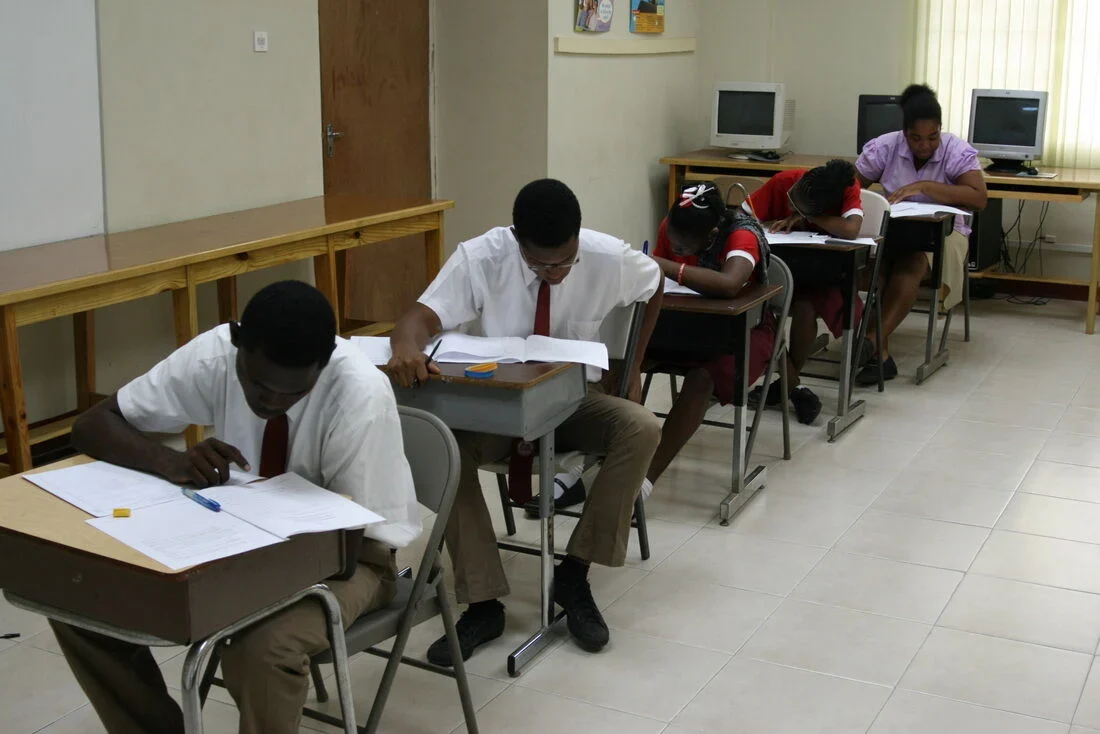
More than 35,000 secondary school students around the region failed to turn up for this year’s CAPE (Caribbean Advanced Proficiency Examination) and CSEC (Caribbean Secondary Education Certificate) examinations, prompting concern from the Caribbean Examinations Council (CXC).
Director of Operations at CXC Dr. Nicole Manning said yesterday: ‘This is a big concern of the Caribbean Examinations Council-absenteeism.’
She said while there was actually a reduction in absenteeism, the issue remained a major concern for CXC.
Manning was speaking at a virtual ceremony for the official release of the CXC 2026 May-June regional exam results.
Of that figure, 3,534 students regionally did not show up for their CAPE examinations.
More worrying was that 32,403 candidates did not turn up for their CSEC examinations, she said.
Noting what this means for such candidates, she said: ‘A candidate that is absent has no opportunity to be graded because they have missed a component and cannot be graded. So, that candidate would have lost out on that opportunity.’
She continued: ‘Not turning up for exams is something that the education system in the region has to be concerned about.’
CXC did not provide details by country on the level of absenteeism for the exams.
Manning said the Council was working to encourage candidates to turn up for the exams.
She also called on parents and guardians to support candidates and noted that CXC had advised educators to encourage candidates to attend their exams.
Manning said CXC had also conducted surveys over the years and found that some candidates felt they were simply unprepared for the examinations and therefore did not show up.
‘This is not a reason to be absent, just try,’ she advised students.
Gender disparity
Manning also spoke about the gender disparity among candidates sitting this year’s examinations.
According to CXC, female students accounted for 62% of CAPE entries, while 38% were male.
For CSEC examinations, she said 59% of the candidates were female, while 41% were male.
‘There must be a deeper assessment regarding the disparity between female and male candidates,’ Manning suggested.
She also noted that the Council had seen regional improvements in the results for CSEC Mathematics.
She said there was a 4% increase compared with last year, adding, ‘This is a good story. I don’t want anybody to be crying because any improvement in math is a good improvement.
‘And so, it is important for us to be happy about that. Improvement is improvement.’
The Education Ministry told TV6 News yesterday it will be doing an internal assessment to ascertain how the data relates to Trinidad and Tobago.
The Express reached out to Trinidad and Tobago Unified Teachers’ Association (TTUTA) president Crystal Ashe and National Parent Teacher Association (NPTA) president Walter Stewart, but both indicated that they needed more information before they could comment.
New approach
CXC has launched a phased approach to CSEC examinations with the introduction of a Caribbean Targeted Education Certificate (CTEC).
The announcement was made by CXC Registrar and Chief Executive Dr. Wayne Wesley yesterday in Anguilla during the release of CSEC and CAPE results.
‘CTEC takes the subject you know, the same syllabus, the same standards, and breaks them down into focus modules that students can master and be assessed on and be certified for, step by step,’ he said.
‘Under its guiding target framework, every module completed is a credential earned that is banked… that builds towards the qualification. And if life interrupts a learner’s journey, as life sometimes does, they no longer leave with empty hands.’
He said 16 months before, the council piloted mathematics as its first subject for CTEC.
Emphasising its importance, he said: ‘For years in mathematics, the subject that is foundational to every vocation in life, only about a third of our candidates have achieved acceptable grades in a typical sitting. CTEC is an assessment redesigned for learners without lowering by a single degree the standard to which we hold.’
He added that during consultations with stakeholders, CXC observed that CTEC mathematics had attracted the interest of parents, while teachers had embraced its modularised format.
He said that more than 2,500 candidates from 15 territories in the region participated in the piloting of CTEC Mathematics Module One for the May-June sitting.
‘I am proud to announce that of these 2,535 candidates who wrote CTEC Module One in the mathematics pilot examination, 88% achieved acceptable grades,’ said Wesley.
He continued: ‘Measured against a generation in which barely one in three candidates succeed in a typical sitting, this achievement represents a remarkable turnaround.’
He stressed that a module is not a whole subject as the full qualification requires, as in the case of mathematics, the full completion of all three modules.
‘When learning is focused in achievable stages, our students do more than cope; they excel, they engage, persist and succeed.’
CXC Director Manning said the 2,535 candidates will have a period of four years to complete modules two and three.
She said once they have completed all three modules, they will get the CSEC certificate. (Trinidad Express)
Discover more from Kaieteur News
Subscribe to get the latest posts sent to your email.