The City of Toronto has granted legal heritage protection to St Peter’s Estonian Evangelical Lutheran Church, recognising the mid-century modern building as a landmark of the city’s Estonian-Canadian community.
The City of Toronto has formally designated St Peter’s Estonian Evangelical Lutheran Church of Toronto as a heritage property, giving legal protection to one of the most important Estonian-built landmarks in Canada.
The designation, approved on 25 June, recognises the church at 817 Mount Pleasant Road as a property of cultural heritage value or interest. It follows years of campaigning by members of the congregation and supporters of Toronto’s Estonian community, who argued that the church was not only a place of worship but also a monument to the postwar Estonian diaspora.
St Peter’s Estonian Evangelical Lutheran Church at 817 Mount Pleasant Road in Toronto. The church has been formally designated as a heritage property by the City of Toronto. Photo courtesy of St Peter’s Estonian Evangelical Lutheran Church of Toronto.
Under the Ontario Heritage Act, heritage designation provides stronger protection than a simple listing. Any significant alteration or demolition now requires city approval, helping preserve the building’s architectural character and historic role for future generations.
A church built by refugees
St Peter’s congregation said the recognition was “a significant milestone” that acknowledged the “historical, architectural and cultural importance” of the church and its contribution to the wider community. A special celebration service is planned for this autumn.
The church was founded in 1948 by Estonian refugees who had fled Soviet occupation after the Second World War. Like many exile communities across the West, Toronto’s Estonians first gathered in borrowed or rented premises. By 1953, the congregation had acquired land on Mount Pleasant Road and set out to build a church of its own.
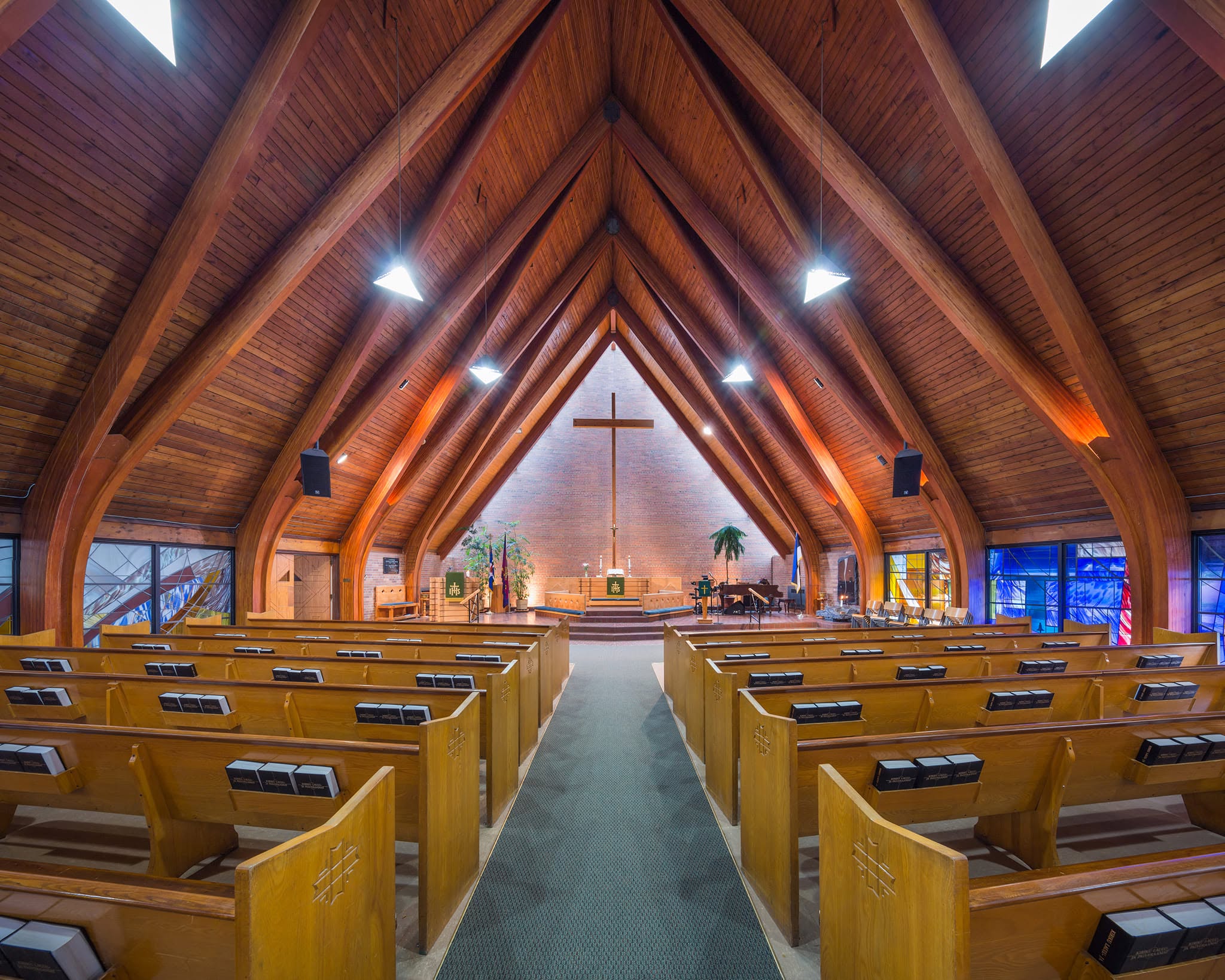
The wooden cross inside St Peter’s Estonian Evangelical Lutheran Church, a postwar Estonian-Canadian landmark built by refugees from Soviet occupation. Photo courtesy of St Peter’s Estonian Evangelical Lutheran Church of Toronto.
The main building was completed and consecrated in 1955. Designed by Estonian-Canadian architect Michael Bach, himself a member of the congregation, the church was conceived as both a Lutheran place of worship and a national home for a community rebuilding its life in exile.
Modernism, memory and Mount Pleasant
The City of Toronto’s heritage documents describe St Peter’s as a representative example of a mid-century modern A-frame church, with a fan-shaped plan, steep copper-clad roof, exposed laminated wood trusses, textured brickwork and a prow-like principal elevation. Its freestanding concrete bell tower, completed in 1970, has become one of the building’s most recognisable features.
The church was also built as a memorial to Estonians who died in the World Wars, the Estonian War of Independence and as refugees. For more than seven decades, it has served as a religious centre, a commemorative space and a cultural hub for the Estonian-Canadian community in the Greater Toronto Area.
A stained-glass window at St Peter’s Estonian Evangelical Lutheran Church in Toronto. The church’s stained glass was among the features noted in the heritage designation. Photo courtesy of St Peter’s Estonian Evangelical Lutheran Church of Toronto.
Toronto’s heritage assessment also noted the building’s association with Bach, a significant figure among the Estonian architects who arrived in Canada after the war and helped advance modernist design in Toronto. Bach taught at the University of Toronto’s Faculty of Architecture and drew on Scandinavian modernist influences in his work.
The church’s artistic value was later deepened by stained-glass windows created between 1987 and 1990 by Ernestine Tahedl, the Austro-Canadian glass artist and painter whose long career included work for the Canadian pavilion at Expo 67.
A national home in a foreign city
The path to designation began in earnest after concern arose over the possible sale of the property. Petitions calling for the church’s preservation attracted more than 1,300 signatures and the issue was raised in both Estonian and English-language media.
Toronto City Council adopted the designation in April 2026 and, after the appeal period passed without objection, the by-law was enacted on 25 June.
A community choir performs inside St Peter’s Estonian Evangelical Lutheran Church, long a place of worship and cultural gathering for Toronto’s Estonian community. Photo courtesy of St Peter’s Estonian Evangelical Lutheran Church of Toronto.
For Toronto’s Estonians, the decision carries a significance beyond architecture. In a text written in 1958, Pastor Oskar Puhm described the church as both a “religious temple” and a “national building”, a place where Estonians in exile could pass on their language, memory and traditions to their children.
Nearly 70 years later, the City of Toronto has given that idea a legal form. St Peter’s is now protected not merely as an old church but as a rare surviving expression of a refugee community that turned loss into permanence, building in brick, wood, glass and copper a home for a nation that, at the time, had been denied its freedom.