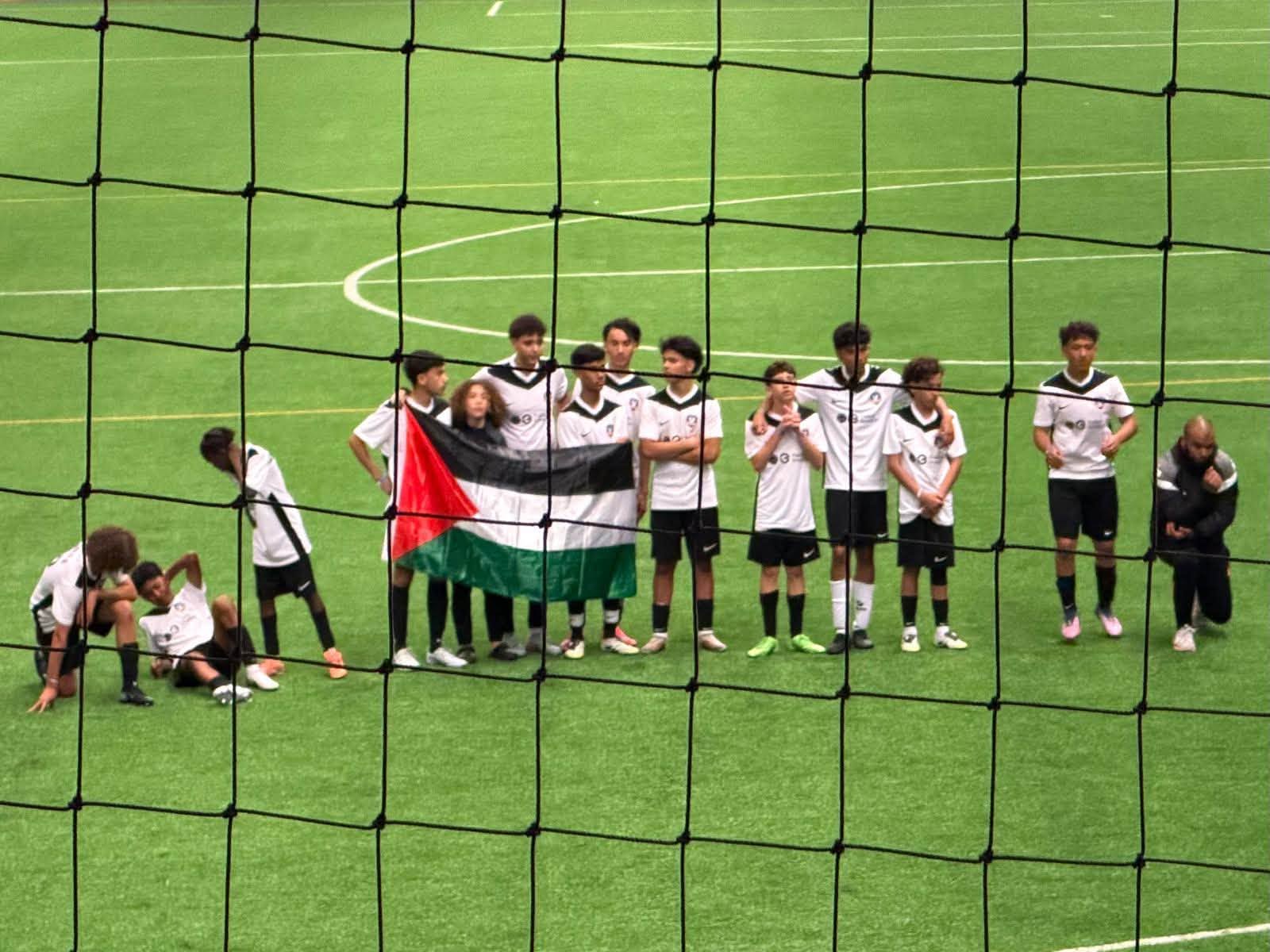
A French youth football team has been accused of punching and kicking Estonian boys at an international tournament in Tallinn after bringing a Palestinian flag on to the pitch during a penalty shootout.
Players from FC Vaujours allegedly punched and kicked members of FC Flora’s under-14 side after a penalty shootout at an international youth tournament in Tallinn.
The incident took place on Sunday at the Estonian Football Association’s indoor hall in Tallinn, where more than 100 youth teams from across Europe had gathered for one of Estonia’s best-known international junior tournaments.
According to Õhtuleht, one of Estonia’s largest daily newspapers, players from FC Vaujours, a French club, allegedly assaulted members of FC Flora’s 2012 Greens team after a match to decide fifth and sixth place in the boys’ under-14 category.
The French side had beaten Flora 3–2 in a penalty shootout. But instead of the customary post-match handshake, several Vaujours players allegedly turned on their Estonian opponents.
Video footage published by Õhtuleht appears to show one Flora player lying on the artificial turf while being kicked. Another Flora player appears to be attacked by several opponents and knocked to the ground.
Coaches from both teams and the referee intervened, and the confrontation was brought under control relatively quickly.
“They were signalling that we would get beaten up”
Dmitri Ustritski, the coach of FC Flora 2012 Greens, told Õhtuleht that the warning signs had already been visible during the match.
“They were constantly going into the body in match situations and making all kinds of gestures,” Ustritski said. “In the second half, they were signalling that we would get beaten up after the match. Even then, it was clear that things could get serious, but we certainly did not think it would go this far.”
The two teams had also met in the group stage, with Flora winning that match 2–1. Ustritski said the earlier match had been relatively calm, but claimed the French side had also been involved in trouble against a Finnish team the previous day.
“They were similarly aggressive there and were shown red cards,” he said. “But in our match it went completely over the line. I suppose they thought it was their last match and they had nothing to hold back for.”
Ustritski said he saw two of his players being punched in the face. He said he did not see another alleged incident, in which the Vaujours goalkeeper was said to have kicked a Flora player in the stomach, because he was trying to bring the wider confrontation under control.
No serious injuries were reported, but Ustritski said several Flora players were left with bruises.
French coach accused Flora of provocation
After the teams had been separated, Ustritski said he spoke to the Vaujours coach on the pitch. According to Ustritski, the French coach did not apologise but instead accused Flora players of provocation, claiming that the referee had favoured the Estonian side.
“We are not the kind of team that plays dirty,” Ustritski told Õhtuleht. “And the video also shows that we are the ones being beaten, not the other way round.”
Ustritski said the coaches did not shake hands after the conversation. He said he had suggested calling the police, but claimed the Vaujours coach replied that he did not care and said the team would return to the school where they were being temporarily accommodated.
The police were not called to the scene.
The Tallinn Cup organisers later contacted Ustritski, apologised and promised to speak to the Vaujours coach about the incident. Ustritski said he did not want to blame the organisers alone, noting that they could not know in advance how every visiting team would behave.
He added that he had not yet had the chance to discuss the incident properly with his own players, many of whom had already left the hall while he was speaking to the French coach. The team has now begun its summer break, but he said the incident would be addressed when the players reconvene.
In his coaching career, he said, he had never experienced anything like it.
“They really were very arrogant,” Ustritski said. “I would not have expected anything like this from children.”
A Palestinian flag on the pitch
In a separate comment piece published by Õhtuleht, Kert Valdaru, the director of the Astangu Vocational Rehabilitation Centre and a parent who attended the match, said the French team had brought a Palestinian flag on to the pitch during the penalty shootout.
Valdaru said the flag was displayed as the shootout between FC Vaujours and FC Flora Greens was taking place. After the French side won, he said, the players attacked the Flora boys.
“It was a frightening sight in the middle of Tallinn, in northern Europe,” Valdaru wrote. “With the Palestinian flag flying, there were fists straight to the face and kicks to the body from boots with studs.”
Players from FC Vaujours display a Palestinian flag during the Tallinn Cup under-14 tournament at the Estonian Football Association’s indoor hall in Tallinn. Photo courtesy of Kert Valdaru.
Valdaru said spectators were shocked by what happened. When people in the stands shouted at the French players to stop and behave, he claimed, the boys merely laughed.
He argued that a children’s football tournament in Estonia was no place for war or political propaganda, and criticised the organisers for not reacting when the flag was brought on to the pitch.
Against the backdrop of the war in Gaza and the wider Israeli-Palestinian conflict, Valdaru said the display of a Palestinian flag at a children’s tournament was a political act.
“What makes it especially sad is that adults have used children as carriers of military and political messages,” he wrote.
Organisers promise to contact the French club
Theimo Tülp, one of the Tallinn Cup organisers, confirmed to Õhtuleht that the incident had taken place and described it as regrettable.
“There was uncontrolled behaviour by the children under the French coach’s supervision,” Tülp said. “There was provocation and swinging of fists and elbows during the match, and the same happened after the match.
“Fortunately, the coaches managed to intervene. It was certainly very ugly behaviour and I do not understand why they did it.”
Tülp said the organisers had also spoken to the FC Vaujours coach. While the French coach had reportedly defended his players when speaking to Ustritski, Tülp said he had expressed regret to the organisers and appeared upset by what had happened.
The organisers said they would write to FC Vaujours and ask the club to address the behaviour of the team.
“As organisers, we will do everything in our power to ensure that such groups do not make it to the tournament in future,” Tülp said. “But we cannot know with 100% certainty beforehand what kinds of groups are coming here, and we had not received any such information about this group. This is also a warning to other tournament organisers that such groups may be travelling around.”
Valdaru said organisers of international youth tournaments should set clear rules at the point of registration, banning political symbols and making violence punishable by immediate disqualification and exclusion from future tournaments.
“It is just as important to react after the first incident, rather than waiting for the situation to escalate,” he wrote.
He added that, despite the incident, the Tallinn Cup remained a well-run tournament of a good standard, and that its overall reputation should not be damaged by the conduct of one group.