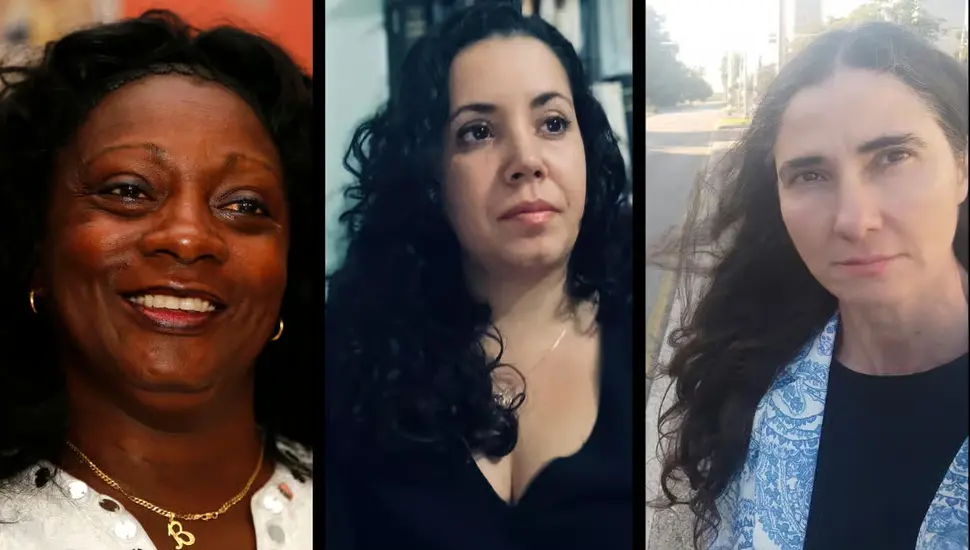
Berta Soler (left), photo: AP / Desmond Boylan. Camila Acosta and Yoani Sánchez, photos: taken from Facebook.
By Eloy Viera Cañive (El Toque)
HAVANA TIMES – When the Cuban government arrests a journalist or puts citizens on trial for organizing independently, a familiar explanation tends to resurface: Cuba faces exceptional circumstances because of the United States embargo, and those circumstances justify restricting rights. That argument can be challenged using legal and theoretical reasoning.
The starting point does not deny that sanctions have consequences. Recognizing that a foreign policy can harm a country is one thing; accepting that this conflict requires its rulers to persecute journalists, prevent independent associations, or prosecute people who organize on their own is quite another.
What Is the Argument for Exceptional Circumstances?
The argument works in three steps: Cuba is under threat, Cuba is subject to an embargo, and therefore those in power can do whatever is necessary to defend themselves. The practical consequence is that Cubans who disagree with government policies are expected to wait until the embargo ends before demanding their rights.
This idea is an old one, and at its core it has a concrete effect: if everything that happens on the island is the fault of the embargo and the exceptional circumstances it creates, then no one bears individual responsibility for what they do in the name of those circumstances. Defending exceptional circumstances as a justification for restricting rights amounts to defending impunity for those who carry out repression.
What Lies Between a Sanction and an Arrest?
Between a US sanction and the arrest of a journalist in Havana lies a series of decisions. Those decisions are made by people and are political in nature: officials issue orders, police officers carry them out, and authorities make choices. For that reason, the embargo cannot erase the individual responsibility of each link in that chain.
An ongoing case illustrates the point. Four men, members of the Freemasons, faced trial on November 5, 2026. The formal charge was an illegal dollar exchange transaction. The amount involved: US $300, which was used to purchase powdered milk for elderly residents of a nursing home. This is a political operation presented as a currency-related crime, and the connection between this case and any US sanction once again runs through a decision made inside Cuba.
The second example involves the independent press. Journalists Camila Acosta and Yoani Sánchez were detained on the street, prevented from moving freely, and had their equipment confiscated. Anyone who justifies these actions by invoking the embargo is siding with those who carry them out.
What Does Hannah Arendt Explain About Terror?
Hannah Arendt, the political thinker who developed the concept of totalitarianism, helps answer the fundamental question: Is violence by a totalitarian state a response to an external enemy? According to Arendt, it is not. Terror under totalitarianism does not arise solely as a reaction to adversaries who threaten the government. Rather, it is part of a system of domination that seeks to destroy pluralism and the individual’s capacity to act independently.
This leads to a conclusion applicable to Cuba: if the objective is to dominate through fear, rather than merely defeat the opposition, repression will continue even after organized opposition has been defeated. Cuba has lacked an organized opposition for years, yet repression continues.
A farm analogy helps explain it: repression functions like herbicide sprayed over an already plowed field to prevent anything from growing except what the owner wants. This interpretation is not new. It has been described since the 1940s by authors who understood totalitarianism as a model for organizing power, rather than a phenomenon tied to any particular country.
Why does a One-Party System clash with any form of autonomy?
A system that claims the right of a single party to direct society has a problem with any space for autonomy. Two examples illustrate this. The independent press is troublesome because it decides for itself what to investigate. Freemasonry is troublesome because its members chose their own leaders regardless of what the Ministry of Justice might say.
Neither case has anything to do with the embargo. With or without a blockade, with or without an embargo, any citizen who decides to organize without asking and receiving permission will run into trouble.
All states have policing functions and use force to maintain order, but that order must be enforced within legal and legitimate frameworks. Political repression in Cuba is not legitimate and often is not even legal under the island’s own laws. Regimes of this kind repress because they need to preserve their existing power structure intact. Allowing citizens to organize, obtain information, and compete politically would mean accepting the possibility of losing control.
Havel and the Independent Life of Society
To conclude, it is worth returning to The Power of the Powerless, the essay by Václav Havel, the first president of post-communist Czechoslovakia. Havel spoke of what he called the “independent life of society”: the lives of those who write, teach, create, practice their religion, or organize according to their convictions. Havel showed that, for regimes such as Czechoslovakia’s at the time or Cuba’s today, that autonomy, that independence of ordinary people, could come into conflict with the system even before it developed into explicit political opposition.
That is the conclusion tying together the arguments presented here. If conflict with those in power begins the moment someone acts independently, as with the Freemasons who buy milk for a nursing home or the journalists who go out to report, the embargo may worsen the country’s difficulties, but it does not explain why people are arrested, prosecuted, or have their belongings confiscated. Those are decisions made by people who bear responsibility for them.
First published in Spanish by El Toque and translated and posted in English by Havana Times.
Read more from Cuba here on Havana Times.