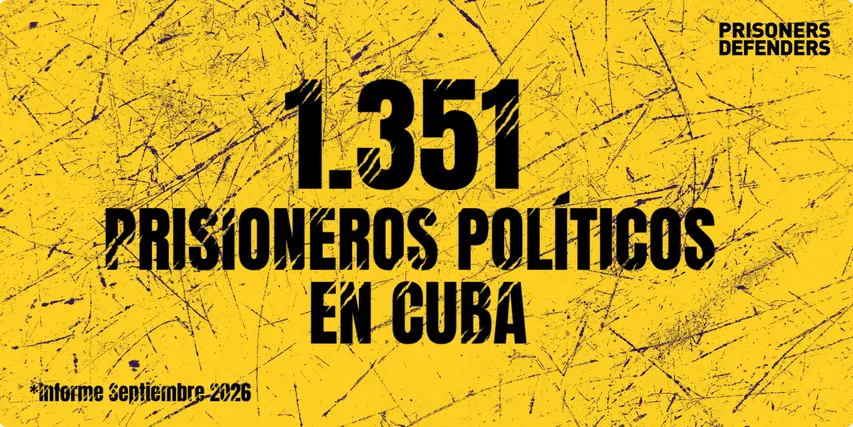
In their September report Prisoners Defenders documents 1,351 political prisoners in Cuba.
By Francisco Acevedo
HAVANA TIMES – This week, the confrontation between influencers Yusmani Companioni Vila and Eliecer Avila over assistance to Cuba’s political prisoners went viral.
It is a thorny issue, and personally, I believe that those who call for insubordination in Cuba do far less than they should. It is very easy, sitting comfortably in a chair in Miami, to ask those of us who live in this country to take to the streets and risk spending several years in prison.
Obviously, the income anyone legitimately earns in the United States or any other country is not meant to solve Cuba’s problems. But just as no one demands anything from them, I don’t understand why they demand personal sacrifices from others. If you ask others to give, you must be willing to give yourself. None of them has thought of creating a fund to help the families of political prisoners.
According to the nongovernmental organization Prisoners Defenders, Cuba had 1,339 political prisoners at the end of August 2026, including 155 women (a record number) and 38 people who were detained when they were minors.
The cases include people imprisoned for protesting shortages of water and electricity, filming government agents, or denouncing abuses, actions that lead to imprisonment, threats, and punishments affecting entire families.
According to the organization’s records, 463 of those still imprisoned suffer from serious medical conditions, while 54 have severe mental health disorders resulting from beatings, forced labor, involuntary psychiatric confinement, and lack of medical care.
This is an extremely high number considering the reasons these people are serving sentences, but economically speaking, it would not be so complicated to ensure that they receive the assistance they deserve for their sacrifices. Mind you, everything they have done has been without asking for anything in return, so this is not about payment, but rather an expression of gratitude and, more importantly, a message to those who are afraid to take to the streets: if they do, they will not be left without support.
I know of people who were imprisoned following July 11, 2021, and spent three years behind bars without their families receiving a single dollar from abroad. That does not seem right to me when it comes to those who continue calling for sacrifices. Those who make so much noise from the comfort of their armchairs should be the first to reach into their pockets to help those who had the courage to express their opposition to the island’s regime.
Instead, many were left to fend for themselves, and only the best-known prisoners have received any kind of assistance, and even that has been sporadic because it depends on individual efforts.
We are not naive. We know that providing assistance also involves many complications, because anyone who approaches these people, considered “untouchables” by the regime, can face consequences such as losing the right to travel to Cuba. But there are many ways to help their families. For example, a bank account can receive money without revealing where it came from.
For years, dissidents living abroad have used these difficulties as an excuse to abandon those who need help the most, including people who have no stable source of employment because the dictatorship denies them that opportunity.
It is legitimate for them to argue that those who should first bear these costs are the Castro regime’s ruling clique, owners of hotels, luxury residences, yachts, and countless other assets, as US representative Mike Waltz denounced last week at the United Nations itself.
We are fully aware that those primarily responsible for alleviating the misery they themselves have created are the dictatorship’s chosen leaders. But then don’t ask others to make sacrifices if you are unwilling to help those who will subsequently face the wrath of the Cuban government. And not just the famous ones, but anyone.
Now Companioni says he wants to create a foundation to serve the Cuban people, according to his announcement, although not specifically to help the families of political prisoners.
The confrontation ended with Companioni asking Ávila to donate $200 to a child with health problems in the central province of Sancti Spíritus. Avila countered by proposing that two children of political prisoners also receive assistance, with all those involved identified by their full names.
The political implications here are considerable, but according to Companioni, he can reach everyone. We will see whether he can actually do so and, above all, whether he is allowed to.
Helping a political prisoner does not always mean performing some grand gesture. Often, it consists of delivering a letter, obtaining medication, accompanying a family to court, keeping a copy of a document, or repeating someone’s name so that it is not erased.
It is also necessary to stand by those left outside, because prison does not confine just one person: its bars extend into the home, to the dinner table, to the bed where someone lies waiting.
Families can lose income, housing, access to medication, or educational opportunities. Sometimes they need money, food, transportation, or simply someone’s presence to remind them that they have not been abandoned. Sitting beside a mother in a waiting room, helping care for her children, listening without demanding that she be strong: these gestures carry a quiet dignity.
But helping also requires thinking about safety, because for years the dictatorship has taken advantage of the recklessness of those who want to do good too quickly.
From outside the country, people can send letters to the authorities, support amnesty campaigns, contact international organizations, share reports from the independent press, and demand that governments, universities, labor unions, and associations keep public attention focused on those behind bars.
But putting food on the table is essential, and providing transportation so that relatives can visit prisoners is indispensable, because international pressure cannot replace the struggle of those who resist from within.
No one can sustain a cause if they are silently breaking down. Dictatorships want terror to isolate us, to make each person believe they are alone, because sometimes simply knowing that they have not been abandoned is enough to make it through the night.
Lee más desde Cuba aquí en Havana Times.