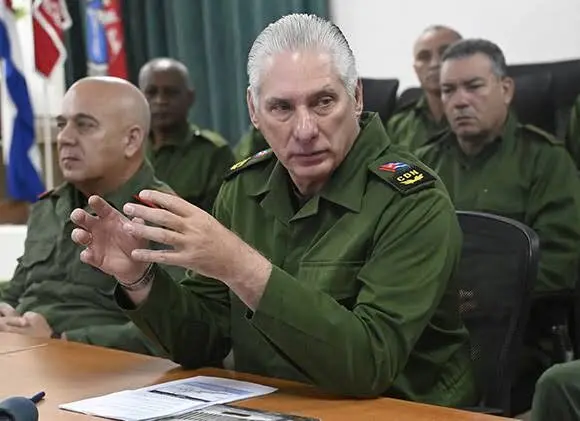
Cuban president Miguel Diaz Canel in a meeting with top military officials.
By Francisco Acevedo
HAVANA TIMES – Cuba has spent nearly 70 years preparing for a military war with the United States, but the truth is that, after the 1960s, that possibility became increasingly remote.
The current US administration has said on more than one occasion that it does not rule out that option, but the reality is that adding yet another armed conflict to the financial burden borne by United States taxpayers would be extremely complicated, to mention only the economic aspect.
Beyond that—which remains a hypothetical scenario—what is actually happening in Cuba is that fear of war is being used to serve the interests of the dictatorship. At the same time, the regime wants Cubans to believe it could withstand a military confrontation, when we all know that would be impossible.
This week, President Miguel Di’z-Canel met with the country’s top military leadership to reiterate the decision to repel any aggression (it would be the height of absurdity if they surrendered at the first opportunity). But far from projecting an image of strength, he looked exhausted.
His words conveyed anything but determination, confidence, courage, or leadership. What we saw was someone badly in need of sleep, someone weakened. Someone repeating the same old rhetoric while seeming almost to beg the United States not to go so far as to invade and to let them live in peace, as he claims the rest of the world advocates—even if that means he can continue enjoying his privileges while the vast majority of Cubans endure hardship.
What we witnessed at the beginning of this year with the capture of Nicolas Maduro in Venezuela demonstrated the enormous military disparity between a superpower and a Third World nation, a gap that would be even greater in a confrontation between Cuba and the United States.
Perhaps the dictatorship’s only advantage in such a scenario would be its extensive infiltration of US government institutions with spies, an effort that has been underway for decades and has proven highly effective. But even if military secrets could not be adequately protected, everything would ultimately be decided on the battlefield. And there, it would be the classic fight between a lion and a monkey—with the monkey tied to a post.
The tyranny’s position is clear: it seeks to impress those who still believe in it and intimidate everyone else, attempting to prevent these threats from triggering another social uprising, which would actually be the perfect formula for change.
To that end, every so often they display their obsolete weapons, which must give US military intelligence a good laugh, while here only the ignorant could believe they would withstand an assault.
Since Fidel Castro’s time, the island’s strategy has been based on establishing pockets of resistance throughout the country, under what was officially called the “War of the Entire People.”
But there is one enormous difference between the Fidel Castro era and today, and it is the key to understanding how different the situation would be now: the vast majority of Cubans do not support their leaders.
I know there are no reliable statistics to substantiate this. That would require the referendum we have been demanding for years, which the dictatorship refuses to hold. But it is what I see every day: countless people tired of being used in this political confrontation while watching their own dreams, and those of their children and grandchildren, continually postponed, just as the dreams of their parents and grandparents were buried.
There is a weariness that makes no noise, that is not proclaimed in public squares or featured in headlines. Instead, it settles on the shoulders of someone returning home late, in the hands of someone counting coins before making a purchase, in the eyes of someone who has learned not to promise their children too much. It is the exhaustion of feeling used.
For years, far too many people have been called upon to defend flags that offered them no shelter, slogans that put no food on their tables, promises that evaporated as soon as the march ended or the ballot boxes closed. They were asked for patience, sacrifice, and loyalty. They were told of a bright future, an imminent victory, a higher cause. And they gave their days, their enthusiasm, even their resentments, while watching the present slip through their fingers.
They had been promised that education would open doors, that honest work would allow them to build a home, that perseverance would be rewarded. But many of those doors remain closed. Owning a home has become a distant aspiration. Young people pack their bags not out of a thirst for adventure, but because they feel that staying means giving up. Parents watch silently as their children inherit not only a surname and a history, but also frustrations and the obligation to start over somewhere else.
That is why the frustration keeps growing. Not necessarily because people have abandoned their ideals, but because they are beginning to distinguish between ideas and those who exploit them. They no longer want to be a crowd, fuel for someone else’s cause, or an argument to be used. They do not want their suffering invoked in speeches by people who live far removed from its consequences. They do not want to keep sacrificing the present in exchange for a future that is always postponed.
The truth is that the real “War of the Entire People” is the struggle for survival. What people want is something simpler and, for that very reason, more profound: to live.
To live without having to justify their children’s hunger. To work without feeling that every effort disappears into a labyrinth. To grow old knowing that their grandchildren will have more opportunities than they did, not fewer. To reclaim the right to dream without asking permission, without waiting for another promise, without turning every hope into an act of faith.
Perhaps the time has come to listen to that exhaustion. Because when a society stops believing in those who summon it to action, it does not always abandon its dreams. Sometimes, at long last, it begins to demand that they be fulfilled. And that is the real terror sweeping through the corridors of the Central Committee.
Read more from Cuba here at Havana Times.