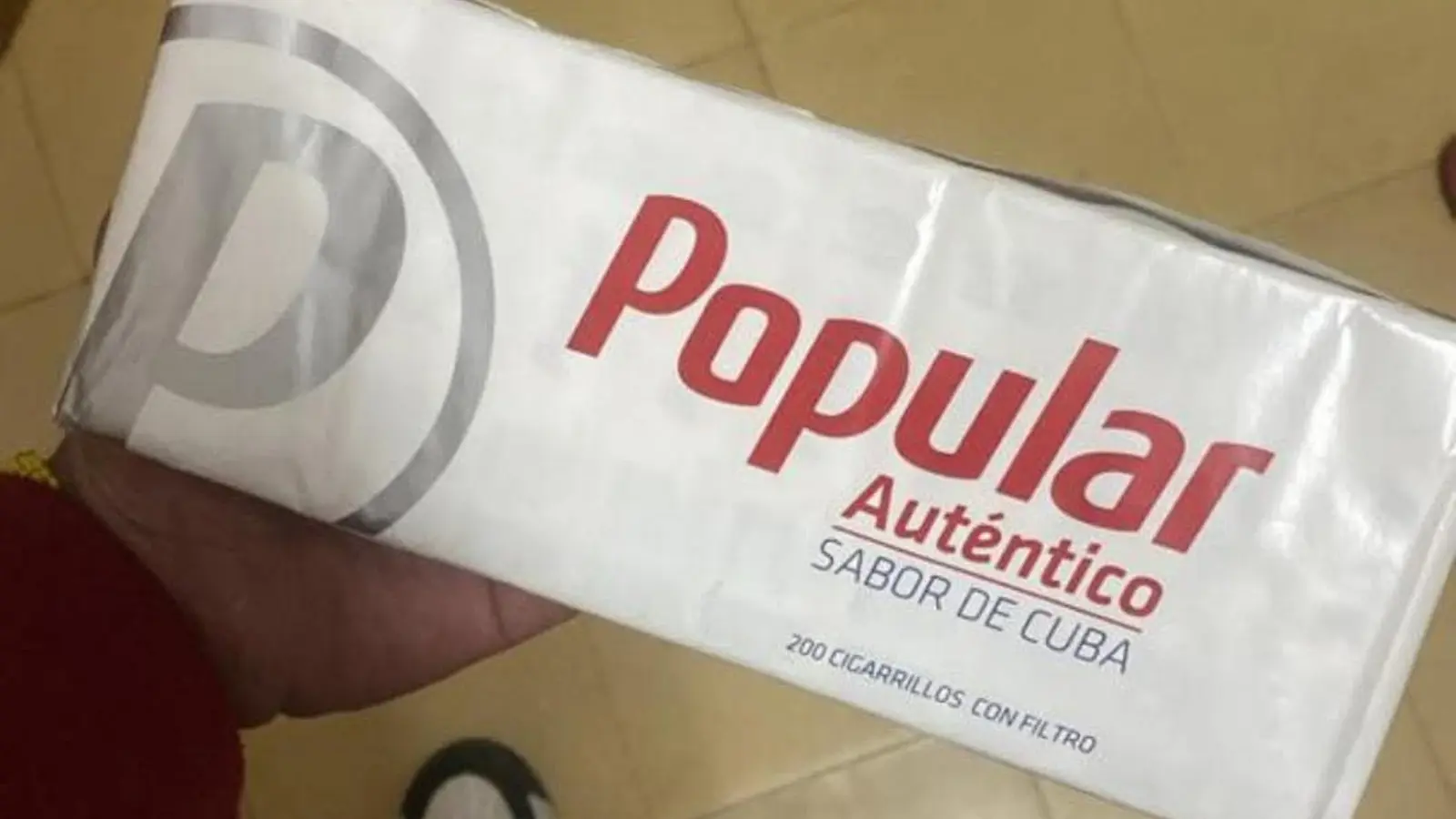
Popular is a low end brand of cigarettes made in Cuba.
By Angry GenXer
HAVANA TIMES – A street vendor passes in front of my building hawking homemade sweets, announcing that he accepts cigarettes as payment.
A healthcare technician, whenever he is on duty at his hospital, makes the rounds along the ramp used to transport stretchers, looking for cigarette butts.
A friend of mine makes four pencil marks on every cigarette she smokes, so she can smoke it “in stages” and avoid having to buy more too often.
Smoking is an addiction that harms your health (in Cuba we call it “a vice”), but it is also a quick way to relieve stress for those living under constant pressure. That is why societies in crisis or at war suffer chronic shortages of “smokable material.” When a critical period begins and the “new poor” emerge, the scarcity of anything containing tobacco quickly becomes visible and painfully apparent, as we have learned from so many novels and movies.
Smoking and Inflation
Since the pandemic, the price of cigars (the inexpensive ones smoked by ordinary Cubans, not the famous Havana cigars exported and sold to tourists) has skyrocketed from 3 to 150 pesos, the latter representing 5% of the official monthly minimum wage (currently 3,210 pesos; pensions and social assistance payments can be even lower). Packs of cigarettes are now sold at private kiosks for prices ranging from three to four digits in Cuban pesos, roughly equivalent to between 15% and 40% of the minimum wage, depending on the brand. Most of these businesses, as well as individual informal vendors, also offer the option of buying cigarettes individually.
Smokers must devote considerable portions of their budgets to satisfying their tobacco addiction, reduce their consumption, or quit smoking altogether.
In Cuba, there are few places where smoking is prohibited. Furthermore, our people are not particularly careful about keeping public spaces clean, so cigarette and cigar butts can be found everywhere. And it has become common to see all kinds of people collecting them. Some use improvised pipes (“cachimbos”) into which they insert the butts to smoke whatever tobacco remains inside; others resort to more sophisticated homemade contraptions.
Finding Our Own Ways to Smoke
This is not the first time that the Cuban people, living in a world tobacco powerhouse and the historic homeland of tobacco cultivation and consumption, have experienced difficulties obtaining it.
In the 1970s, there was a cigarette shortage, and people said it was due to the massive export of tobacco products to other countries belonging to the Soviet-led Eastern European bloc economic alliance that, in turn, supplied the Caribbean nation with all kinds of goods.
People found a solution: they rolled homemade cigarettes using tobacco recovered from previously smoked butts or from cigars distributed by the state through the family rationing system (not everyone in Cuba smokes cigars). These homemade cigarettes were jokingly called “Tupamaros” (after the Uruguayan guerrilla organization whose bank robberies were famous at the time).
The “Tupamaros” returned in the 1990s, along with cigarette shortages during the crisis of the so-called Special Period. I remember that my late father built a rudimentary wooden machine to make them. Some people turned the sale of “Tupamaros” into a business to survive.
Cigarette Butts in Today’s Cuba and Measuring Poverty
“Every time I make my rounds, I find more Tupamaro butts around here…” a cigarette-butt collector tells me. I frequently run into him on the streets of my neighborhood. This means that more and more smokers are rolling their own cigarettes using tobacco left over from other people’s smoking.
It occurs to me that the number of “Tupamaro” butts found on Cuban streets could serve as a measure of emerging poverty: an indication of how many people can no longer afford commercially sold cigarettes.
The length of the butts left from commercially manufactured cigarettes is also an indicator of scarcity: the shorter the butts, the more precious every second of smoking becomes.
Perhaps some sociologist could devise a field study using these indicators to measure emerging poverty in Cuba.
Read more from Cuba here on Havana Times.