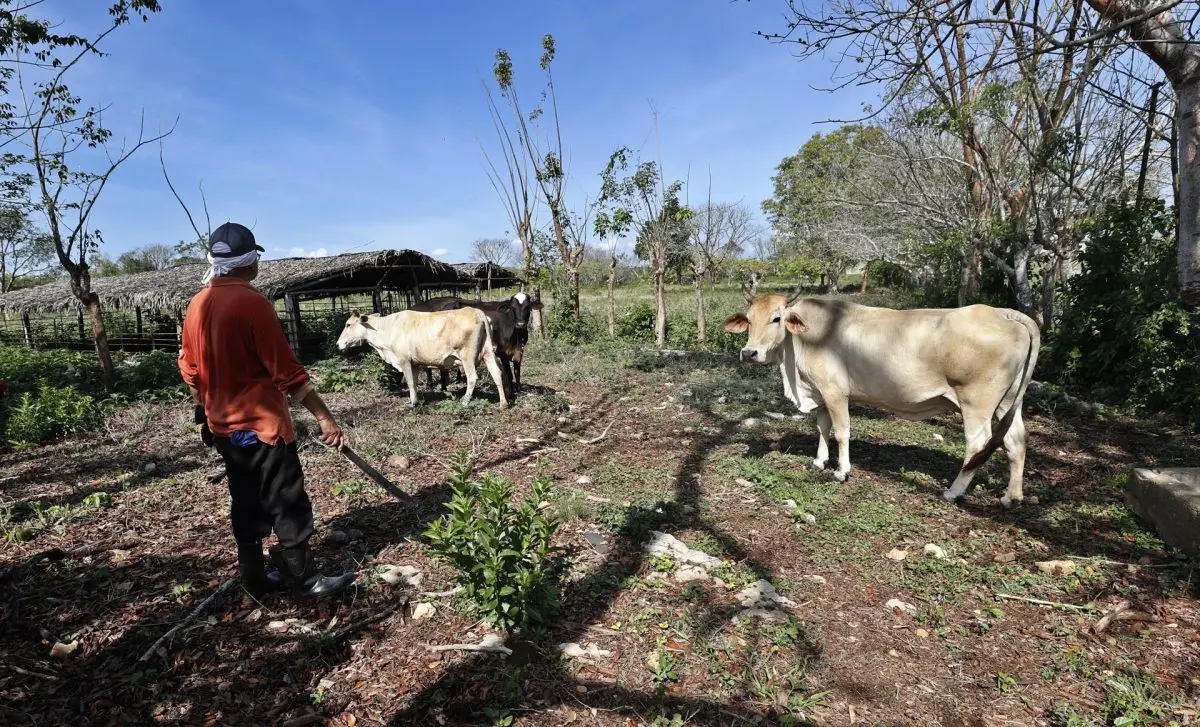
Photograph taken on April 1, 2025, of a farmer on his property in Cárdenas, Cuba. Julio, a 71-year-old Cuban farmer, decided to sell all his cows last year, fed up with vandals who would steal them at night to then sell the meat on the black market. File photo: EFE/ Ernesto Mastrascusa
By Amado Viera
HAVANA TIMES – It was not until late August, after a gang of cattle rustlers kidnapped a family on their farm, that the police in Guantanamo took notice of the wave of violence sweeping through the countryside of this eastern Cuban province. It took two weeks and an extensive operation to capture the 13 members of the gang responsible for the crime, some of whom resisted arrest with weapons.
Their behavior was predictable after months of growing accustomed to terrorizing vast rural areas of the province. At least a dozen families had been forced to abandon their farms for fear of violence.
The mass kidnapping in Palmarito del Guaso attracted attention because among the victims was a 10-year-old girl who was held captive along with her family while the thieves looted the farm. The outrage sparked by this abuse forced the police to launch an active search for the criminals. In the weeks that followed, the Palmarito gang and other criminals were captured in operations carried out throughout the province and neighboring Santiago de Cuba.
But shortly afterward, robberies and assaults were once again reported in the same areas. “There are mountainous areas of Guantanamo where people hardly plant crops or raise animals anymore because there are so many loafers waiting for a chance to steal whatever they can,” explained Yonimiller Horrutiniel, a Guantanamo native from the municipality of Niceto Perez.
The situation he describes is not limited to eastern Cuba. Nearly 500 kilometers to the west, in Camagüey province, the owners of the farm where he works decided to sell the property to “avoid trouble.”
That was the expression the owner used when he informed Yonimiller of his decision. Since the beginning of the year, thieves had stolen seven head of cattle and a myriad of other, less valuable belongings. But the incident that marked the point of no return was the theft of a horse to which the owner was particularly attached. The victim himself tracked down the animal and notified the authorities so they could arrest the thieves. But by the time they did so—a week later—the criminals had already slaughtered the horse.
Cities Come First
The farm where Yonimiller worked is located in Siete Palmas, a rural community southwest of the city of Camagüey. Because of its distance from the provincial capital, the community had its own police post for decades.
These neighborhood police posts form the foundation of Cuba’s public security system. Staffed by an officer and several agents, their responsibilities include compiling what is known as the “criminal potential” registry, a list of residents with criminal records or behavior suggesting a propensity to commit crimes. Traditionally, they have been an effective tool for preventing crime and identifying perpetrators.
Years ago, as part of a process of closing local police posts, the one in Siete Palmas was dismantled and converted into housing. To compensate, the police sent patrols through the community and surrounding areas for a time, but these visits gradually became less frequent. By the time the fuel crisis reached its peak this year, such patrols had long since become a thing of the past.
“We’d also have to see how they would manage to get here, considering the terrible condition of the roads. Modern patrol cars are only good for driving around town,” said Emilio Acevedo, a resident of the area.
When planning new purchases of police vehicles, the Ministry of the Interior has for years favored sedan models from brands such as Geely, Peugeot, and Hyundai, which are well suited to cities but impractical in rural areas. This reveals its priorities regarding public order: maintaining it in urban centers is considered more important than doing so in the countryside. To understand why, one need only ask where most anti-government protests have taken place in recent years.
More Crime Despite Harsh Sentences
In 2025, more than 90% of those tried in Cuban courts for stealing and slaughtering cattle and other large livestock were sentenced to prison. A report on the subject by the People’s Supreme Court adds that another 7.5% of defendants received fines, while barely 3% were found not guilty.
Such a high conviction rate is virtually unparalleled in contemporary legal systems. Nor is the severity of the sentences: according to the Ministry of Justice’s own statistics, judges’ decisions tend to be characterized by their “exemplary nature,” meaning that they impose the harshest penalties provided for in the Penal Code.
Despite the government’s punitive approach, reports of livestock theft and slaughter have continued to multiply. These cases represent only the “tip of the iceberg,” since “there are other crimes that aren’t even reported,” Felix Duarte Ortega, president of the National Association of Small Farmers (ANAP), pointed out a few months ago.
At an assembly of the organization held in the western province of Mayabeque, participants told him that many farmers find it burdensome to travel into town to report everything that happens on their farms. As a solution, the leader recommended “forming more farmers’ patrols.”
These groups attempt to make up for the absence of police in rural areas. Provinces such as Santiago de Cuba and Camagüey stand out for the number of farmers’ patrol units they have organized to confront cattle rustlers.
In September, ANAP’s leadership in Camagüey announced that it already had 25 such groups, with approximately 330 members in total. At first glance, that might seem like an impressive number, but in reality it falls far short of the province’s security needs. Covering 15,000 square kilometers, Camagüey is increasingly feeling the absence of the police, to the point that many farmers are beginning to wonder what purpose reporting a crime even serves.
Read more from Cuba here on Havana Times.