Photos: Idania Cardenas
Photo Feature by Idania Cardenas
HAVANA TIMES – At a maritime and fisheries training center, education goes far beyond the classroom. Amid nets being cast, fish being transferred from ponds to laboratories, and boats setting out at dawn, students learn the trades that will connect them to the sea and its resources.
In Mariel, vocational training comes with the smell of salt air, hands learning new skills, and workdays that begin before sunrise. Located in the municipality of Mariel, in western Cuba’s Artemisa Province, the center is Cuba’s only institution dedicated to training mid-level technicians in maritime and fisheries professions. It has approximately 90 students enrolled in three specialties: fishing vessel captain, marine engine mechanic, and fisheries biology.
A visit to the institute reveals that much of the learning takes place outside the classroom. Practical training plays an essential role in preparing these young people, who must become familiar with equipment, marine organisms, vessels, and the real-world conditions in which they will practice their future professions.
This photo series captures three aspects of their training: a demonstration of fishing gear, a laboratory exercise with live fish, and a practical session on personal survival techniques at sea, one of the fundamental skills required in international maritime training. Three different scenes from the same educational experience: learning by doing.
1. Among Nets and Traps: Knowledge Gained Through Practice
A demonstration by students training to become fishing vessel captains reveals skills developed through practice and knowledge of fishing techniques. Nets and traps are put into action. The students demonstrate how to prepare, operate, and retrieve this fishing equipment, with each movement revealing a skill that cannot be mastered overnight.
What might appear to visitors as a simple demonstration is actually part of a much broader training process. Future fishing vessel captains must understand the characteristics of each type of gear, identify the species that can be caught with it, and know when and how to use it. Training begins in the early years of study through various intensive practical sessions and reaches a decisive stage in the fourth year, when students undertake internships at fishing enterprises.
Coastal and small-scale fishing demand more than strength and dexterity. They require observation, knowledge of the environment, and sound judgment in making decisions. That is why behind every net cast and retrieved lie hours of training and accumulated knowledge that gradually become professional experience.
2. From the Pond to the Laboratory: Learning About Marine Life
Working with live fish taken from the center’s ponds, fisheries biology students develop essential skills for their future professional careers.
In the laboratory, teaching takes on another dimension. The instructor removes live fish directly from the institute’s pond and places them in the students’ hands. Gathered around him, the young people carefully observe, examine, and handle the specimens. Studying external characteristics, identifying anatomical structures, measuring specimens, and recording data are fundamental activities for understanding aquatic organisms.
The fisheries biology specialty has a unique distinction: it is the only program of its kind at the mid-level technical education level in Cuba. Its graduates can work in fishing companies, aquaculture facilities, and research support centers, where direct contact with living organisms is part of the job.
Training does not end in the laboratory. Near the institute are genetics and aquaculture facilities that complement the students’ practical education. However, many essential skills begin to develop through that direct interaction among the pond, the instructor, and the students.
Each fish thus becomes an opportunity to learn how to observe, identify, and understand aquatic life from a scientific perspective.
3. Learning to Survive at Sea: A Lesson That Can Save Lives
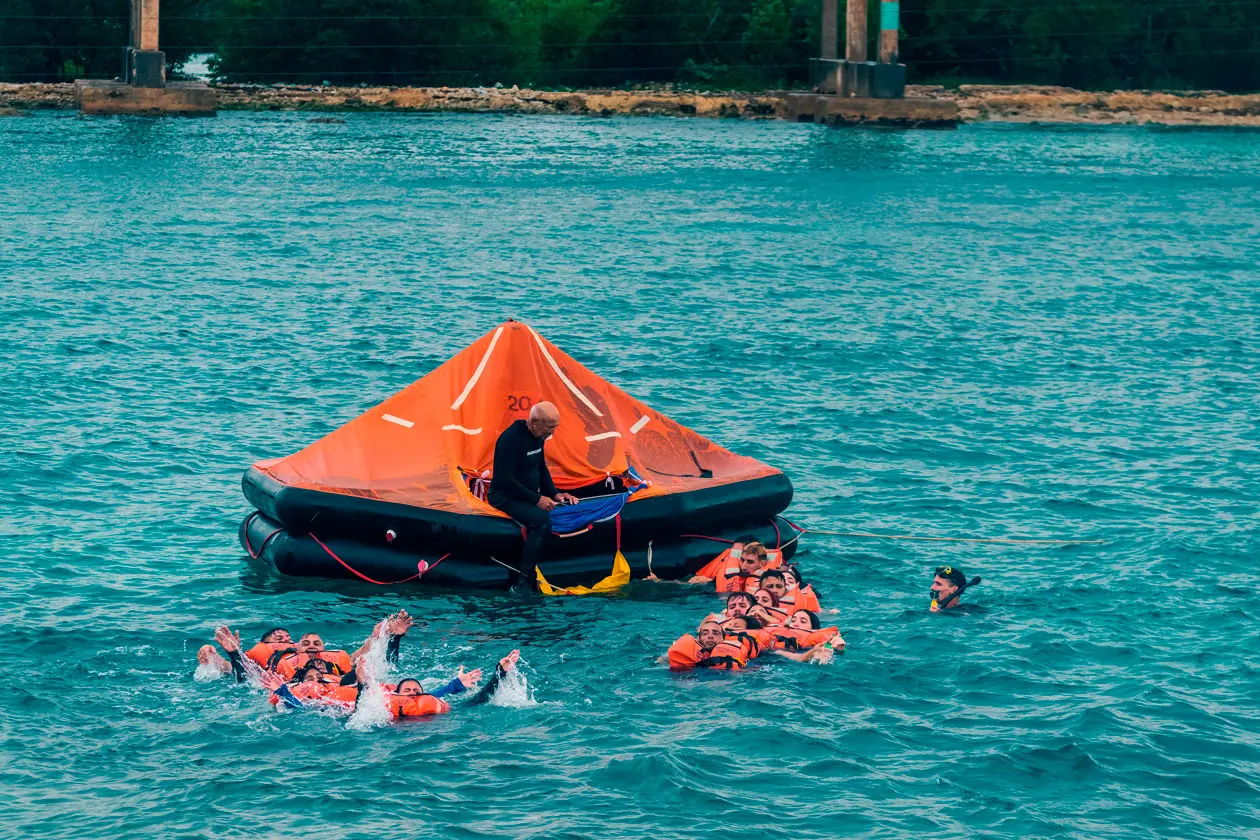
Wearing life jackets in rough seas, students participate in survival training designed to prepare them to respond to emergencies aboard vessels.
The sea does not always offer favorable conditions. For those preparing to work aboard boats and ships, knowing how to swim is not enough. They must also learn how to react in an emergency, remain calm, and coordinate their actions with others.
In the waters near the Mariel training center, a group of students performs personal survival exercises. Equipped with life jackets, they stay afloat and form groups while coping with the movement of the waves.
The exercise is part of essential training for seafarers, helping them acquire skills that could prove decisive if they must abandon ship or face an emergency. Every movement has a purpose. Staying afloat, maintaining group formation, moving through the water while wearing a life jacket, and learning to act together are skills that go far beyond a classroom exercise.
For those hoping to pursue careers aboard passenger vessels, including cruise ships, these skills are part of a safety culture that must accompany every working day.
Each specialty involves its own learning process, but all share the same fundamental principles: respect for the sea, an understanding of its challenges, and the responsibility that comes with working on it.
Because in Mariel, students do more than learn about the sea; they learn how to live and work on it, and how to be prepared to face its challenges.
See more photo features here at Havana Times.