Yoel Alejandro Perez Serrano. FREEDOM
By Francisco Acevedo
HAVANA TIMES – In contemporary Cuba, protesting is not merely a public expression of discontent: it is also an act of personal exposure. Those who raise their voices against those in power face not only the possibility of arrest but also a system of surveillance, discrediting, isolation, and punishment that can turn a social demand into a personal tragedy.
It is in this context that the name Yoel Alejandro Perez Serrano emerges. He is a resident of Guamuta, a community in Cuba’s Santiago de Cuba province, marked—like all the others—by the economic and political tensions that permeate everyday life on the island.
This young man became well known in late 2025 for confronting President Miguel Diaz-Canel during one of those carefully planned visits that the “handpicked president” makes to mingle with the crowds, although those gatherings are generally thoroughly screened to prevent uncomfortable situations.
In this case, however, Hurricane Melissa had just swept through eastern Cuba, and apparently the screening apparatus had not been fully activated. Somehow, Yoel Alejandro managed to reach the president and tell him some hard truths about how badly his fellow citizens in the eastern region were suffering. As usual, the responses were evasive, and everything seemed to end there—until the young man decided to take matters into his own hands.
First, he decided to write a book so that silence would not be the final outcome of his concerns, although he never made its title or publication date public, to avoid reprisals.
With the support of prominent dissident Jose Daniel Ferrer, the young man took small steps to improve his neighbors’ quality of life. But he committed the sin of saying that none of it had been accomplished with government assistance.
As though that were a grave offense rather than an undeniable truth, the regime’s henchmen arrested him and sent him to jail at the Versailles Police Operations Unit in Santiago de Cuba.
When someone is imprisoned after participating in a protest, the essential question is not simply which legal provision is invoked, but whether that provision is applied in a manner consistent with freedom of expression and assembly. Laws can become instruments of justice or mechanisms of intimidation. It all depends on whether they protect citizens from abuse or end up protecting those in power from the citizenry.
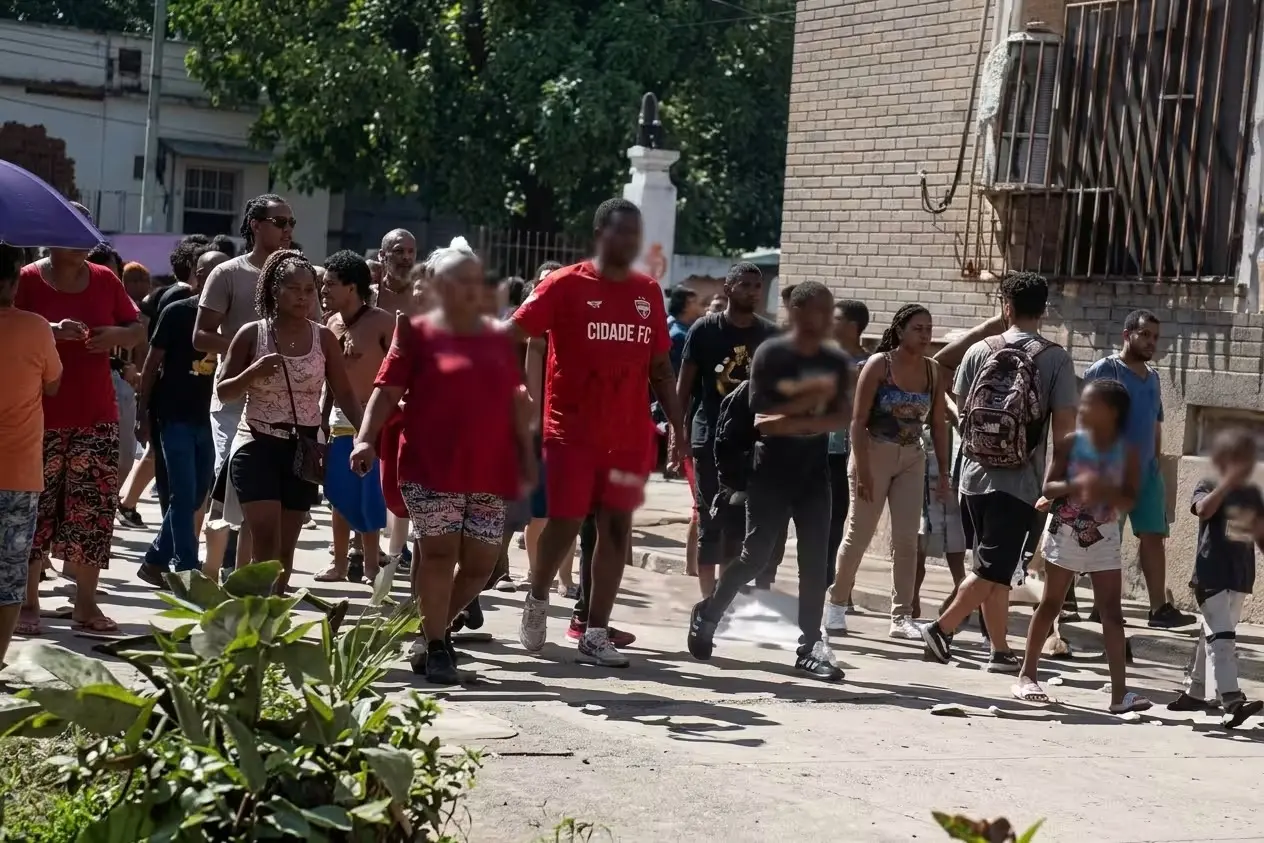
Protest in Guamuta, Cuba over Yoel Alejandro Perez Serrano’s arrest.
Perez Serrano’s case is not an exception
As with other protesters against the regime whom we have discussed in recent months, Perez Serrano’s case should not be viewed merely as an individual case, but as a window into the broader problem of the criminalization of protest.
In Guamuta, as in so many Cuban communities outside the major urban centers, scarcity is felt more personally, and support networks are limited. Complaints circulate by word of mouth, through private messages, in family backyards, and in discreet conversations. When a protest erupts, it does not come out of nowhere: it represents months or years of accumulated frustration.
In this setting, the figure of the political prisoner—or the citizen detained for participating in a protest—takes on symbolic significance. Their body becomes the battleground between two opposing interpretations. For the authorities, the person may be a violator of public order, someone accused of contempt, disobedience, assaulting authorities, or public disorder.
For their relatives and supporters, however, that person is being punished for demanding rights or expressing legitimate grievances. In Perez Serrano’s case, he also tried to do something about the problems he denounced, contributing what little he could to alleviate the difficult circumstances facing his fellow citizens.
Unlike on other occasions, this time the person who stood up against tyranny was not met with indifference. Several videos are circulating on social media showing Guamuta residents demanding his release.
In Cuba, protests in recent years have revealed a profound transformation in social discontent. It is no longer simply a matter of organized opposition groups or voices from exile. Demonstrations have involved neighbors, workers, young people, mothers, and individuals who may never have considered themselves political.
Many take to the streets not with a fully developed ideological platform, but with immediate demands: “food,” “freedom,” “electricity,” and “medicine.” That spontaneity makes any power structure uncomfortable because it reveals that discontent can emerge outside official channels.
The state’s response to these expressions of discontent has included arrests, interrogations, prison sentences, and subsequent restrictions intended to silence certain individuals temporarily. Yet these measures simultaneously deepen social resentment.
A community may learn to remain silent, but that does not necessarily mean it stops thinking. Imposed silence is not the same as consensus, and sometimes it is merely a pause filled with fear.
The fundamental solution is not simply to release one person, although freedom for those unjustly imprisoned is an immediate demand. It is also necessary to review the laws that allow protests to be punished disproportionately, guarantee public and impartial trials, permit the presence of independent observers, and recognize citizens’ right to assemble peacefully.
A country does not grow stronger by punishing every dissenting voice. It grows stronger when it can listen to those voices without feeling that its very existence is constantly under threat.
Guamuta reminds us that Cuba’s political history is not written solely through official speeches or in major capitals, but also in small towns, on anonymous streets, and through the voices of those who, tired of waiting, decide to speak out.
Dignity remains in Guamuta, because a society that forgets its prisoners ends up normalizing injustice, and a society that turns protest into a crime gradually loses its ability to correct itself.
True stability does not arise from fear, but from the ability to voice grievances without facing persecution. And that distinction determines not only the fate of one man—in this case, Yoel Alejandro Perez Serrano—but also the public dignity of an entire country.
Read more from Cuba here on Havana Times.