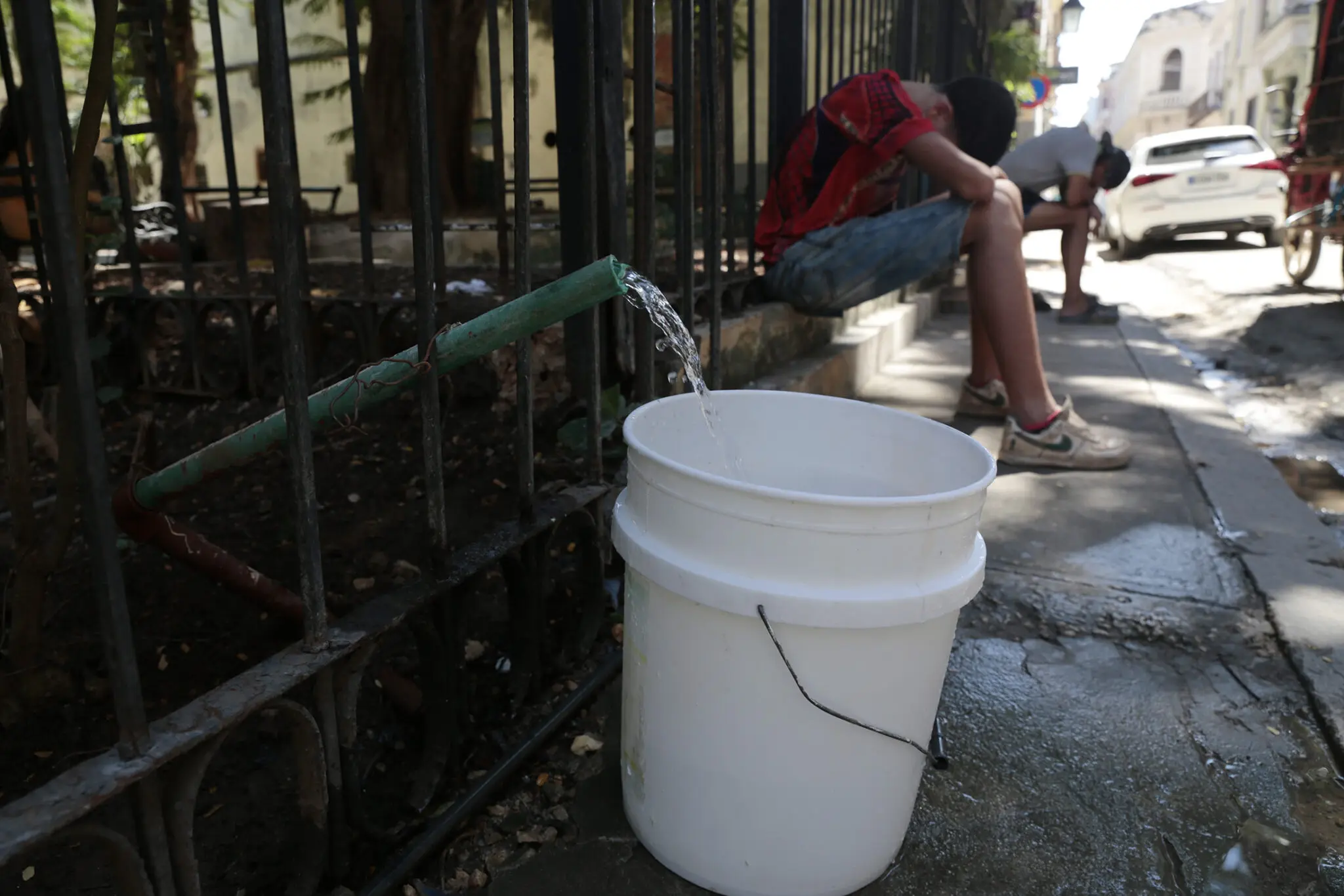
A young man waits for a container used to store drinking water to fill up at an improvised water tap in Havana. Water scarcity in Cuba has been exacerbated by the energy crisis, which hinders pumping through aging water infrastructure that suffers from constant leaks. Image: Jorge Luis Baños / IPS
By Dariel Pradas (IPS)
HAVANA TIMES – “Water that arrives, trust that stays.” That is how an advertisement on Revolico, a classified ads website for Cuba, ends. It is one of many offering home water delivery by private tanker trucks amid the country’s widespread water shortages.
“The water shortage this year is beyond description. Here in our area, we used to get water every other day. But now I’ve gone about two weeks without it. In desperation, I started looking into how much it would cost to have a tanker truck deliver water to my house, but they’re far too expensive,” Yunaisy Pupo, a 48-year-old human resources manager, told IPS.
Offers advertised on Revolico, social media, and by word of mouth can easily cost more than $15 to fill a household’s water cisterns.
Pupo earns slightly less than the equivalent of nine dollars a month at a public institution, roughly the average salary in Cuba’s state sector, which employs 68.5% of the country’s 4.1 million workers.
Problems caused by breakdowns in water distribution networks, water lost through leaking pipes, power outages, and even fuel shortages have long made it difficult for Cubans to access water, a service historically subsidized by the state and provided at extremely low prices.
Cuban President Miguel Diaz-Canel said on Wednesday, November 4, during the radio program Criterio Compartido (Shared Perspectives), that the water problem, which he described as “real, serious, and complex,” has “structural roots, distribution networks that have been in operation for decades, and investments we have been unable to make on the scale required.”
Last year, 20% of Cuba’s approximately nine million inhabitants experienced some type of disruption to their water service every day, according to a report presented on December 19 to the National Assembly.
In 2026, with the US oil blockade against the island imposed on January 29, the country’s chronic water supply crisis worsened even further.
During the same radio program on Wednesday, November 4, Antonio Rodríguez, president of the National Institute of Hydraulic Resources, reported that disruptions to the piped water supply affect more than 2.6 million people in Cuba. He said 66% of the problem is linked to the electricity crisis, while 25% is due to failures in pumping equipment.
Rodriguez specified that Havana alone has 536,000 affected residents, twice the number in any other province.
“We don’t have fuel to pump water, and on top of that, we don’t have enough fuel to generate electricity. Without electricity generation, there is no way to distribute water,” the Cuban president said during the radio broadcast.
A man in Havana transports several containers of drinking water using an improvised, rudimentary handcart. Many Cubans must leave their homes to secure a water supply—sometimes by collecting it directly from leaks in the water distribution network. Image: Jorge Luis Baños / IPS
The War Over Water
Water shortages force many Cubans to collect and transport water to their homes using wheelbarrows, bicycles, cars, or electric tricycles, sometimes traveling several kilometers in rural or suburban communities.
Yunior Machado, a 37-year-old unemployed resident of Old Havana, used to fill his two 20-liter containers from a nearby leaking pipe whenever he went days without receiving water through the distribution network. The pipe protruded directly from the street and spewed water, attracting dozens of people who lined up to fill their containers.
“They’ve apparently fixed the pipe because they paved the street. Now I have to walk farther away” to find another leak or water source, he told IPS.
In an apartment building in Arroyo Naranjo, one of Havana’s 15 municipalities, located on the outskirts of the city, a silent war began when water started reaching the apartments with much lower pressure and less predictability.
Or perhaps it wasn’t so silent, because everything began in May when the first neighbor installed a noisy “water thief,” as Cubans call the pumps that suck up the limited water flowing through the distribution network and push it into a particular home at higher pressure.
Installing these pumps in the same neighborhood reduces pressure throughout the network, making it even harder for households without such equipment to obtain water.
Because the closest neighbors are the most affected, the other families in the building soon began buying their own water thieves, creating a kind of competition in which the winner is whoever has the most powerful pump and takes all the water.
“This has become a situation where it’s every person for themselves. It’s a war over water. And I still haven’t bought a pump for that. So, I only get water when the electricity goes out, because then none of the pumps work,” said Reinier Sotolongo, a 25-year-old package delivery worker.
The situation outside the capital is even worse because some rural communities are not connected to distribution networks and depend on tanker trucks provided by the state, also at subsidized rates.
Power outages, which last longer outside Havana and commonly extend for 48 or even 72 hours, further reduce water pumping capacity.
In early 2026, Hilda Freyre, a homemaker living in the city of Gibara, in the eastern province of Holguin, went almost three months without receiving water.
“We’ve had to buy more buckets and water containers,” the 61-year-old woman told IPS in an interview conducted in July.
According to Freyre, some neighbors cope with the water shortage by using wells dug in their backyards. In her case, however, she has managed thanks to a large underground cistern roughly the size of her terrace, which never completely empties or fills.
Her cistern came close to running dry during those three months. She did not believe it would ever fill up with the three or four hours of water service she received from time to time.
“I would need at least three days of continuous water supply,” she said.
Workers from the state-owned company Aguas de La Habana are working to repair a breakdown reported in Havana on October 29. Ruptures in water distribution networks have been a recurring problem in Cuba, even before the multidimensional crisis intensified in 2026. Image: Jorge Luis Baños / IPS
Solar Panels for Water Supply
On Wednesday, November 4, the same day as the radio program featuring Diaz-Canel, the Cuenca Sur water supply facility underwent an emergency shutdown, disrupting water service in six of Havana’s 15 municipalities, according to the state-run company Aguas de La Habana, which is responsible for the city’s water service.
The incident occurred just days after the company warned, on October 29, of various interruptions at several water supply sources due to the energy deficit, forcing it to extend the intervals between water deliveries in all Havana municipalities.
In recent months, such announcements have become somewhat routine.
The government’s proposed solution is to make water pumping at the capital’s three main supply sources — the Ariguanabo Basin, Cuenca Sur, and El Gato — independent of the national electricity grid.
Rodriguez, the head of the National Institute of Hydraulic Resources, announced that construction of 10 solar parks with a combined capacity of 200 megawatts would be completed by August 2027, along with batteries to provide backup power.
He also announced the upcoming arrival of pumping equipment that will benefit several areas of the country, giving priority to Havana, Santiago de Cuba, Holguin, Matanzas, Artemisa, and Pinar del Rio, the provinces most affected by the crisis.
“The crisis must give us an opportunity to move forward, not only to solve the immediate problems but also to address the accumulated problems we face in these areas of water supply,” Díaz-Canel said.
First published in Spanish by IPS and translated and posed in English by Havana Times.
Read more from Cuba here on Havana Times.