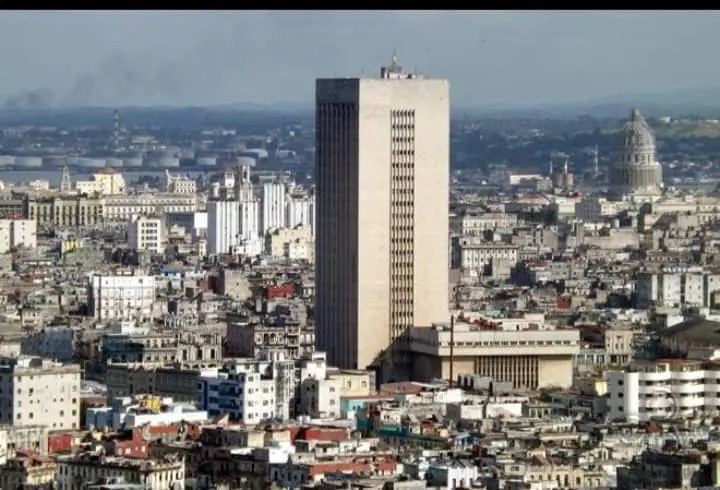
Photo of the exterior of the Hermanos Ameijeiras Hospital, taken from the hospital’s archives.
By Kamil Kenders
HAVANA TIMES – Some buildings are part of a city’s landscape, while others are also part of its memory. Hermanos Ameijeiras Hospital belongs to both categories.
Its tower, visible from different points along Havana’s Malecon, was for many years an image associated with the development of Cuban medicine. For thousands of people, that building represented something more than a hospital: it offered the possibility of receiving specialized care, obtaining a diagnosis for a complicated condition, or undergoing treatment that was not available at just any other institution in the country.
Inaugurated on December 3, 1982, Hermanos Ameijeiras was conceived as a national referral center. Its facilities, equipment, specialists, and the diversity of services it offered placed it among Cuba’s most prestigious hospitals.
Highly complex medical procedures, research, and professional training programs were carried out there. For decades, its name inspired confidence. For many Cubans, being referred to Ameijeiras meant reaching one of the best possible places to receive medical care. But the years have passed, and that image of excellence seems to have become trapped in memory.
Today, speaking of Hermanos Ameijeiras also means speaking of shortages, deterioration, limited services, and difficulties that ultimately affect both patients and their families.
The reality behind its doors is far removed from the institution that was once a source of pride. It is not simply a matter of the physical deterioration of certain areas. It goes much deeper. The scarcity of material resources, lack of supplies, difficulties keeping equipment operational, and loss of medical professionals have gradually weakened the capacity of an institution that needs precisely the opposite: resources, technology, and specialized personnel.
Many healthcare professionals have emigrated in search of better living and working conditions. Those who remain in the country try to practice their profession under increasingly difficult circumstances. And those who continue caring for patients must confront a reality in which they do not always have what they need to do their jobs. Because a doctor may possess all the knowledge in the world, but without the necessary medications, reagents, instruments, or equipment, their ability to provide adequate care is inevitably limited.
According to accounts I have heard, difficulties performing certain clinical tests because of a lack of reagents have become another obstacle for patients at this hospital. Sometimes, even when a patient manages to obtain an appointment or see a specialist, completing the necessary diagnostic tests remains an unresolved problem.
A CT scan can be crucial in determining how a disease is progressing. An MRI can provide essential information for establishing a diagnosis. These are not optional machines or luxuries reserved for those who can afford them. They are fundamental tools of modern medicine. Yet breakdowns and a lack of resources to maintain and repair this equipment have ended up compromising essential services.
In July 2026, Associated Press published a report on the state of healthcare in Cuba that specifically included Hermanos Ameijeiras Hospital. A patient with a history of cancer had been waiting seven months for a CT scan because the hospital’s machine was broken. Her story was a painful illustration of what it means to lack access to technology that can be decisive for a person’s life.
But some situations do not need to appear in a news report to reveal just how far the deterioration has gone. Not long ago, I witnessed a scene that I still find difficult to forget.
One of the hospital corridors. The cart with two blue tanks is used to transport water to the upper floors.
Family members accompanying hospitalized patients had to go down to the hospital basement to fetch water because the supply was not adequately reaching the upper floors. While patients remained hospitalized, their relatives had to take responsibility for obtaining something as basic as water. I am not talking about a bottle of drinking water out of personal preference or some additional comfort. I am talking about a basic necessity in any healthcare institution, especially in a place where there are sick people, some with mobility difficulties and others completely dependent on those caring for them.
I stopped to think about what it means for a family to have a loved one hospitalized and, on top of worrying about their health, have to go down to the basement to fetch water. How many other things must these family members manage on their own? How many needs end up becoming family responsibilities because the hospital cannot guarantee even the most basic conditions?
It is difficult not to feel disappointed. Because one can understand that a country is going through economic difficulties, that there are supply problems, or that certain resources are hard to obtain. But it is also impossible not to wonder how an institution of such importance has come to depend on such makeshift solutions for basic aspects of its operation.
And what is most troubling is that we are not talking about a small municipal hospital, a secondary facility, or a center that never had substantial resources. We are talking about Hermanos Ameijeiras.
That hospital which was once a national benchmark, which received patients from across the country, and which for years concentrated some of Cuba’s most specialized medical services.
I think about those who arrive there seeking answers about a serious illness. About those waiting for a diagnostic test that cannot be performed because the equipment is broken. About those who need laboratory tests and discover there are no reagents. About the family members who walk the corridors, climb up and down stairs, and end up taking care of needs that the institution itself should guarantee.
I also think about the doctors and other healthcare workers who remain there, trying to keep what still functions going, often under conditions that do not match the enormous responsibility resting on their shoulders.
Because the deterioration of a hospital is not measured solely by its walls, elevators, or facilities. It is measured, above all, by what it can no longer offer those who need its services.
And perhaps that is the saddest part of this story: the hospital’s name still carries the prestige of what it once was, but the everyday reality of many patients no longer seems to live up to that reputation.
The building is still standing. Its tower continues to dominate part of Havana’s skyline. It still bears the name “Hermanos Ameijeiras” and preserves the memory of an era when it represented the most advanced achievements of Cuban medicine.
But a hospital cannot live off its history. It cannot make diagnoses with memories of its former specialists, perform CT scans with broken equipment, or guarantee medical care by relying solely on the prestige of its name.
A hospital needs doctors, nurses, technicians, medications, reagents, water, electricity, and functioning technology. Above all, it needs to be able to care for its patients.
Hermanos Ameijeiras is still there. But I fear that, for many Cubans, its greatness is beginning to belong to the past. And that is much more than the deterioration of a building.
Read more from the diary of Kamil Kenders here on Havana Times.