to force him to quit CubaNet
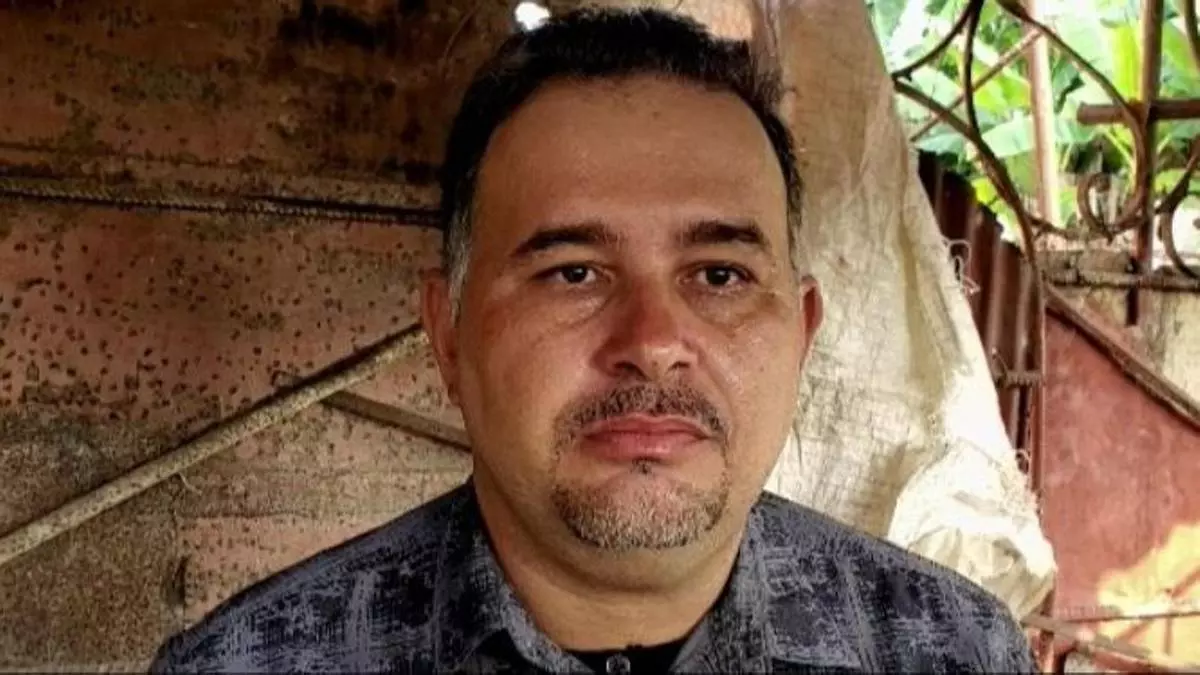
Vladimir Turró was held in police custody for approximately ten hours and threatened with imprisonment if he continued working as a journalist. / CubaNet
Vladimir Turro Paez says State Security agents took him to a wooded area and tried to force him to record a video.
By 14ymedio
HAVANA TIMES – Independent journalist Vladimir Turro Paez reported on Friday that three State Security agents forcibly took him to a secluded area of Havana, where they threatened him with a gun while attempting to force him to record a video announcing his resignation from CubaNet.
The reporter was held in police custody for approximately ten hours before being released, after receiving further threats of imprisonment if he continued practicing journalism.
The incident occurred on Thursday November 12, when Turró was visiting his mother in the Havana municipality of La Lisa. According to his account, three officers arrived at the house and ordered him to accompany them. They forced him into an unmarked vehicle and, during the journey, made him keep his head down between his legs.
The vehicle eventually stopped in a wooded area, far from the city’s usual activity. There, one of the agents pulled out a pistol while another prepared a phone to record the statement they intended to extract from the journalist.
“They pointed a gun at me and demanded that I resign from CubaNet,” Turro reported. According to his testimony, the armed man repeatedly manipulated the magazine and pulled the trigger. The reporter said he did not know whether the weapon was loaded and that he feared for his life.
The agents insisted that he publicly announce his departure from the independent news outlet, but Turró remained silent. Two days earlier, the journalist had received an informal summons to appear at Villa Marista, the headquarters of State Security in Havana, but he decided not to attend.
Following the incident, he was taken to the Sixth Police Station, where an investigator who said he was from Villa Marista handed him an official warning notice. The official accused him of “usurpation of legal capacity” and maintained that independent (non-government) journalism was not permitted in Cuba.
Turro rejected that argument and reiterated his determination to continue working. He was finally released at around nine that evening. “I’m going to keep practicing journalism,” he stated in his testimony published by CubaNet.
The incident comes amid a new wave of arrests and threats against independent reporters. On November 5, Yoani Sanchez, director of 14ymedio, was detained for nine hours after being intercepted as she left her home in Nuevo Vedado. During her detention, political police agents threatened to prosecute her for propaganda against the constitutional order.
Two days earlier, Camila Acosta, a contributor to CubaNet, was arrested while taking her cat to the veterinarian. She spent several hours at a police station and received a fine of 3,000 pesos, along with renewed threats of imprisonment. On November 2, Adelth Bonne Gamboa, another journalist associated with the same outlet, had also been arrested.
On November 9, Reporters Without Borders denounced those three arrests in just four days as a new offensive against press freedom. Its Latin America director, Artur Romeu, demanded an end to the harassment and emphasized that reporting on matters of public interest is not a crime.
The situation is particularly serious for Henry Constantín, director of La Hora de Cuba, who has been imprisoned in Camagüey since September and placed in pretrial detention on a charge of disobedience. His case has been denounced by international organizations calling for his release.
Intimidation against reporters also includes surveillance of their homes, restrictions on movement, and threats. On November 6, several journalists woke up to find police patrols stationed outside their homes to prevent them from attending a cultural event organized by the US Embassy in Havana.
In Turro’s case, the complaint introduces a particularly alarming element: the use of a firearm in an attempt to obtain a public resignation. His testimony describes an operation intended not only to prevent journalistic coverage but also to force the reporter to abandon his profession permanently.
First published in Spanish by 14ymedio and translated and posted in English by Havana Times.
Read more from Cuba here on Havana Times.